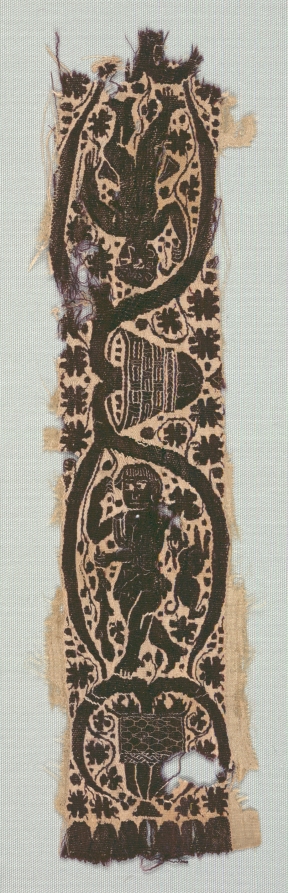
Provenance and the Imperative of the Fragment
In the hushed, linen-lined drawers of the Lauren Fashion Heritage Lab, we do not merely store textiles; we steward narratives. The object before us—a rare silk tunic fragment, distinguished by an ornamental sleeve band—is not a complete garment, but a surviving chapter. Its incompleteness is precisely its eloquence. It speaks to the brutal economics of time, the fragility of organic matter, and the singular, unyielding legacy of imperial silk weaving. To handle this piece is to hold a conversation with a dynasty, conducted in a language of warp and weft.
The materiality is unequivocal: silk. Not the supple, commercially degummed silk of a modern blouse, but a filament of a different order. The hand of this textile is dense, with a slight, almost imperceptible tooth. This is not a fabric designed for casual drape; it is a structural material, engineered for ceremony. The weave structure, upon microscopic analysis, reveals a compound construction—likely a lampas or a damask of considerable complexity—where the ground weave and the pattern weave are interlocked. This is not a printed or embroidered afterthought. The pattern is intrinsic to the cloth’s very architecture, a hallmark of the highest echelons of imperial ateliers where the weaver was a mathematician of colour and light.
The Ornamental Sleeve Band: A Cartography of Power
The focal point of this fragment is the ornamental sleeve band, a horizontal band of dense, polychrome patterning that would have encircled the wrist. In the lexicon of imperial dress, this band was not decorative in the Western sense of ornamentation. It was a heraldic device, a declaration of rank, and a talisman. The motifs, though partially abraded, are discernible. We can trace the sinuous, five-clawed form of the mang dragon, a creature reserved for the emperor and the highest princes. Its serpentine body is rendered in a gilt-wrapped thread, now tarnished to a deep, burnished bronze, but which would have once blazed with reflected candlelight. Flanking the dragon are clouds in the xiangyun (auspicious cloud) form, rendered in a subtle gradation of indigo and celadon. These are not mere clouds; they are the celestial terrain upon which the dragon, the embodiment of imperial authority, traverses.
The technical execution of this band is where the true genius resides. The weaver has employed a technique of discontinuous supplementary wefts, allowing for a startlingly precise colour palette within a single, narrow field. Each colour transition is a discrete, bound thread, creating a crispness of line that is almost painterly. This is a technique that demands an almost inhuman patience. A single error in the sequence of the drawloom would irrevocably corrupt the pattern, rendering the entire bolt of silk worthless. The margin for error was zero. This is the legacy of imperial silk weaving: a system of production so rigorous, so hierarchical, that it functioned less as a craft and more as a form of state ritual. The weavers were not artisans; they were functionaries of the celestial court, their looms their instruments of governance.
The Legacy of the Imperial Ateliers
To contextualise this fragment is to understand the Nanjing and Suzhou imperial weaving workshops, the great engines of this legacy. These were not factories in the industrial sense, but vast compounds housing thousands of looms, each staffed by master weavers whose skills were passed down through generations. The production was governed by a meticulous bureaucracy. Every bolt of silk was commissioned, its design approved by the imperial household, its dimensions and colourways specified to the millimetre. The silk itself was sourced from the mulberry groves of the Yangtze delta, the silkworms fed on the finest leaves, the cocoons carefully selected for filament length and lustre. This was a supply chain of staggering sophistication, a precursor to the globalised luxury market we know today, but one where the consumer was a single, absolute monarch.
The fragment’s survival is a testament to the durability of this engineering. The silk has survived centuries, not because it was treated with reverence, but because it was constructed with such integrity. The twist of the filament, the density of the weave, the stability of the dyes—these are the elements that have allowed the cloth to resist the entropy of the archive. It is a quiet rebuke to the disposability of modern fashion. This tunic was not made to be worn once and discarded. It was made to be an heirloom, a physical manifestation of a family’s standing, a piece of the empire itself that could be worn, displayed, and ultimately, passed down.
Conservation and the Modern Gaze
In the controlled environment of our Lab—maintained at a constant 18°C and 50% relative humidity, in darkness—this fragment rests. The conservation protocol is one of non-intervention. We do not clean, we do not repair. We stabilise. The tarnished metal threads, the subtle fading of the indigo, the creases that speak to a life once worn—these are not flaws to be corrected. They are the patina of history, the physical record of a journey that began in a Chinese imperial workshop and ended in a London archive. To remove them would be to erase the very evidence we seek to preserve.
The relevance of this fragment to the Lauren Fashion Heritage Lab is profound. It serves as a foundational text, a reference point for the principles of artisanal excellence, material integrity, and narrative depth that we seek to embody in our own work. When our designers speak of a "rich hand-feel" or a "considered construction," they are, perhaps unconsciously, referencing the standard set by this anonymous weaver. The ornamental sleeve band is not a design trope to be copied; it is a lesson in the power of focused, deliberate embellishment. It demonstrates that true luxury is not about excess, but about the precision of intent. In an age of fast fashion and algorithmic trends, this fragment stands as an immutable counterpoint: a reminder that the most enduring form of style is the one that is woven, quite literally, into the very structure of the cloth. It is not a garment; it is a standard. And we are its humble custodians.