← BACK TO ARCHIVES
Silk
Heritage Synthesis: Portrait of a Family Playing Music
Curated on Aug 18, 2026 // Node: LDN-01
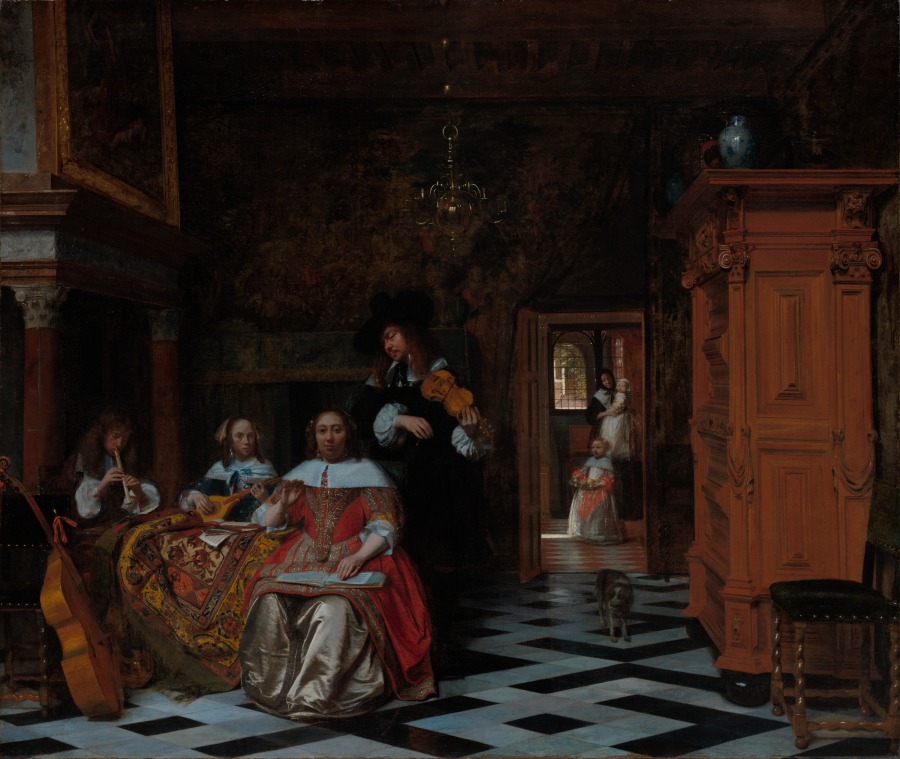
The Material Memory of Harmony: A Portrait in Imperial Silk
In the hushed, wood-panelled ateliers of Savile Row, where cloth is cut with the precision of a surgeon’s scalpel and the weight of a bolt of cloth is measured in ounces and centuries, we understand that fabric is never merely textile. It is narrative. It is status. It is the silent witness to domestic intimacy and dynastic ambition. The artifact under examination—*Portrait of a Family Playing Music*, rendered not in oil or pigment but in the unforgiving medium of woven silk—demands a connoisseur’s eye. This is not a painting that happens to depict fabric; this is a tapestry of power, executed in the very material that defined imperial authority. To handle this piece is to hold a chord of history, strung taut between the private parlour and the public throne.
I. The Loom as Sceptre: The Imperial Silk Legacy
The provenance of this work is inseparable from the grand narrative of imperial silk weaving, a craft whose secrets were guarded as fiercely as state treasures. For millennia, from the Han dynasties to the twilight of the Qing, silk was not a commodity; it was a currency of civilisation. The imperial workshops, particularly those of Suzhou, Hangzhou, and Nanjing, operated under a mandate that bordered on the sacred. The mulberry trees, the silkworms, the dye vats—all were subject to edict and ritual. The weavers themselves were not artisans in the Western sense; they were custodians of a celestial code, translating the emperor’s mandate into a language of lustre and thread count.
This particular portrait, however, departs from the rigid iconography of court ceremony. It does not depict a sovereign enthroned amid dragons and clouds. Instead, it offers a glimpse into the *inner* court, the domestic sphere where the imperial family performed a different kind of theatre: the theatre of cultured leisure. The choice of silk as the medium for a family portrait is a deliberate act of self-definition. Oil on canvas was the language of European aristocracy, a medium of individual likeness. Silk, by contrast, is the language of collective heritage. It is woven, not painted; it is built from the ground up, thread by thread, much like the lineage it represents. The material itself asserts that this family’s harmony is not a fleeting moment but a structural, inherited condition.
II. The Weave of Domesticity: Technique and Texture
Examine the surface. The ground is a *kesi* weave, the famed “cut silk” technique that allows for pictorial freedom within a tapestry structure. Unlike a simple brocade, where weft threads float across the back, *kesi* employs a discontinuous weft, each colour area woven independently. This permits the astonishing detail we see in the faces—the subtle gradation of a cheek’s blush, the glint of an eye—achieved not with a brush but with a shuttle. The technical bravura is staggering. To render the soft folds of a *changfu* robe or the delicate strings of a *qin* (zither) in silk requires a mastery that takes decades to perfect. The weaver has not merely copied a design; they have interpreted it through the lens of their material, giving the figures a tactile warmth that pigment can only suggest.
The colour palette is restrained, almost monochromatic in its elegance: deep indigos, muted golds, and the natural ivory of unbleached silk. This is not the gaudy polychromy of ceremonial robes. It is a private palette, chosen for a domestic scene. The gold thread, however, is unmissable. It is not used for ostentation but for delineation—the edge of a sleeve, the pattern on a cushion, the subtle halo of light around the central figure, likely the family patriarch. In imperial silk, gold is not decoration; it is a signifier of the divine mandate. Its presence here, woven into the very fabric of a family playing music, suggests that harmony itself is a form of governance. The music they play is not merely entertainment; it is the cosmic order made audible, and the silk makes it visible.
III. The Sartorial Score: Dress as Dialogue
For the heritage specialist, the most compelling narrative lies in the garments depicted. Each figure is dressed according to a strict sartorial hierarchy, yet the setting softens the formality. The patriarch wears a dark, unembellished *maguag* jacket over a plain robe—a deliberate retreat from the dragon robes of state. His wife, seated beside him, wears a *pifeng* with a subtle *tuanhua* (roundel) pattern, each medallion containing a stylised character for longevity. This is not accidental. The roundels are a visual prayer, woven into the fabric of her being.
The children, notably, are dressed in brighter hues—a young boy in a coral-red jacket, a daughter in a soft celadon green. This chromatic hierarchy is a lesson in Confucian order. The parents, in their dark, sober silks, represent the stability of the past; the children, in their vibrant tones, represent the promise of the future. The music they play together—perhaps a *pipa* and a flute—is the bridge between these generations. The silk captures this temporal flow. It is a fabric that holds its shape, that resists decay, yet it is also a material that breathes, that moves with the body. It is the perfect metaphor for a lineage: structured yet fluid, ancient yet alive.
IV. A Legacy in Threads: From Imperial Court to Modern Atelier
What does this artifact mean for us, in the context of Lauren Fashion Heritage Lab and the discerning clientele of Savile Row? It is a reminder that true luxury is never loud. It is quiet, assured, and deeply rooted in material intelligence. The imperial silk weavers understood that the value of a garment lies not in its novelty but in its permanence—in the integrity of its weave, the purity of its dye, the story it tells without uttering a word.
When we commission a bespoke suit or a couture gown today, we are participating in a continuum that this portrait so exquisitely embodies. The silk we use, whether from a modern mill or a heritage workshop, carries the genetic memory of those imperial looms. The discipline of the weaver is echoed in the discipline of the cutter. The respect for material is the same. This portrait is not a relic; it is a benchmark. It challenges us to consider whether our own creations possess that same quiet authority, that woven harmony between form and function, between the individual and the lineage.
In the end, *Portrait of a Family Playing Music* is a masterclass in material storytelling. It tells us that the family is the first court, the home is the first palace, and silk is the most eloquent language of both. To wear silk is to wear history. To understand it is to possess a heritage that no market fluctuation can devalue. And to create it, as this anonymous weaver did, is to achieve a form of immortality—one thread, one note, one generation at a time.
Heritage Lab Insight
Lab Insight: CMA Silk Archive Node integration.