← BACK TO ARCHIVES
Silk
Heritage Synthesis: Bridal Robe (Hwarot)
Curated on Aug 18, 2026 // Node: LDN-01
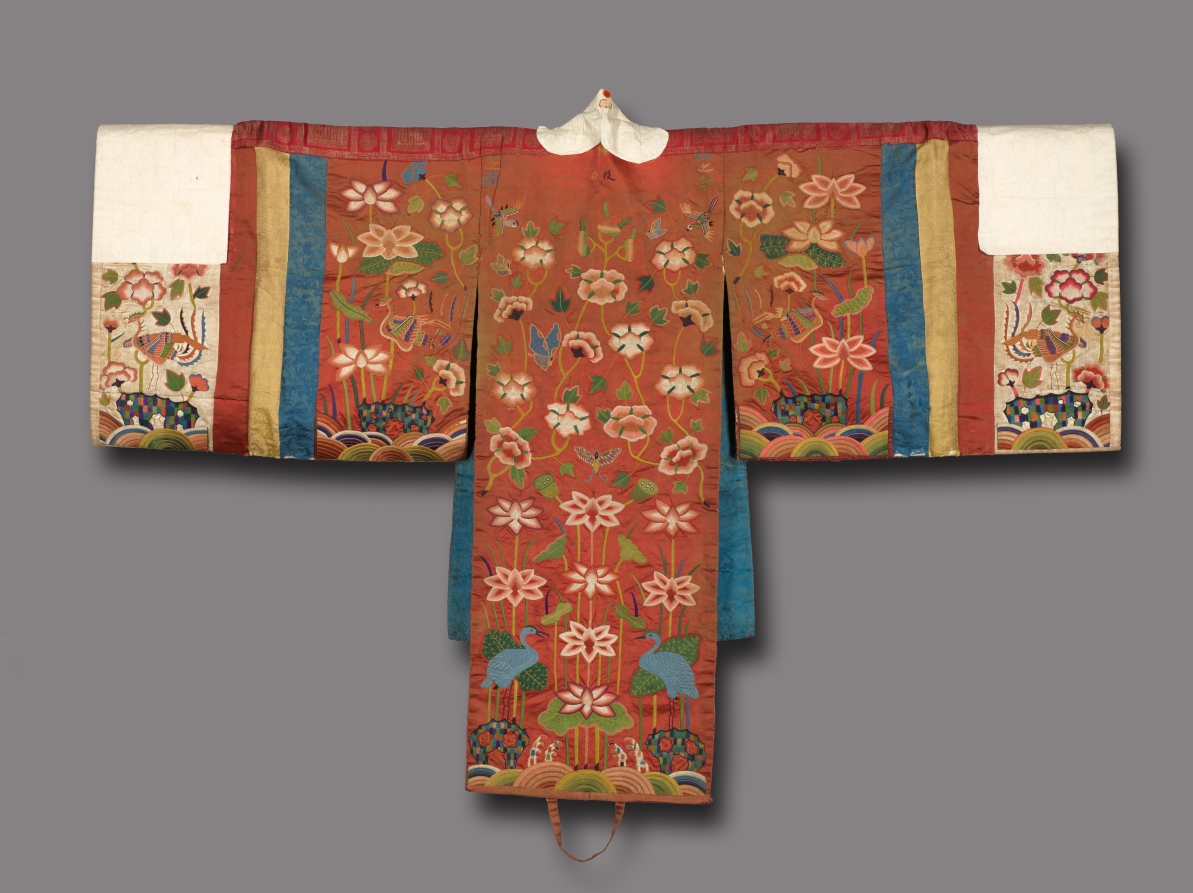
The Hwarot as a Testament to Imperial Silk: A Study in Material Legacy
In the rarefied world of haute couture and bespoke tailoring, there exists a quiet reverence for provenance—the whispered history of a bolt of cloth, the lineage of a weaving house, the unbroken thread of craft that connects a modern atelier to an ancient loom. It is with this same discerning eye, honed on the measured streets of Savile Row, that we approach the Hwarot, the Korean bridal robe. This is not merely a garment; it is a document. And its primary language is silk—specifically, the imperial silk of the Joseon dynasty (1392–1897), a material so laden with political, spiritual, and artisanal significance that it transcends the category of textile to become a sovereign artifact.
The Materiality of Power: Imperial Silk as a Medium
To understand the Hwarot is to first understand the medium upon which its narrative is embroidered. The silk used in a royal or aristocratic Hwarot was not the commercial grade found in trade routes. It was the product of a state-sanctioned monopoly, cultivated in designated sericulture farms and woven in royal workshops under the strict supervision of the *Sang-ui-won* (the Office of Royal Attire). The material itself—a high-density, lustrous *dan* (satin) or *sa* (gauze) weave—was selected for its ability to hold the dense, multi-layered embroidery that would follow. The warp and weft were set with a precision that rivals the finest English worsted, creating a surface that is at once supple and structurally rigid, a paradox that mirrors the garment’s dual role as both a soft, intimate covering and a public declaration of status.
The legacy of imperial silk weaving here is not merely technical; it is philosophical. In Confucian court culture, silk was the only fabric deemed worthy of proximity to the sovereign’s body, and by extension, to the bodies of those who served the state. The Hwarot, worn by a bride on her wedding day, was thus a proxy for the state’s blessing. The silk was dyed in hues of *hong* (deep crimson) and *nok* (emerald green) using natural pigments—safflower for the red, indigo and gardenia for the green—each batch requiring weeks of controlled vatting. The result is a chromatic intensity that does not fade; it deepens with age, much like a well-aged single malt or a fine leather patina. This is not a fabric that shouts; it resonates.
Construction and Cut: The Architecture of Ceremony
From a tailoring perspective, the Hwarot is a masterclass in the manipulation of volume. Unlike the Western bridal gown, which often relies on boning and corsetry to sculpt the body, the Hwarot uses the silk’s inherent drape and the weight of its embroidery to create a silhouette that is both monumental and fluid. The robe is cut in a T-shape, with wide, sweeping sleeves that terminate in a distinctive white cuff (*hansam*), a deliberate contrast that frames the hands—the most expressive part of a bride’s body, as they were the only visible skin during the ceremony.
The construction is deceptively simple: a front opening, tied with a wide sash, and a full, unbroken back panel. Yet the genius lies in the *gore*—the insertion of triangular panels at the side seams that allow the skirt to flare dramatically from the waist. This is not a random flare; it is calculated to create a bell-like circumference of approximately 1.5 meters at the hem. When the bride walks, the silk moves in a slow, deliberate wave, a kinetic display that is both regal and serene. The interior is fully lined with a lighter-weight silk, often a soft *myeongju* (raw silk), which provides a whisper-quiet rustle—a sound that, in the silence of the ceremony hall, becomes a percussive accompaniment to the ritual.
Embroidered Narratives: The Silk as Canvas
The true legacy of imperial silk weaving is most evident in the embroidery that covers the Hwarot’s surface. This is not decorative appliqué; it is a dense, three-dimensional cartography of auspicious symbols, executed with gold-wrapped thread (*geum-sa*) and twisted silk floss. The motifs—the phoenix (*bonghwang*), the peony (*moran*), the ten symbols of longevity (*sipjangsaeng*)—are not chosen for mere aesthetics. Each stitch is a prayer, a talisman woven into the very fabric of the bride’s future.
Consider the phoenix, embroidered in raised gold thread on the chest and shoulders. The technique, known as *jasu*, involves laying the gold thread over a padded cotton core, creating a relief that catches the light with every subtle movement. This is the same technique used in the robes of the king and queen, and its presence on the bridal robe is a deliberate appropriation of imperial iconography. The peony, embroidered in shades of pink and coral silk floss, represents wealth and honor, while the bats (a homophone for “fortune” in Korean) are rendered in a deep indigo, their wings spread in a stylized, almost geometric pattern. The sheer density of the embroidery—often exceeding 30,000 individual stitches per robe—transforms the silk from a woven plane into a sculpted relief. The fabric becomes a topography of blessings, each thread a testament to the patience and skill of the *jamo* (embroidery artisans), who were often women of the court working in seclusion.
The Legacy in the Modern Atelier
For the contemporary designer or heritage specialist, the Hwarot offers a profound lesson in material integrity. In an era of synthetic blends and fast fashion, the robe stands as a rebuke to disposability. Its silk is not a passive substrate; it is an active participant in the garment’s life. The natural dyes continue to interact with light, the gold threads develop a subtle tarnish that adds depth, and the silk itself, if properly stored in a breathable, acid-free tissue, can endure for centuries. This is the legacy of imperial silk weaving: a commitment to material excellence that anticipates a long, dignified afterlife.
On Savile Row, we speak of the “house cut” and the “signature shoulder.” The Hwarot has its own equivalent—the *baerae* (the inner breast panel) and the *dongjeong* (the white collar). These are not mere construction details; they are the markers of a specific, unbroken lineage. To study the Hwarot is to understand that true luxury is not about novelty but about the perfect, patient execution of a timeless ideal. The silk is the law; the embroidery is the commentary; and the bride, for a single day, is the sovereign. In that, the Hwarot achieves what all great tailoring aspires to: the absolute, silent alignment of material, craft, and meaning.
Heritage Lab Insight
Lab Insight: CMA Silk Archive Node integration.