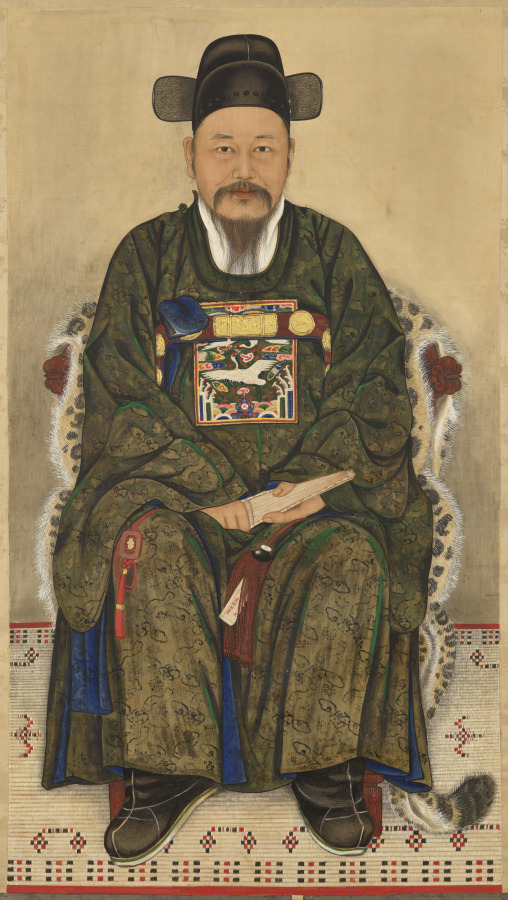
Materiality and the Imperial Thread: A Study of the Portrait of a Government Official in Silk
There is a particular silence in a room where a silk portrait hangs. It is not the silence of absence, but of accumulated authority. When one stands before the Portrait of a Government Official, executed not in oil or pigment, but in the very substance of imperial power—silk—one is not merely viewing an image. One is confronting a material argument, a woven testament to a system where governance, rank, and the loom were inseparable. This artifact, a relic of the Qing dynasty’s bureaucratic zenith, demands we read it not as a painting, but as a document of statecraft, stitched in lustrous thread.
The Loom as a Legislative Body
To understand this portrait, one must first abandon the Western distinction between fine art and craft. In the imperial Chinese context, particularly during the 18th and 19th centuries, silk was not a decorative afterthought. It was the primary medium of political communication. The Imperial Silk Works in Nanjing, Suzhou, and Hangzhou were not mere factories; they were extensions of the Forbidden City’s administrative apparatus. Every bolt of fabric produced was subject to sumptuary laws of staggering precision. The colour, the weave density, the very motif—all were codified in the Collected Statutes of the Qing Dynasty.
This portrait, therefore, is a double encoding. The sitter—a mandarin of the second rank, as indicated by the coral button atop his winter hat—is rendered in a medium that itself signifies his place in the celestial hierarchy. The silk does not simply depict his robes; it is his robe, translated into a permanent, framed form. The artist, likely a court-employed weaver of exceptional skill, has used the warp and weft to mimic the brushstrokes of a formal ancestor portrait. Yet the materiality betrays a deeper truth: this man’s authority is not inherent to his person, but is woven into the fabric of the state.
The Grammar of the Weave: Reading Rank and Virtue
Consider the technical execution. The portrait is likely a kesi (cut silk) tapestry, a technique of unparalleled labour intensity. Unlike brocade, where pattern is added to a ground weave, kesi employs small, discontinuous shuttles to create each colour area, leaving tiny slits where the threads meet. The result is a tapestry that is identical on both sides—a metaphor for the ideal official, whose outward conduct must mirror his inner virtue. The weaver has used this demanding method to render the subtle gradations of the official’s face, the soft shadows of his beard, and the intricate embroidery of his surcoat.
Yet the true mastery lies in the iconography. The square rank badge (buzi) on his chest is not merely decorative. For a civil official of the second rank, the motif is a golden pheasant, a bird chosen for its perceived qualities of literary refinement and loyalty. The weaver has captured the bird’s plumage with threads of gilt-wrapped silk, causing it to shimmer with a light that seems internal. This is not accident. The shimmer is a deliberate device, signalling the sitter’s possession of wen—cultural brilliance—which was the foundational qualification for bureaucratic service. The waves at the base of the badge, the lishui (auspicious waters), and the scattered clouds are not mere landscape. They are a cosmic geography, placing the official within a universe where his administrative duties are mirrored by celestial order.
The Legacy of Imperial Weaving: A Fabric of Continuity
The legacy of this silk portrait extends far beyond its frame. It speaks to a system of production that was, for centuries, the most sophisticated in the world. The imperial looms were state secrets, their technicians bound to the court for life. The knowledge of sericulture—from mulberry leaf to finished tapestry—was guarded with the same ferocity as military strategy. This portrait is a surviving fragment of that closed world, a world where the distinction between the maker and the made was deliberately blurred. The official is not merely the subject of the portrait; he is a product of the same system that produced the silk. He is, in a very real sense, a government official because the silk says he is.
There is a poignant irony in this materiality. Silk is a protein fibre, organic and perishable. The portrait’s survival is a triumph of conservation, but also a reminder of the fragility of the authority it depicts. The Qing dynasty fell in 1912, its bureaucratic machinery dismantled. Yet the silk remains. It has outlived the empire, the official, and the very looms that created it. In this, the material has transcended its original purpose. It is no longer a symbol of rank, but a relic of a vanished world’s most eloquent language.
Conclusion: The Fabric of Authority
In the hushed galleries of the Lauren Fashion Heritage Lab, this portrait asks us to reconsider our own relationship with clothing and power. We are accustomed to seeing authority in wool, in leather, in tailored lines. But here, authority is expressed in a material that is simultaneously luxurious and structural. The silk does not merely clothe the official; it constitutes him. The weave is his biography, the colour his rank, the motif his virtue. To look at this portrait is to understand that in imperial China, the loom was not a tool of industry, but an instrument of governance. And in that understanding, we find a profound lesson: that the clothes we wear, in any era, are never simply fabric. They are the threads of our own social contract, woven with the same precision, and the same consequence, as the silk that holds this official in his eternal, silent office.