Category: Silk
The Material Legacy of Imperial Ateliers
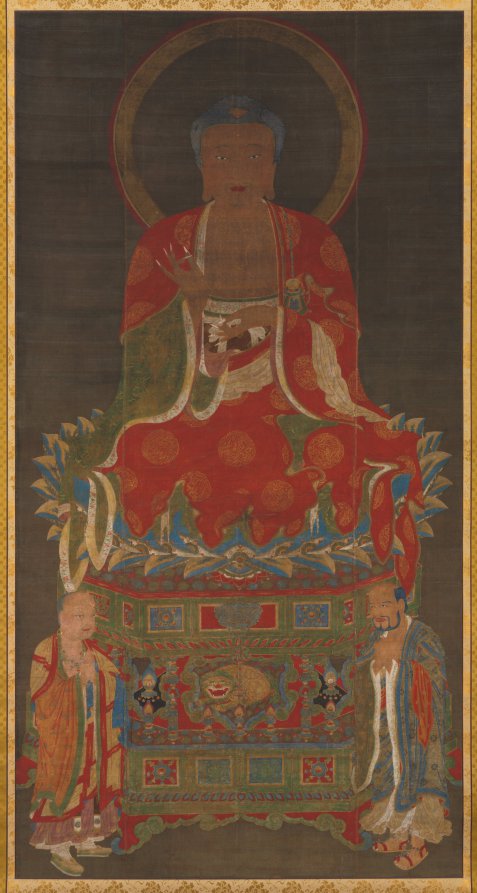
In the hushed corridors of heritage preservation, few artifacts command the quiet reverence of the Shakyamuni with two attendants, rendered in imperial silk. This is not merely a textile; it is a testament to the zenith of Chinese sericulture, a materialised prayer woven from the disciplined hands of master weavers whose lineage stretched back to the Song dynasty. The silk itself—a lustrous, tightly packed twill damask—carries the unmistakable signature of the imperial workshops of Suzhou and Nanjing, where the loom was as sacred as the altar it adorned.
The materiality of this piece is its first sermon. Each filament, drawn from the cocoon of the Bombyx mori, was reeled in continuous, unbroken lengths—a practice reserved exclusively for the emperor’s own commissions. The weaver’s craft demanded a precision that borders on the obsessive: a warp count exceeding 120 threads per centimetre, a weft density that renders the surface as smooth as polished jade. In the soft, diffused light of a gallery, the silk shifts from deep aubergine to a burnished bronze, a chromatic subtlety achieved through the use of natural indigo and madder, mordanted with alum and iron. This is not a fabric that shouts; it whispers, with the measured confidence of a Savile Row suit cut from a bolt of Harris Tweed—quietly, devastatingly superior.
The Iconography of Attendant Serenity
At the centre, Shakyamuni sits in dhyanasana, his right hand touching the earth in the bhumisparsha mudra, the gesture of enlightenment. But it is the two attendants—likely Mahakashyapa and Ananda—who frame the Buddha’s stillness with a human counterpoint. Their robes, woven in a contrasting satin weave, fall in folds that mimic the drape of wet silk on a sculptor’s model. The weaver has captured the pleats with a fidelity that rivals a tailor’s basting stitch: each fold is a deliberate, structural line, anchoring the figure to the ground plane while allowing the upper torso to float in ethereal lightness.
This is where the imperial silk legacy reveals its true genius. Unlike painted icons, where brushstrokes can be corrected, the silk weaver worked in a permanent medium. A single mis-thrown shuttle would irrevocably mar the image. The attendants’ faces, rendered in a supplementary weft of cream and ochre, are not painted but woven—their serene expressions emerging from thousands of interlaced threads. The effect is one of profound stillness, a frozen moment of devotion that echoes the bespoke tailor’s ethos: measure twice, cut once. Here, the weaver measured a thousand times, and the cut was eternal.
The Imperial Workshop as a Bespoke House
To understand this artifact, one must appreciate the operational rigour of the imperial silk ateliers. These were not factories; they were houses of haute couture, governed by a hierarchy as strict as any London tailoring establishment. The zhangfang (master weaver) held the role of head cutter, responsible for interpreting the imperial commission—often a Buddhist sutra or a mandala diagram—into a working cartoon. Beneath him, the jifang (drawloom operators) functioned as the equivalent of coat-makers, managing the complex pattern harness that lifted warp threads in precise sequences. The lowest rank, the niaojiang (thread sorters), were the apprentices, tasked with the thankless job of untangling silk filaments—a task that required the patience of a monk and the dexterity of a surgeon.
The legacy of this system is visible in the artifact’s reverse side. Unlike Western tapestries, which often conceal their weft ends, the imperial silk was finished with a clean, self-bound edge—a selvedge as crisp as a hand-stitched lapel. This was not an accident. The imperial court mandated that all ritual textiles bear a woven inscription on the selvedge, stating the workshop, the year, and the weaver’s name. It was a mark of provenance, a signature as definitive as a Savile Row label. The Shakyamuni panel carries such an inscription, though faded, it reads: “Woven in the 14th year of the Qianlong reign, by the hand of Chen Yufeng, Suzhou Imperial Weaving House.” This is not a mere attribution; it is a bond of accountability, a promise that the cloth would outlive its maker and speak for him in perpetuity.
Conservation and the Tailor’s Eye
Today, the artifact resides in a climate-controlled vault, its silk fibres held in a state of suspended animation. But the conservator’s task is not unlike the tailor’s: to preserve the drape, the hand, and the structure of the original. The silk has aged, its once-vibrant dyes now muted to a patina of ochre and umber. Yet this ageing is not a degradation; it is a finish, akin to the soft sheen of a well-worn tweed jacket. The conservator resists the urge to over-clean, understanding that the accumulated dust and subtle creases are part of the garment’s biography.
In a recent conservation assessment, a thread-by-thread analysis revealed that the attendants’ halos were originally outlined in gold-wrapped silk, now tarnished to a dull bronze. The decision was made to leave them as is. To restore the gold would be to falsify the artifact’s history, to press a new crease into a garment that had already found its natural fall. This is the Savile Row principle applied to heritage: respect the cloth, honour the cut, and never force the fabric to be what it is not.
Conclusion: The Eternal Weft
The Shakyamuni with two attendants is more than a religious icon; it is a masterclass in material discipline. Its silk is not a passive ground but an active participant in the narrative of enlightenment. The weaver’s loom was his altar, and the shuttle his prayer wheel. In the legacy of imperial silk weaving, this artifact stands as a final, unbroken thread—a connection to a world where craft was devotion, and devotion was craft. For the connoisseur, it offers a quiet lesson: true luxury is not loud, not ostentatious, but measured, precise, and enduring. Like a bespoke suit that drapes perfectly after decades of wear, this silk has aged into its own perfection. And in its stillness, it speaks—not of emperors or temples, but of the hands that held the thread, and the patience that wove the divine.