An Armoured Proposition: On the Material Paradox of the Silk-Velvet Garniture
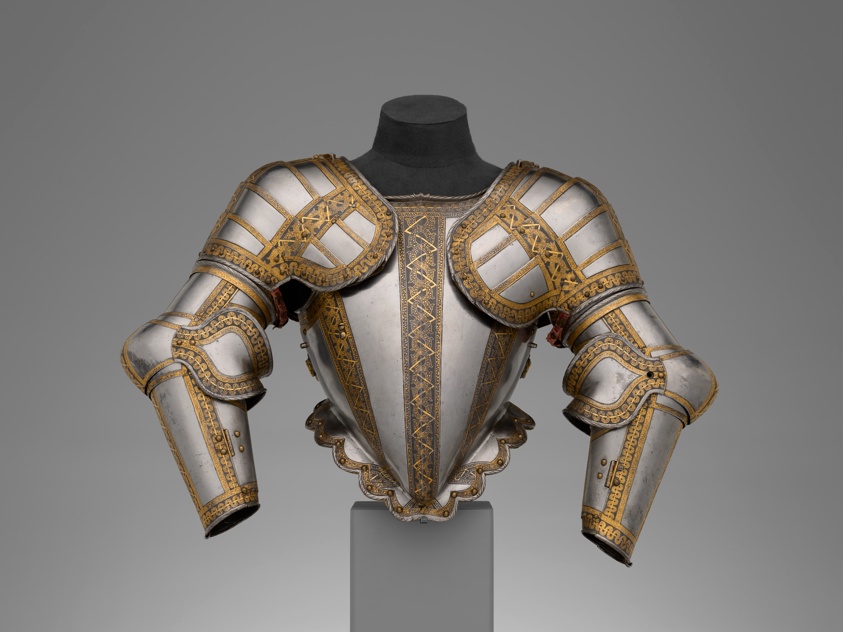
To consider the field armour—specifically those portions comprising the cuirass, pauldrons, and articulated vambraces—is to engage with the most resolved expression of the metallurgist’s art. Its materiality, a formidable matrix of hardened steel, judiciously augmented with brass and gilding, speaks a language of absolute purpose: deflection, resilience, and the imposition of will. Yet, when this martial carapace is lined, faced, or accompanied by silk velvet, a profound and deliberate contradiction is introduced. This is not mere embellishment; it is a statement of philosophy. The conjunction of steel and silk represents one of tailoring’s most audacious propositions: that true authority is vested not in brute force alone, but in the seamless integration of power and grace, where protection and presentation become indivisible.
The Foundation: Steel as the Bespoke Substrate
Examine the steel itself. A proper armour garniture, much like a definitive Savile Row lounge suit, begins with an intimate understanding of form and articulation. The steel plates are not mere shelter; they are a second skeleton, engineered to follow the line and movement of the wearer’s body. The process of raising, dishing, and tempering the metal is a forging equivalent of a tailor’s baste and fit: iterative, demanding, and utterly personal. The introduction of brass borders or gilded etching along the borders—often in foliate or geometric patterns—functions as the subtle pick-stitching or discreet boutonnière of this ensemble. It announces a consideration beyond the purely functional, a willingness to engage with the language of aesthetics even within the most severe of contexts. This armature is the canvas, the structured shoulder, the suppressed waist. It provides the impeccable, unyielding line.
The Contrapuntal Element: The Silk Velvet Vernacular
Against this language of adamant resolve, silk velvet introduces an entirely different vernacular. Its materiality is one of absorption and depth, both visual and tactile. Where steel reflects light with a cold, sharp gleam, velvet consumes it, offering a profound, luminous darkness or a rich, sumptuous hue—crimson, sapphire, or a profound black. The very nature of velvet, with its dense pile, speaks of luxury, of the cabinet rather than the camp. To line the interior of a steel cuirass with silk velvet is a profound act of sartorial civility. It addresses the intimate experience of the wearer, providing a buffer against the metal’s unforgiving chill and abrasion. It is the equivalent of a fully lined jacket, where the inner experience belies the outer formality—a private comfort supporting a public front.
More significantly, when velvet is applied externally as a covering or as panes suspended from the armature, it performs a remarkable act of sartorial alchemy. It softens the silhouette, introducing a fluidity that counterpoints the rigid geometry of the plates. In motion, these textile elements would sway and flow, creating an impression of elegance and ease that belies the deadly purpose beneath. This is the essence of fluid elegance: the suggestion of effortless movement, a dancer’s poise, imposed upon a form designed for the violent kinetics of the field. The velvet becomes the drape of a tailored coat, the roll of a lapel, introducing a sense of organic, breathing life to the engineered form.
The Synthesis: A Statement of Unassailable Composure
The ultimate power of this synthesis lies in the totality of the impression it creates. A commander so attired is not merely protected; he is composed. The steel asserts an inviolable competence, a technical mastery of the martial craft. The silk velvet, in its depth and richness, communicates a cultural and economic authority that is equally formidable. It speaks of resources that extend beyond the armoury, into the realms of commerce, art, and connoisseurship. This is the armour of a man who understands that campaign are won not only on terrain but in the minds of men—both his followers and his adversaries.
In the lexicon of classic craftsmanship, this artefact stands as a paramount example of cross-disciplinary dialogue. The armourer’s hammer and the silk weaver’s loom are unlikely collaborators, yet here their outputs are rendered not merely compatible, but co-dependent. The velvet requires the steel’s structure to achieve its most dramatic, elevated presentation; the steel is humanised and elevated by the velvet’s tactile luxury. The leather straps and ties, functional and unassuming, act as the silent seam, binding these two worlds together with understated efficiency.
Conclusion: The Enduring Legacy of an Integrated Philosophy
To regard these portions of a field armour, therefore, is to witness a principle that transcends its historical context. It is a study in the power of integrated contrasts. The lesson for the modern purveyor of heritage—whether in tailoring, design, or leadership—is clear: ultimate distinction arises from the confident unification of apparent opposites. The robust and the refined, the technical and the aesthetic, the assertive and the elegant, are not mutually exclusive domains. They are complementary forces, which, when masterfully conjoined, create an impression of unshakeable, complete authority. The steel provides the unwavering line; the silk velvet provides the profound depth. Together, they articulate a proposition as relevant now as it was on the field of honour: that true power is always, and ultimately, impeccably dressed.