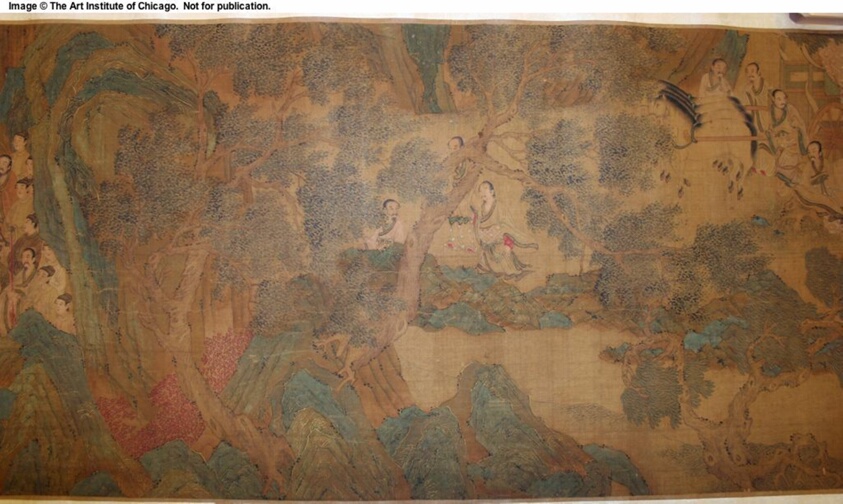
An Exegesis of Resolve: The King Yu Handscroll as a Testament to Sovereign Craft
To engage with the handscroll is to participate in a ceremony of revelation. It is an artefact demanding not mere observation, but a performative commitment; the slow, deliberate unfurling from right to left, a controlled disclosure of narrative and topographical intellect. The subject herein—King Yu Moving a Mountain to Control the Floods—is not merely a heroic anecdote but the foundational parable of governance through applied wisdom. Rendered in ink and colour upon the most exacting of grounds, silk, this piece transcends illustrative function. It stands as a sartorial manifesto, wherein the fluid elegance of the medium becomes the very metaphor for the central tenet: the mastery of chaos through disciplined flow.
The Ground: A Foundation of Silent Prestige
Before a single stroke of ink meets the surface, the silk establishes its authority. This is not a passive receptacle for pigment, but an active collaborator in the statement. Like the finest bespoke canvas—a wool of specific origin, weight, and hand—the silk selected for this commission possesses a tacit understanding of its role. Its weave, a testament to generations of technical refinement, offers a surface that is at once receptive and resistant. It drinks the ink, allowing for depths of tonality and soft, bleeding washes that speak of torrents and mist, yet its inherent strength provides a crisp boundary, a defining line as sharp as that on a master cutter’s chalk. The materiality whispers of a heritage built not on ostentation, but on the quiet confidence of uncompromised substrate. The luxury is intrinsic, understood only upon intimate engagement.
The Narrative Cut: Tailoring Chaos into Order
The legend of Yu the Great is, in essence, a narrative of bespoke solution. The universal flood is a problem of catastrophic disproportion—a world drowned, a system failed. Yu’s genius, as depicted in the scroll’s meticulous progression, lies not in confrontation, but in artful redirection. The scroll unfolds not as a single heroic tableau, but as a sequence of strategic engagements. We witness the surveying, the consultation with the land’s own grain, the mobilization of labour not as brute force, but as coordinated endeavour. The mountain is moved, yes, but with the precision of a surgeon, not the rampage of a titan. Channels are carved; rivers are given new, purposeful lines. This is the sartorial principle applied to hydrology and statecraft: the material (the water, the populace) is not fought against, but understood, measured, and guided into a more elegant, functional form. The chaos is cut away, the essential flow is preserved and enhanced.
The Line and Wash: A Grammar of Fluid Elegance
The artistic execution mirrors the parable’s core philosophy. The ink work employs a hierarchy of line, from the gossamer-fine threads depicting distant labourers—each a deliberate stitch in the broader canvas—to the robust, confident strokes that define the tectonic shoulders of the mountain being shifted. This variation in weight and pressure is the scroll’s articulated silhouette. The controlled application of colour, primarily mineral-derived blues and ochres, is never permitted to drown the underlying drawing. It is applied like strategic ornamentation—a lapel’s width of piping, a discreet pocket welt—serving to clarify form and depth rather than obscure the foundational structure. The famous fluidity of the brushwork, particularly in rendering the now-tamed waters, is the ultimate expression of controlled elegance. It demonstrates that true mastery lies not in static perfection, but in the confident management of movement and transition.
Provenance and Legacy: The Unbroken Thread
This handscroll, as an object of heritage, carries its lineage in every fibre. The craftsmanship it embodies—from the loom to the painter’s studio—speaks of a guild-like tradition where knowledge is transmitted not through manuals, but through apprenticeship and tactile memory. It is a continuum of excellence, akin to the unbroken thread of a Savile Row house, where the shears of today are guided by the patterns of a century past. King Yu’s story is one of establishing order for future generations; the scroll itself is a physical manifestation of that principle. Its preservation, its careful unfurling, and the scholarly engagement it demands are rituals that honour the resolve it depicts. It teaches that heritage is not a museum piece under glass, but a living, breathing methodology—a way of approaching monumental problems with patience, respect for material, and an unwavering commitment to the long, elegant line.
In conclusion, this artefact is far more than a depiction of a myth. It is a constitutive document of a civilisational mindset. Through the alchemy of silk, ink, and sublime narrative, it posits that the greatest triumphs are not those of obliteration, but of tailored resolution. The flood is not stopped; it is worn, channelled, and given a form that serves. In this, the handscroll offers a timeless proposition: whether facing unruly waters or crafting an enduring garment, true authority is expressed not through force, but through the intelligent, graceful guidance of flow. It is, in every sense, a masterpiece of cut and construction.