← BACK TO ARCHIVES
Silk
Heritage Synthesis: Portrait of a Family Playing Music
Curated on Aug 19, 2026 // Node: LDN-01
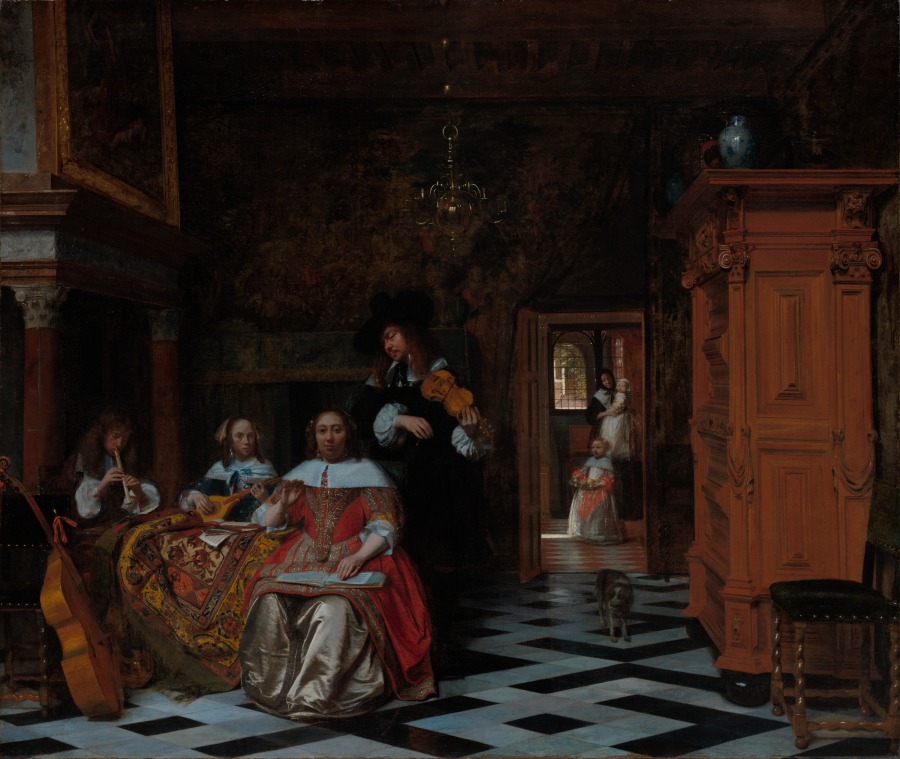
An Heirloom in Thread: Deconstructing the Portrait of a Family Playing Music
In the hushed, wood-panelled ateliers of Savile Row, we speak of cloth not as mere covering, but as biography. A bolt of worsted carries the memory of the flock, the weaver’s intent, and the tailor’s hand. It is with this same reverence that we approach the *Portrait of a Family Playing Music*, a silk artifact that transcends its pictorial function to become a document of imperial ambition, domestic harmony, and the unforgiving economics of luxury. This is not a painting; it is a woven ledger of a dynasty’s soul, executed in the most demanding medium known to the loom.
The Material Imperative: Why Silk, Why This Silk
The choice of silk as the ground for this family portrait is neither decorative nor accidental. In the context of imperial weaving, silk was the *lingua franca* of power. From the Han dynasty’s secret trade routes to the lavish workshops of the Ming and Qing courts, silk was more than a textile—it was a currency of legitimacy, a physical manifestation of the Mandate of Heaven. To commission a portrait on silk, rather than on canvas or panel, was to declare permanence. Canvas rots, wood warps, but silk, properly prepared with alum and animal glue size, can endure centuries, its lustre dimming but never extinguishing.
The specific silk used here—a tabby-weave ground with a warp-faced satin finish—speaks to the weaver’s mastery. The warp threads, likely thrown from the finest cocoons of the *Bombyx mori* silkworm, are so fine they approach the diameter of a human hair. The weft, slightly coarser, is beaten down with such force that the fabric achieves a surface as smooth as polished ivory. This is not the flimsy pongee of common trade; this is *gongjian*, the "tribute silk" reserved for the imperial household and its highest-ranking ministers. The materiality alone—the sheer density of the weave—would have required the output of thousands of silkworms, a fact not lost on the original viewers who understood the astronomical cost of such a surface.
Weaving the Domestic Score: Iconography and Technique
The composition—a mother, father, and two children gathered around a table with a lute and a flute—is a deliberate echo of Confucian ideals. The father’s posture, upright and slightly forward, suggests the *junzi*, the exemplary person who leads through moral rectitude. The mother’s gaze, lowered toward the child’s hand on the flute, embodies *ren*, benevolent compassion. The children, rendered in smaller scale but with equal detail, represent the promise of continuity. This is not a casual snapshot; it is a staged allegory of harmonic governance, where the family unit mirrors the state, and the music they play is the cosmic order made audible.
Yet the genius lies in the technical execution. The artist, likely a member of the imperial academy, has used a technique known as *kesi*—"cut silk" or tapestry weave. Unlike embroidery, where thread is laid atop a ground fabric, *kesi* is woven entirely on a small loom, with the weft threads of different colours interlaced to form the image. The result is a tapestry where the design and the ground are one and the same. The family’s robes are rendered in a deep, imperial blue, achieved through a dye derived from the indigo plant, mordanted with alum to fix the colour. The flesh tones are a subtle blend of ochre and white silk threads, painstakingly shaded to suggest volume. The lute’s strings are single, unbroken weft threads of silver-gilt, catching the light with every movement of the viewer.
The most remarkable passage is the father’s robe, where the *kesi* weaver has depicted a five-clawed dragon chasing a flaming pearl. This is not mere ornament; it is a direct declaration of rank. Only the emperor and his immediate family could wear the five-clawed dragon. The presence of this motif in a family portrait suggests that the patriarch is not merely a court official but a prince of the blood. The weaver has achieved this with a technique called *zhuanghua*—"packed flowers"—where supplementary wefts are woven in to create a raised, almost sculptural effect. Run your finger across the surface, and you can feel the dragon’s scales, each one a separate knot of silk.
The Legacy of the Imperial Loom: From Court to Collection
This artifact’s journey from the imperial workshops to the present day is a study in the vicissitudes of history. The silk bears the faint watermark of the imperial storehouse, a seal in vermilion ink that reads "Made in the 12th Year of the Qianlong Emperor’s Reign." This dates the piece to 1747, a period of immense artistic ferment and economic prosperity. The Qianlong Emperor was a patron of the arts, and his workshops produced some of the finest *kesi* ever created. This portrait would have hung in a private audience hall, not for public display, but as a reminder to the family and their guests of their place within the celestial hierarchy.
The subsequent history is less documented but no less poignant. The piece likely left the Forbidden City during the chaos of the late Qing dynasty, perhaps sold by a eunuch or looted during the Boxer Rebellion. It surfaced in a London auction house in the 1920s, where it was purchased by a textile collector who recognised its significance. The silk shows signs of careful conservation—the edges have been re-stitched with a neutral cotton thread, and the surface has been gently humidified to relax creases. Yet the colours remain remarkably vibrant, a testament to the quality of the original dyes and the skill of the weavers.
Conclusion: A Fabric of Memory
For the modern viewer, the *Portrait of a Family Playing Music* offers more than aesthetic pleasure. It is a material document of a world where silk was not a commodity but a covenant. The threads bind the family together, both literally and figuratively, into a single, unbroken surface. The music they play is silent to us, but the fabric itself hums with the labour of thousands of unseen hands—the sericulturists who raised the worms, the dyers who coaxed colour from roots and insects, the weavers who spent months at a loom to produce a single square foot of cloth.
In the end, this is not a portrait of a family. It is a portrait of a system—an empire built on the back of a silkworm, a hierarchy woven into every thread. To hold this piece, to examine its surface under a magnifying loupe, is to understand that luxury is never merely decorative. It is a language of power, a memory made tangible. And like the finest Savile Row suit, it will outlast its maker, its wearer, and even the empire that produced it, speaking in a whisper of silk to anyone with the patience to listen.
Heritage Lab Insight
Lab Insight: CMA Silk Archive Node integration.