← BACK TO ARCHIVES
Silk
Heritage Synthesis: Samite fragments with double-headed eagles, from the tomb of Saint Bernard Calvo
Curated on Aug 19, 2026 // Node: LDN-01
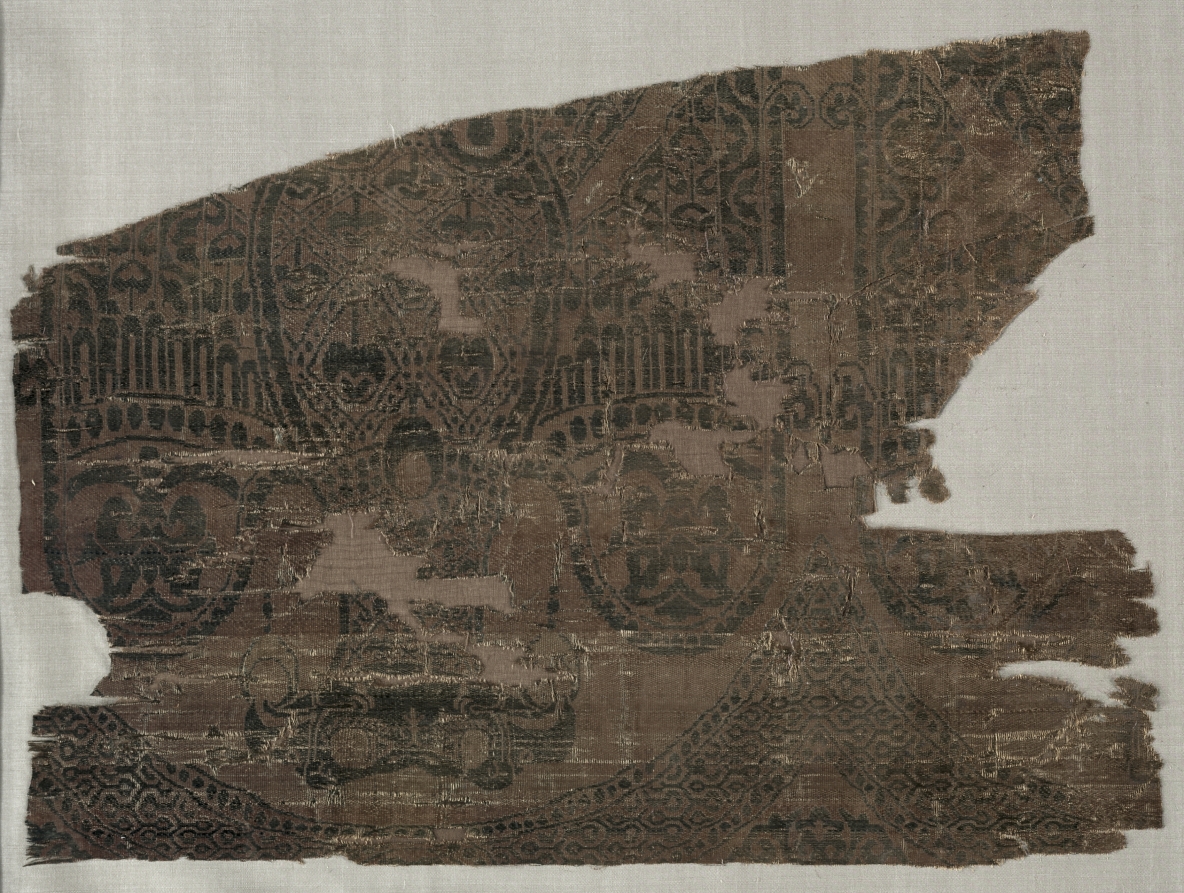
The Imperial Thread: Samite Fragments of Saint Bernard Calvo
In the hushed, climate-controlled vaults of ecclesiastical treasuries, one occasionally encounters an object that transcends mere textile. It is not simply cloth; it is a frozen political manifesto, a testament to the intertwined destinies of faith, empire, and the loom. Such is the case with the samite fragments bearing the double-headed eagle, recovered from the tomb of Saint Bernard Calvo. These are not remnants of a vestment, but rather the shards of a diplomatic and spiritual statement, woven in the most luxurious medium the medieval world knew: imperial silk.
Materiality and the Language of Silk
To the modern eye, silk is a commodity. To the medieval mind, particularly in the Latin West, it was a material of near-mystical significance. The very word "samite," derived from the Greek *hexamiton* (meaning "six threads"), denotes a heavy, twill-woven fabric of exceptional density and sheen. The ground weave, often in a deep, saturated hue—perhaps a Tyrian purple or a rich Byzantine blue—provided a lustrous canvas for the weft-faced patterning. The fragments from Calvo’s tomb, though now faded and fragmented by centuries of interment, still whisper of their original opulence. The silk threads, imported at immense cost along the perilous Silk Roads, were not merely dyed; they were imbued with the authority of their point of origin. To wear or to be buried in such cloth was to claim a share of that imperial prestige, a tangible connection to the courts of Constantinople or, later, the great weaving centres of the Islamic world.
The double-headed eagle itself is the key to decoding this artifact. This heraldic device, with its two heads gazing east and west, was the supreme emblem of the Byzantine Empire, signifying dominion over both the secular and spiritual realms, and the unity of the Roman legacy. Its presence on the silk is not incidental. It marks the fabric as a product of the imperial *gynaecea*—the state-run workshops that held a monopoly on the most prestigious weaves. These workshops were not merely factories; they were instruments of statecraft. The export of such silks was strictly controlled, often given as diplomatic gifts to cement alliances, reward loyalty, or impress foreign dignitaries. The fragments found with Saint Bernard Calvo, a Catalan bishop who died in the early 13th century, therefore represent a direct, material link between the Catalan counties and the Byzantine sphere of influence.
Context: The Legacy of Imperial Silk Weaving
The legacy of imperial silk weaving is a story of technological mastery and political appropriation. The techniques were jealously guarded, initially confined to the imperial workshops in Constantinople. The production of samite, with its intricate compound twill structure, required a sophisticated drawloom and a highly skilled weaver capable of managing hundreds of warp threads to create complex figural designs. This was not a craft for the provincial artisan; it was a courtly art, a form of soft power projected through pattern and thread.
By the time of Calvo’s death in 1230, the Byzantine monopoly had fractured. The Fourth Crusade in 1204 had sacked Constantinople, scattering its weavers and their secrets across the Mediterranean. New centres of production emerged in Sicily, in Lucca, and in the Islamic courts of Al-Andalus. Yet, the iconography of the double-headed eagle persisted, a powerful visual shorthand for imperial authority that was adopted by the emerging powers of the West—most notably the Holy Roman Emperors and, later, the Russian Tsars. The silk fragments in Calvo’s tomb, therefore, stand at a fascinating crossroads. They could be a product of the late Byzantine era, a final flowering of the old imperial workshops, or they could be a product of a nascent Western workshop, deliberately imitating the Byzantine style to claim its prestige. The distinction is crucial, but the message is the same: the wearer or the deceased was connected to a lineage of power that stretched back to Rome.
Interpretation: A Bishop’s Political and Spiritual Wardrobe
The presence of such a fabric in the tomb of a bishop is profoundly telling. Saint Bernard Calvo was not a monarch. He was the Bishop of Vic, a man of the Church. Yet, his burial in imperial samite signals a deliberate act of self-fashioning. It speaks to the complex role of high-ranking clergy in the medieval period, who were as much political players as spiritual leaders. Calvo was a close advisor to King James I of Aragon, and his diplomatic missions likely brought him into contact with the finest textiles of the age. To be buried in this cloth was to assert his own status as a prince of the Church, a man who operated on the same stage as emperors and kings.
Moreover, the choice of the double-headed eagle, rather than a purely Christian motif, is significant. It suggests a layering of meaning. For the Church, the eagle could be interpreted as a symbol of the Gospel of John, soaring to heavenly heights. For the political elite, it was the emblem of empire. For Calvo, it may have represented both: a claim to spiritual elevation and a testament to his earthly authority as a mediator between the papacy, the crown, and the remnants of the Byzantine world. The silk, in this context, becomes a biographical document, woven in thread, that speaks of ambition, faith, and the enduring allure of imperial Rome.
The fragments are a poignant reminder that the history of fashion and textiles is not a history of frivolity. It is a history of power, economics, and identity. In these few square inches of faded silk, we see the entire complex web of medieval geopolitics—the flow of luxury goods, the assertion of sovereignty, and the deeply human desire to be remembered with the trappings of greatness. The samite of Saint Bernard Calvo is not merely a relic; it is a final, eloquent statement from a man who understood that in the language of the medieval court, cloth was the most persuasive word of all.
Heritage Lab Insight
Lab Insight: CMA Silk Archive Node integration.