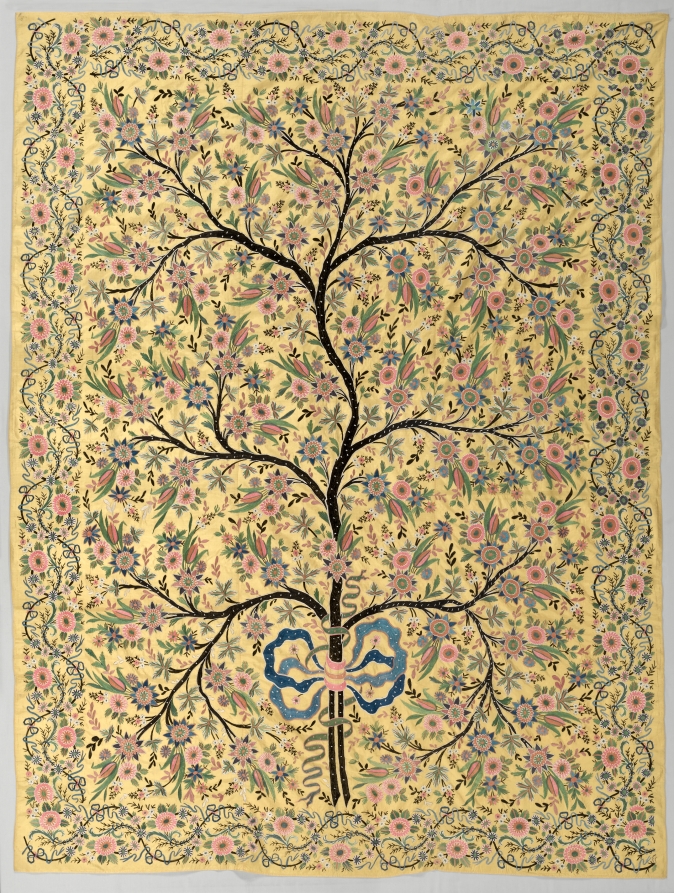
The Enduring Thread: A Silk Hanging and the Legacy of Imperial Weaving
Introduction: An Artifact of Power and Patience
In the hushed, wood-panelled corridors of Lauren Fashion Heritage Lab, we encounter more than a textile; we encounter a thesis. The subject before us—a silk hanging embroidered with the Tree of Life—is not merely a decorative object. It is a material testament to a lineage of craftsmanship that predates the modern concept of fashion itself. For those of us on Savile Row, where the cut of a jacket is a matter of honour and the fall of a lapel a declaration of intent, this hanging speaks a language we understand intimately: the language of absolute, uncompromising mastery. It is a reminder that true luxury is never loud; it is the quiet, assured presence of something made without a single concession to haste.
Materiality: The Sovereign Fibre
Let us begin with the ground upon which this story is woven. Silk is not a fabric; it is a miracle of biology and chemistry, harvested from the cocoon of the Bombyx mori moth. For millennia, the production of this filament was a state secret of the Chinese Empire, guarded with the same ferocity as a military strategy. To possess silk in the imperial courts was to possess a fragment of the heavens. Its natural lustre, its ability to take dye with an intensity that wool or linen could only approximate, and its extraordinary tensile strength—stronger than steel of the same diameter—made it the sovereign fibre. In this hanging, the silk ground is not a passive backdrop. It is a canvas of light, catching and reflecting the ambient glow in a way that gives the embroidery a three-dimensional, almost breathing quality. The warp and weft are so fine, so densely packed, that the surface feels like a frozen pool of water, smooth and unyielding. This is not the silk of a mass-produced scarf; this is the silk of a dynasty, woven on looms that were themselves works of art.
The Iconography: The Tree of Life as Imperial Metaphor
Embroidered upon this luminous field is the Tree of Life. In Western iconography, this motif often evokes Eden or a romanticised pastoral. But in the context of imperial Chinese weaving, the symbolism is far more precise and politically charged. The tree is not merely a botanical specimen; it is a cosmological diagram. Its roots plunge into the earth, drawing sustenance from the underworld. Its trunk rises with unerring verticality, representing the axis mundi—the central pillar that connects the mortal realm to the celestial. Its branches, laden with blossoms and fruit, spread outward in perfect symmetry, signifying the reach of the emperor’s benevolence and the prosperity of his reign. Every element is deliberate: the peony for wealth, the lotus for purity, the pomegranate for fecundity. To commission such a piece was to assert one’s place in the cosmic order. To wear it, or to display it within the Forbidden City, was to embody that order. The embroiderer, therefore, was not a craftsman in the modern sense; he was a scribe, transcribing a sacred text in thread.
Technique: The Discipline of the Needle
Now, consider the execution. This is where the Savile Row analogy becomes most apt. A master tailor does not simply sew a seam; he engineers a structure. Similarly, the imperial embroiderer approached this hanging with a rigour that borders on the obsessive. The technique employed is likely a combination of satin stitch, seed stitch, and couched gold thread. The satin stitch, laid flat and parallel, creates the smooth, painterly surfaces of the leaves and petals. The seed stitch, a myriad of tiny knots, fills the background with a subtle, textured shimmer that prevents the eye from resting too easily. And the couched gold thread—real gold, wrapped around a silk core—is laid along the contours of the trunk, not merely as decoration, but as a structural reinforcement. Each stitch is placed with a precision that allows for no correction. There is no seam ripper in the imperial atelier. A single misplaced thread could compromise the entire piece, both aesthetically and symbolically. This is the discipline of the needle, a practice that demands years of apprenticeship, a steady hand, and a mind free of distraction. It is the same discipline that allows a tailor to cut a sleeve that hangs perfectly from the shoulder, without a single wrinkle, for the life of the garment.
Context: The Imperial Silk Weaving Legacy
This hanging must be understood within the broader legacy of imperial silk weaving, a system that reached its zenith during the Ming and Qing dynasties. The imperial workshops, known as the Jiangnan Silk Manufactories, were located in the cities of Suzhou, Hangzhou, and Nanjing. These were not factories in the industrial sense; they were academies of excellence, employing thousands of artisans who were organised into strict hierarchies. The finest weavers and embroiderers were conscripted, often for life, and their work was reserved exclusively for the court. The looms themselves were monumental structures, requiring two or three operators to work in tandem. The patterns were not drawn on paper; they were encoded in the loom’s harness, a complex system of cords and pulleys that could take months to set up for a single new design. The output was not measured in yards, but in individual pieces of perfection. A single robe could take a team of artisans over a year to complete. This hanging, with its intricate embroidery, would have been a commission of the highest order, perhaps destined for a throne room, a ceremonial hall, or a private imperial chamber. It was an object of state, as significant as a diplomatic treaty or a military victory.
Conclusion: A Lesson in Permanence
As we stand before this hanging, we are reminded of a truth that the modern fashion industry, with its relentless cycles of seasonal drops and disposable trends, often forgets: true luxury is a function of time, not of novelty. This silk hanging was not designed to be photographed and discarded. It was designed to endure, to be passed down through generations, to accrue value with age. Its beauty is not in its surprise, but in its permanence. For the House of Lauren, this artifact is not a relic; it is a benchmark. It challenges us to ask whether our own creations possess that same quality of intention, that same refusal to compromise. In the quiet, confident presence of this embroidered tree, we find not just a heritage, but a standard. And it is a standard we must strive to meet, stitch by stitch, every single day.