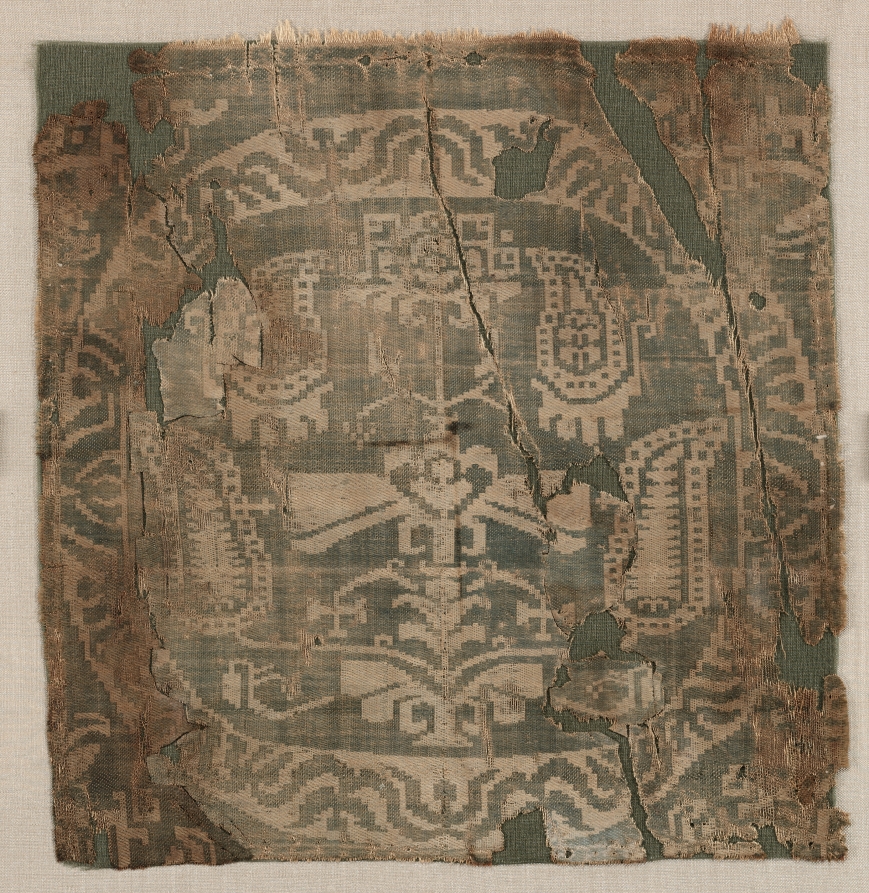
An Examination of the Imperial Roundel: Silk as the Substrate of Sovereignty
To comprehend the object before us—a roundel excised from a tunic, its silk ground cradling the solemn symmetry of a palmette tree—one must first appreciate the absolute primacy of its material. This is not mere fabric. It is silk: the ultimate expression of controlled luxury, a technological secret guarded with the fervour of state intelligence, and the most potent non-verbal language of power the ancient and medieval worlds ever devised. The legacy it carries is not one of incidental adornment but of deliberate, imperial command. In the hands of the Byzantine or Sassanian workshops from which such a motif likely emanates, silk was the physical manifestation of oikoumene—the inhabited, civilised world—with the emperor, or shahanshah, at its literal and figurative centre.
The Grammar of the Loom: Where Technique Becomes Tenet
Consider the construction. This roundel, likely woven by the drawloom technique, represents a staggering investment in human capital and technical patience. The very existence of the pattern, a discrete medallion enclosing a sacred arboreal form, speaks of a complex, pre-planned mechanism. Each intersecting warp and weft is a calculated decision, rendering the design inseparable from the ground. This is not embroidery, where pattern is applied; here, pattern is integral. The integrity of the message is thus woven into the very structure of the cloth, making it as immutable as a decree. The silk itself, with its luminous sheen and formidable tensile strength, was the only substrate worthy of such an endeavour. It accepted dye with unparalleled depth—the now-faded blues from lapis lazuli or indigo, the crimson from kermes—transforming light into a spectacle of wealth that no painted surface or stitched thread could rival. The material dictated the method, and together, they established an aesthetic of incontrovertible authority.
The Palmette Tree: An Arboreal Heraldry of Dominion
Within the confines of the roundel, the palmette tree stands not as a mere botanical motif, but as a heraldic device of the highest order. Its rigid, radial symmetry echoes the perceived cosmic order emanating from the throne. This is nature, not as found in the wild, but as administrated—pruned, stylised, and organised into a perfect, self-contained system. In the context of imperial ideology, the tree often symbolised the Axis Mundi, the world-tree connecting heaven and earth, a conduit of divine favour to the ruler. The palmette, with its origins in ancient Near Eastern art, was refined through Greco-Roman interpretation before being fully co-opted by imperial Persian and Byzantine workshops. Its presence on a silk tunic transformed the wearer into a mobile assertion of this cosmology. The roundel, repeated across the garment’s surface, would have created a rhythmic field of power, a visual incantation reinforcing the wearer’s place within a divinely sanctioned hierarchy.
The Currency of Cloth: Diplomatic Armoury and Economic Instrument
The significance of such a textile extends far beyond the atelier or the court wardrobe. Imperial silks like this fragment were the hard currency of geopolitics. They were diplomatic gifts of the first rank, presented to allied kings, troublesome chieftains, or favoured clergy. To bestow a garment of such technical complexity and iconographic weight was to envelop the recipient in the giver’s own cultural and political narrative. It was an act of immense condescension and calculated inclusion. Conversely, to possess and wear such silks, whether acquired through gift, tribute, or lavish purchase, was to affiliate oneself with the pinnacle of civilised achievement. The silk trade itself, from the secretive Seres of China to the monopolistic control exerted later by Constantinople, was the ancient world’s equivalent of a strategic resource industry. Control over the means of production and distribution was as crucial as control over a silver mine or a grain-producing province. This roundel, therefore, is a fossil of that vast economic and political engine.
Savile Row Reflection: The Enduring Legacy of the Bespoke Code
While separated by millennia and motive, a direct, if nuanced, lineage can be traced from this imperial roundel to the ethos of a Savile Row lounge suit. The connection lies not in aesthetic imitation, but in the shared understanding of code. The palmette tree roundel was a bespoke communication, its language understood by a privileged, transnational elite. It spoke of status, affiliation, and a rarefied position within a strict hierarchy. In a not dissimilar manner, the cut of a coat, the discreet pattern of a cloth, the very roll of a lapel on Savile Row, communicates a complex message of tradition, personal station, and sartorial literacy to those equipped to decipher it. Both are products of consummate, guarded craftsmanship where material integrity is non-negotiable. Both utilise the garment as a canvas for non-verbal, authoritative statement. The silk roundel was imperial branding of the most sophisticated kind; the Row’s legacy is one of personal branding through imposed tradition and exquisite materiality. One was dictated by the throne, the other by a tailored silhouette of self-presentation, yet both acknowledge that true authority is often best expressed through restrained, impeccably executed form.
In final analysis, this fragment of silk is far more than a relic of decorative art. It is a concentrate of imperial will. From the biological miracle of the silkworm to the mathematical precision of the loom, from the sacred geometry of its motif to its role in the theatre of statecraft, every aspect was engineered to inspire awe and confirm order. The palmette tree, eternally blooming within its circular frame, stands as a silent testament to an age when cloth was not merely worn, but deployed—a luminous, tactile manifestation of power woven, quite literally, into the very fabric of empire.