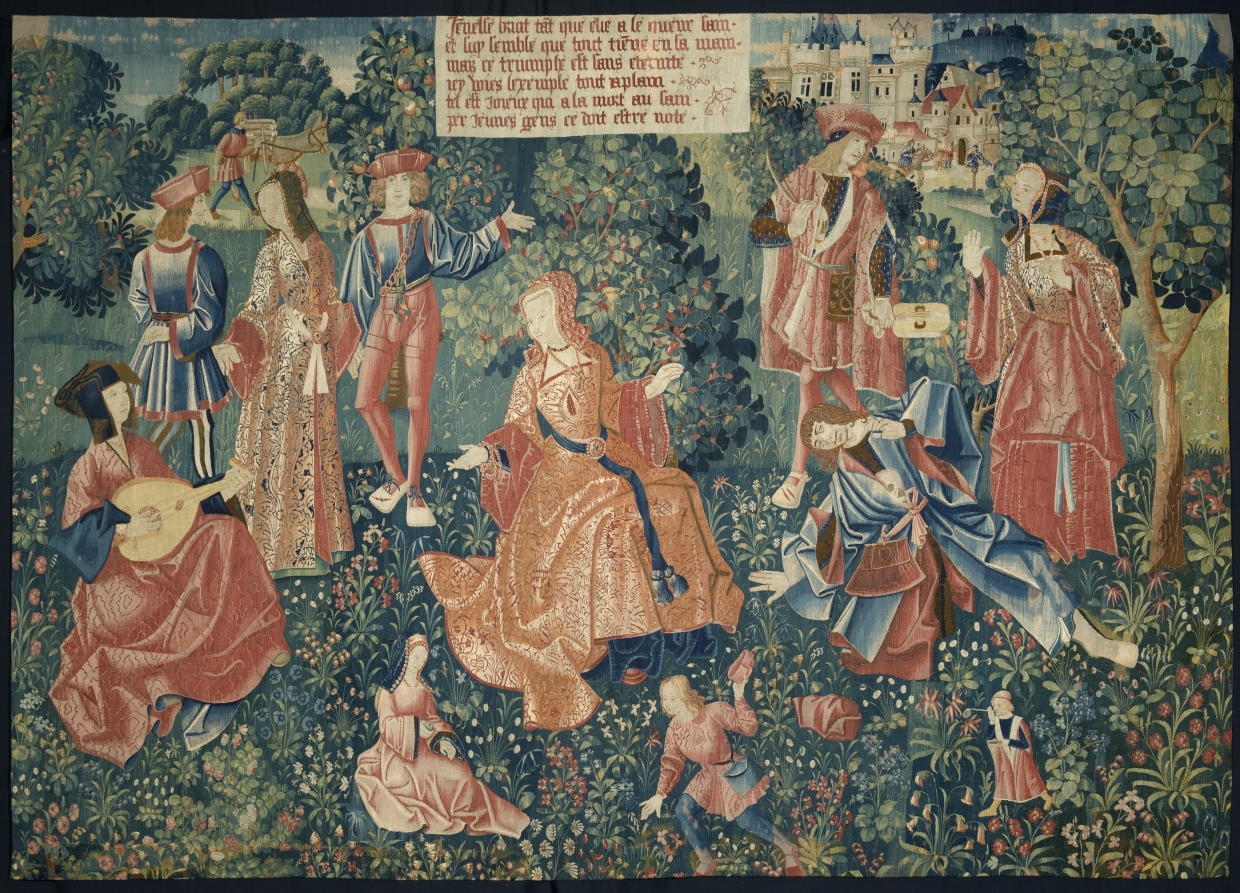
Heritage Research Artifact: The Youth of Chaumont
Category: Silk
In the rarefied atmosphere of London’s Savile Row, where cloth is not merely fabric but a statement of lineage and intention, we encounter a singular artifact: a silk panel designated as ‘Youth’ from the Chateau de Chaumont set. This is not a textile to be dismissed as mere decorative trimming. It is a document of imperial ambition, a relic of a manufacturing discipline that once bent nature to the will of a crown. To handle this silk is to hold a fragment of a lost world—a world where the loom was a throne, and the shuttle a scepter.
The materiality of this piece is its primary testimony. The silk is of a weight and density that speaks to a specific, uncompromising standard. This is not the flimsy, airy silk of modern couture. It is a substantial, almost architectural silk, woven with a tightness that suggests it was intended to withstand the scrutiny of candlelit salons and the heavy drapery of a chateau’s grand halls. The hand-feel is cool, smooth, yet with a subtle, granular resistance—a testament to the high twist of the raw filaments and the precise, unhurried pace of the drawloom. The weave structure, likely a compound satin or a lampas, allows for a play of light that is both deep and diffuse. The lustre is not a garish shine but a quiet, internal glow, the hallmark of the finest mulberry silk, degummed and dyed with a mastery that has since become a lost art.
The Imperial Thread: A Legacy of Statecraft
To understand ‘Youth,’ one must first understand the context of its creation. The Chateau de Chaumont set, of which this panel is a part, is inextricably linked to the grand narrative of French imperial silk weaving, a legacy that reached its apotheosis in the 18th century under the auspices of the crown. The great manufactories of Lyon—the Gobelins, the Savonnerie—were not mere workshops; they were instruments of state policy. They were the engines of a soft power that projected French supremacy across Europe. The silk produced there was not for the common man. It was a diplomatic weapon, a gift for foreign courts, a livery for the royal household, and a statement of absolute, unassailable taste.
This particular artifact, however, carries a more nuanced narrative. The designation ‘Youth’ suggests a departure from the rigid, formal allegories of the earlier Baroque period. While the imperial looms of Louis XIV produced heavy, gold-threaded brocades celebrating the Sun King’s military victories, ‘Youth’ hints at a later, more refined sensibility. It speaks to the Rococo’s embrace of the pastoral, the playful, and the ephemeral. The iconography, likely featuring cherubic figures, garlands of flowers, or scenes of pastoral leisure, is not a celebration of martial might but an ode to the fleeting nature of innocence and vitality. It is a silk that whispers of spring mornings and the first blush of dawn, a deliberate counterpoint to the stern, martial silks of the previous generation.
The very existence of this piece is a testament to the extraordinary technical and artistic infrastructure of the imperial silk industry. The design would have been executed by a master painter, translated into a point paper by a draftsman, and then interpreted by a weaver of immense skill. The weaver, working at a drawloom with a second operator pulling the harness cords, would have manipulated thousands of individual threads to create the intricate pattern. Each pass of the shuttle was a calculated act, a negotiation between the design’s complexity and the physical limitations of the loom. The result is a fabric that is not merely patterned but painted in silk, with a depth of color and a subtlety of shading that rivals any oil on canvas.
Materiality and the Savile Row Ethos
From a Savile Row perspective, the value of ‘Youth’ lies not only in its historical significance but in its profound lessons for contemporary craftsmanship. We are a trade built on the principle of bespoke—the idea that a garment should be a unique, perfect response to an individual’s form and character. This silk embodies that principle in its very construction. It was not mass-produced; it was created for a specific space, a specific light, a specific patron. The weaver’s hand is evident in every repeat of the pattern, a human imperfection that is, paradoxically, the source of its enduring perfection.
Our own work with silk, particularly in the creation of linings, neckwear, and formal evening wear, is a direct descendant of this imperial legacy. We understand that silk is not a neutral ground; it is a living material that responds to the body, to the ambient environment, and to the passage of time. The way a silk lining falls, the way it breathes, the way it catches the light—these are not accidents. They are the results of choices made at the loom, choices that we must respect and emulate. When we cut a jacket from a modern silk, we are not merely using a fabric; we are engaging in a dialogue with a tradition that stretches back centuries.
Furthermore, the ‘Youth’ panel serves as a benchmark for quality. The density of the weave, the purity of the dye, the integrity of the selvedge—these are all details that we in the modern trade must strive to match. The current market is flooded with silks that are chemically washed, artificially weighted, or woven on high-speed looms that sacrifice substance for speed. These fabrics lack the gravitas of ‘Youth.’ They do not have the same hand, the same depth of color, the same ability to hold a crease or drape with authority. To handle this artifact is to recalibrate one’s standards, to be reminded of what true luxury means.
In conclusion, the ‘Youth’ silk from the Chateau de Chaumont set is more than a historical curiosity. It is a masterclass in materiality, a testament to the power of imperial patronage, and a benchmark for the craft of tailoring. It reminds us that true elegance is not found in novelty but in the enduring principles of quality, precision, and intention. It is a fragment of a lost world, but its lessons are timeless. For those of us on Savile Row, it is not merely a relic to be admired; it is a standard to be upheld, a quiet challenge to every cutter, every tailor, and every designer who dares to work with the most noble of fibers.