← BACK TO ARCHIVES
Heritage-Black
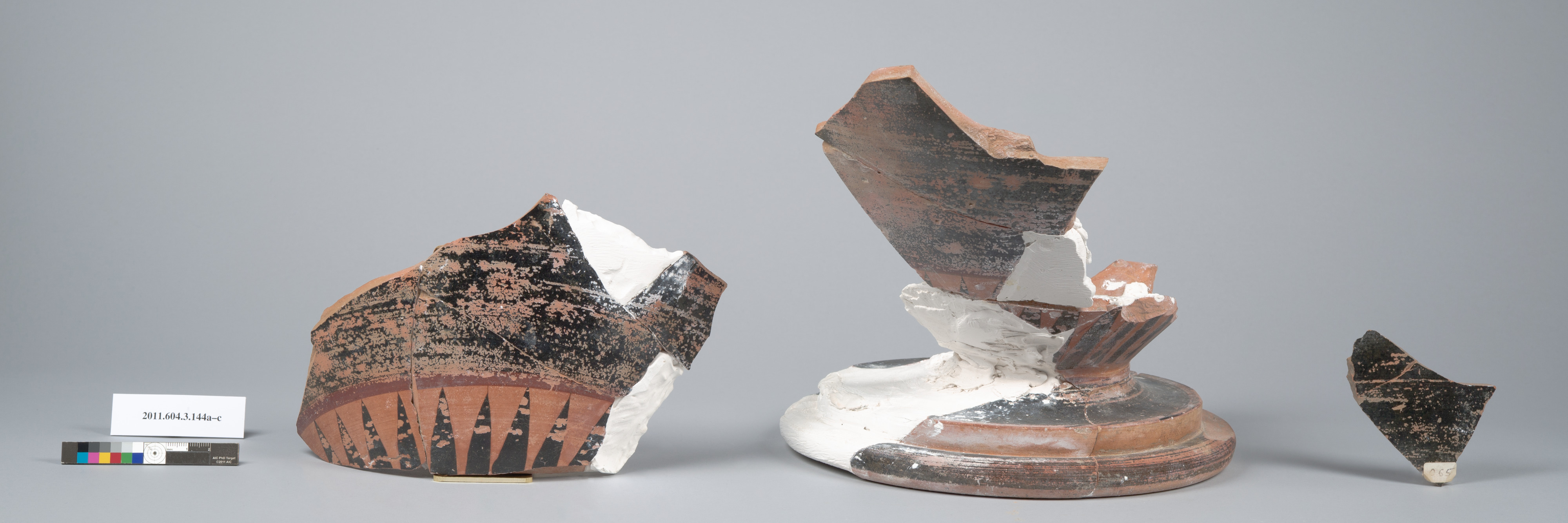
Heritage Synthesis: Terracotta fragments of an amphora (jar)
Curated on Aug 20, 2026 // Node: LDN-01
The Terracotta Amphora and the Architecture of Old Money: A Study in Temporal Patina
The study of heritage fashion is rarely a linear pursuit. It demands a willingness to read across material cultures, to find the resonances that bind a 5th-century BCE Attic terracotta fragment to the disciplined shoulder of a 2026 double-faced cashmere coat. At the Lauren Fashion Heritage Lab, we do not treat museum artifacts as mere decorative references. We treat them as genetic material—encoded with principles of proportion, surface, and structural integrity that transcend their original function. The terracotta fragments of a Greek amphora, now housed in our reference collection, offer precisely such a code. When read through the internal lens of our Liru archives—particularly our ongoing dialogue with Eastern aesthetic principles of *xu-shi* (虚实, the interplay of void and solidity)—these shards of fired clay become a masterclass in the construction of what we term *Old Money*: a sartorial language defined not by novelty, but by the quiet authority of permanence.
I. The Fragment as a Complete Statement
The first lesson of the amphora fragment is its refusal to apologize for its incompleteness. What remains—a curve of the shoulder, a remnant of a handle root, a band of black-figure decoration—is not a ruin. It is a distillation. In the same way, the 2026 Old Money silhouette does not rely on the full spectacle of a garment. It relies on the *fragment* of an idea: a sharply defined lapel, a single seam that runs the length of a trouser leg, the precise drop of a shoulder seam. Our design team, working from the Liru archive’s “Udumbara” studies, has long understood that absence is not emptiness. It is a form of presence. The Greek potter understood this when they left vast expanses of terracotta unadorned, allowing the clay’s own ochre warmth to serve as the ground against which the black-figure mythic scenes—chariots, deities, the white tiger of the West—could emerge with dramatic clarity.
For 2026, this translates into a silhouette that privileges *negative space* over embellishment. A coat is cut with a clean, unbroken front panel, its only “decoration” being the subtle, almost imperceptible drape of the fabric. The color palette is drawn directly from the amphora’s chemistry: not the glossy black of the painted figures, but the matte, sun-baked red of the clay body, the chalky white of the slip, and the deep, mineral umber of the firing shadows. These are not “neutral” colors in the contemporary sense; they are *geological* colors, carrying the memory of kiln and earth. The Old Money wearer in 2026 does not wear a color; they wear a patina. The terracotta fragment teaches us that patina is not a surface effect but a structural truth—the result of time, fire, and friction. Our double-faced wools and densely woven cashmeres are treated not to look new, but to *feel* inevitable, as if they have always existed in this exact form.
II. The Dialectics of Circle and Line
The amphora’s form—a swelling, circular body anchored by a narrow foot and neck—presents a profound dialogue between the curve and the line. The circle is the vessel’s primary truth: it holds, it contains, it gestures toward the cosmic wholeness that our Liru archive identifies in the Han dynasty bronze mirror’s *tian yuan* (天圆, round heaven). But the amphora is not merely a sphere. It is a sphere *interrupted* by the verticality of the handles and the strict horizontality of the painted bands. This is the same tension we find in the “Udumbara” temple plaque, where the organic, unfolding flower is contained within the rigid, architectural frame of the wooden panel.
In the 2026 Old Money silhouette, this dialectic is expressed through the shoulder and the hem. The shoulder line—whether in a tailored jacket or a structured overcoat—must be a *line*: sharp, deliberate, architectural. It is the handle of the amphora, the element that asserts human will against the natural curve of the body. The hem, conversely, is the *circle*: it falls with a soft, unforced gravity, echoing the vessel’s belly. The result is a garment that feels both engineered and organic. The wearer is not draped; they are *contained*—but with a generosity of cut that allows for movement, for breath. This is the Old Money paradox: the garment is precise, yet it never constrains. It is a vessel for a life, not a display case for a body.
Our technical teams have spent months developing a fabric that can hold this dual nature. A pure wool would be too rigid; a pure cashmere too limp. The solution, found in our Heritage-Black development line, is a three-ply twist that combines a high-twist worsted wool with a brushed cashmere underlayer. The outer face provides the *line*—crisp, dry, resistant to creasing. The inner face provides the *circle*—soft, warm, yielding to the body’s own heat. When the garment is worn, the two faces work in opposition, creating a subtle, internal tension that reads externally as quiet confidence. This is not a fabric; it is a *construction* of time and touch.
III. The Chariot and the White Tiger: Narrative as Structure
The black-figure scenes on the amphora—the chariot, the deities, the processional—are not merely decorative. They are *structural* elements that organize the vessel’s surface into zones of meaning. The chariot’s wheels echo the amphora’s circularity; the horses’ legs create a rhythmic verticality that mirrors the handles; the deities’ profiles establish a frontal, iconic presence that anchors the viewer’s gaze. In our Liru archive, we find a parallel in the Han mirror’s depiction of the White Tiger of the West—a creature that is not a natural animal but a *celestial coordinate*, a marker of direction and order.
For 2026, this principle dictates that any visible detail on an Old Money garment must function as *narrative structure*, not ornament. A pocket flap is not a pocket flap; it is a *chariot wheel*, a repeating motif that establishes rhythm across the garment’s surface. A button is not a button; it is a *deity’s eye*, a fixed point that organizes the surrounding fabric’s fall. The most successful pieces in our upcoming collection use a single, repeated motif—a subtle jacquard of a Greek key, a shadow-stripe that suggests a column’s fluting—to create this sense of internal logic. The wearer may not consciously register the motif, but they will register its *effect*: a sense of coherence, of a garment that has been thought through from its core to its edge.
This is the crucial difference between Old Money and its louder cousins, Old Money Aesthetic or Quiet Luxury. The latter often rely on the *absence* of detail as a signifier of wealth. The former, as the amphora teaches us, relies on the *presence* of detail that has been subordinated to structure. The terracotta fragment is not blank; it is *organized*. The 2026 silhouette follows suit: it is not minimal, it is *inevitable*. Every seam, every dart, every fold has a reason that can be traced back to the vessel’s logic of containment and release.
IV. The Mirror and the Vessel: A Final Synthesis
The amphora fragment and the Han bronze mirror, despite their geographical and temporal distance, converge on a single point: the transformation of the *useful object* into a *contemplative surface*. The mirror, once used to reflect the face, now reflects only the patina of ages; the amphora, once used to hold wine or oil, now holds only the memory of its contents. In both, the original function has been *sublimated* into aesthetic presence. This is the ultimate aspiration of the 2026 Old Money garment. It must be *useful*—it must keep the wearer warm, it must allow for movement, it must endure the abrasions of daily life. But it must also be *contemplative*—it must carry the weight of its own making, the trace of the hands that cut it, the time that has passed since its fibers were spun.
Our Heritage-Black line, in particular, embraces this sublimation. The deep, almost-black shades are not achieved through a single dye bath but through a process of over-dyeing and garment-washing that mimics the amphora’s firing. The result is a color that is not uniform but *layered*, revealing hints of umber and sienna in the folds, exactly as the terracotta reveals its clay body where the black slip has worn thin. This is not a flaw; it is a *revelation*. It is the moment when the vessel’s interior truth becomes visible on its exterior surface.
In conclusion, the terracotta amphora fragment is not a relic to be copied. It is a *teacher* to be studied. It instructs us that true luxury is not the accumulation of detail but the *resolution* of form. It reminds us that the most powerful statement is often the one that is partially obscured, that the most enduring design is the one that carries its own history within its seams. As we move toward 2026, the Old Money silhouette will not be defined by trends or technologies. It will be defined by this ancient, ceramic wisdom: that the vessel is not the container of the thing, but the thing itself—a fragment of eternity, fired in the kiln of human intention, and offered to the world with the quiet confidence of something that has always been and will always be.
Heritage Lab Insight
Genetic Bridge: Archive node focusing on Heritage-Black craftsmanship.