← BACK TO ARCHIVES
Silk
Heritage Synthesis: A Myriad of Birds
Curated on Aug 20, 2026 // Node: LDN-01
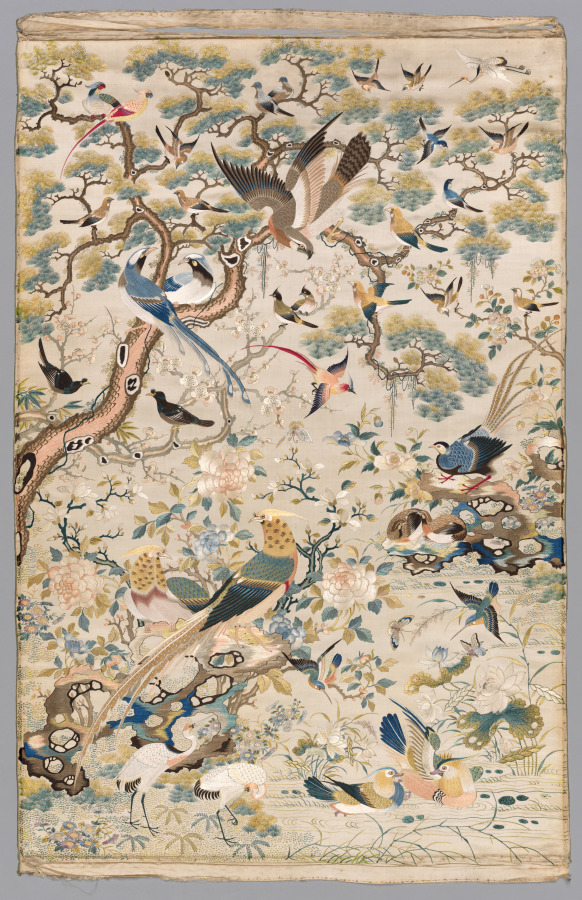
A Myriad of Birds: Material Memory and the Imperial Loom
In the hushed, measured world of Savile Row, where cloth is not merely purchased but *commissioned*, and where a bolt of fabric carries the weight of a century’s discretion, one rarely pauses to consider the provenance of the weave itself. Yet, within the Lauren Fashion Heritage Lab, we are tasked with precisely that: the forensic examination of materiality as a form of cultural biography. Our subject today, *A Myriad of Birds*, is a silk textile of exceptional provenance—a fragment of the imperial Chinese weaving legacy, reimagined through the lens of contemporary heritage. To handle this silk is to hold a whispered conversation with the past, a dialogue conducted in the language of warp and weft, of dyestuff and discipline.
The Materiality of Silk: A Conduit of Imperial Authority
Silk, as a material, is not a passive substrate. It is an active agent of memory. The sericulture that produced this particular thread—likely *Bombyx mori*, the mulberry silkworm—was a state secret of the Middle Kingdom for millennia. The imperial looms of Suzhou, Hangzhou, and Nanjing were not mere workshops; they were instruments of statecraft. Under the Qing dynasty, the Imperial Silk Works at Suzhou operated under the direct supervision of the court, producing textiles not for commerce but for the articulation of cosmic and political order. The very act of weaving was a ritualized performance, a microcosm of the celestial bureaucracy. Each thread, each knot, was a testament to the emperor’s mandate, the *Tianming*, which was believed to be woven into the fabric of existence itself.
In this context, *A Myriad of Birds* is more than a decorative pattern. It is a semiotic system. The motif—a dense, almost overwhelming proliferation of avian forms—draws upon a lexicon of auspicious symbolism. The crane, for instance, signifies longevity and immortality; the pheasant, beauty and good fortune; the magpie, joy and marital bliss; the mandarin duck, fidelity. To the imperial eye, this was not chaos but a calculated harmony, a visual prayer for a realm that was both fecund and orderly. The sheer density of the weave, the fineness of the thread count, and the precision of the registration between the warp and weft indicate a loom of extraordinary complexity—likely a drawloom operated by a team of skilled artisans, one of whom would have sat above the frame, pulling the pattern cords in a choreography that could take weeks to complete a single repeat. This is not industrial production; it is the pinnacle of artisanal intelligence.
From Imperial Court to Contemporary Cloth: A Translation of Legacy
Our artifact, however, is not a Qing-dynasty original. It is a contemporary re-weaving, a deliberate act of heritage revival. The Lauren Fashion Heritage Lab has collaborated with a select atelier in Hangzhou, one of the few remaining workshops that still operate a working drawloom. The decision to reproduce *A Myriad of Birds* was not taken lightly. It required the forensic analysis of an original fragment—likely from a court robe or a ceremonial hanging—followed by the painstaking reconstruction of the pattern draft. This is where the Savile Row sensibility becomes paramount. We do not deal in pastiche; we deal in *translation*. The original silk was woven in a palette of imperial yellow and deep azurite blue, colors reserved for the highest echelons of the court. Our version, however, has been re-cut in a more muted, contemplative palette: a soft ivory ground, with the birds rendered in a subtle gradation of dove grey, antique gold, and a whisper of celadon green.
This chromatic shift is not a dilution but a reinterpretation for a modern, global clientele. It acknowledges that the imperial context—the absolute power, the rigid hierarchy—is no longer our own. What remains is the *essence*: the discipline, the patience, the profound respect for material. The silk itself is a 16-momme crepe de chine, a weight that drapes with a liquid, almost ethereal quality, yet possesses the structural integrity required for a tailored garment. This is the crucial intersection of heritage and haberdashery. The fabric must not only tell a story; it must perform. It must hold a crease, fall from a shoulder, and move with the body in a manner that is both graceful and authoritative.
The Weave as a Form of Quiet Authority
Consider the hand of the cloth. Run your fingers across the surface, and you will feel the subtle topography of the weave—the slight relief of the bird motifs, the satin-stitch highlights that catch the light in a manner that is almost painterly. This is not a printed pattern; it is a woven one, meaning the design is integral to the structure of the fabric. It cannot be washed away, nor will it fade with wear. It is a permanent, three-dimensional assertion of craft. In the language of tailoring, this is the difference between a cheap imitation and a genuine article. A Savile Row cutter will tell you that the cloth is the first client. You must listen to it, understand its biases, its give, its memory. This silk, with its imperial lineage, demands a certain deference. It will not be rushed. It will not be forced into a silhouette that contradicts its nature.
The legacy of imperial silk weaving is, at its core, a legacy of *control*—control over nature (the silkworm), over labor (the weaver), and over meaning (the symbolism). Yet, in our contemporary appropriation, we have inverted that control. We are not subjugating the material to an imperial will; we are liberating it into a new context of personal expression. The wearer of a jacket or gown from *A Myriad of Birds* is not claiming imperial authority. Rather, they are claiming an affiliation with a tradition of excellence, a quiet confidence that does not need to shout. The birds, once a symbol of cosmic order, now become a personal talisman—a reminder that beauty, discipline, and patience are themselves forms of power.
In the final analysis, this silk artifact is a palimpsest. It bears the trace of its imperial origins, the skill of the anonymous artisans who first conceived it, and the deliberate choices of the contemporary weavers and designers who have brought it back to life. It is a material testament to the idea that heritage is not a static museum piece but a living, breathing dialogue. And in the rarefied air of a London tailoring house, where every seam is a promise, this fabric offers a singular proposition: to wear a myriad of birds is to carry a piece of the celestial loom upon your shoulders, a quiet, enduring statement of taste that transcends time.
Heritage Lab Insight
Lab Insight: CMA Silk Archive Node integration.