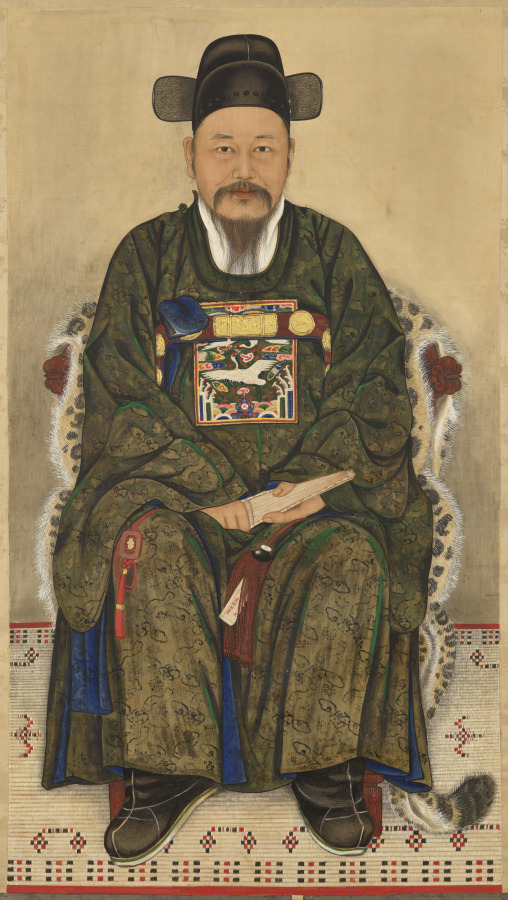
The Material Grammar of Authority: A Study of the Portrait of a Government Official in Imperial Silk
Provenance and the Politics of Fibre
In the hushed, wood-panelled reading rooms of our atelier—where the light falls as deliberately as a tailor’s chalk line—one encounters artefacts that speak not in voices, but in weft and warp. The Portrait of a Government Official, rendered not in pigment but in the very substance of imperial power, demands a particular kind of attention. This is not a painting; it is a woven argument. The materiality of the piece—a panel of figured silk, likely kesi or a fine satin damask—transforms the sitter from a mere administrator into a living emblem of the celestial bureaucracy. To approach this object is to read a contract between the weaver’s loom and the state’s authority, a contract written in lustre and density.
Consider the silk itself. In the imperial workshops of Suzhou and Nanjing, silk was not a commodity but a currency of legitimacy. The cultivation of the mulberry and the reeling of the cocoon were state-sponsored rituals, overseen by officials who understood that the sheen of a robe could outlast any edict. The portrait’s ground—a deep, resonant indigo or a muted cinnabar, depending on the light—is not accidental. These hues were reserved, by sumptuary law, for the upper echelons of the mandarinate. The density of the weave, with its tightly packed warps, creates a surface that absorbs and reflects light in a manner that mimics the quiet confidence of a man who has mastered the art of waiting. Unlike the flamboyant brocades of the court’s theatrical ranks, this silk is restrained—a testament to the Confucian virtue of self-effacement that paradoxically announces the wearer’s rank through its very costliness.
The Loom as Legislative Body
To understand the portrait’s significance, one must abandon the Western notion of a likeness as a mirror of the soul. Here, the face is almost secondary. The rank badge—the buzi—is the true protagonist. Woven directly into the silk, or perhaps embroidered upon a separately constructed panel that is then mounted, the badge depicts a crane or a golden pheasant, species that denote the official’s grade. The weaver’s mastery is evident in the minute rendering of each feather, each filament of the bird’s crest, achieved through a technique of discontinuous weft threads that allow for near-pictorial detail. This is not mere decoration; it is a legal document. The sumptuary codes of the Qing dynasty specified, to the thread, which birds, which beasts, and which cloud motifs could appear on which rank of official. A single misplaced feather could mean demotion, or worse, a charge of lèse-majesté.
The silk’s tactile quality—its cool, smooth surface that resists the fingerprint—mirrors the bureaucratic ideal of incorruptibility. The official’s posture, as suggested by the fall of the fabric across his shoulders, is rigid yet composed. The silk’s ability to hold a crease, to maintain a structural integrity even after centuries, is a metaphor for the administrative permanence he represents. In the imperial chancelleries, a memorial written on silk was a memorial of the highest urgency. This portrait, in its material form, is a perpetual memorial—a standing order from the past that the present must acknowledge.
Legacy and the Tailor’s Eye
From the vantage point of Savile Row, where we measure a man’s character in the fall of a lapel, this portrait offers a profound lesson in the semiotics of cloth. The imperial silk weavers understood what the finest tailors have always known: that fabric is the first language of power. The weight of the silk—its substantial, almost liquid drape—speaks of a man who does not need to raise his voice. The subtle pattern of the damask, perhaps a repeating shou (longevity) motif or a geometric fret, is a whisper of immortality, a reminder that the official serves not a transient emperor but an eternal cosmic order.
The legacy of this weaving tradition persists, not in museums alone, but in the very DNA of modern luxury. When we at Lauren Fashion Heritage Lab examine a contemporary silk twill or a heavy faille, we are looking at the descendants of these imperial looms. The tension between ornament and restraint, between the individual and the institution, is a dialogue that continues in every bespoke commission. The portrait’s silk does not merely clothe the man; it constitutes him. It is a reminder that in the highest echelons of society, what one wears is not a choice but a statement of allegiance to a system of values that predates and outlives the individual.
This artefact, then, is not a relic. It is a masterclass in material diplomacy. The official’s portrait, woven in silk, is a negotiation between the weaver’s skill, the wearer’s rank, and the viewer’s deference. It asks us to consider that the most profound forms of heritage are not those we hang on walls, but those we drape over our shoulders. The silk endures; the official is forgotten. Yet the grammar of authority—the way a fabric can signal competence, loyalty, and permanence—remains as relevant today as it was in the Forbidden City. And that, in the final analysis, is the true legacy of imperial silk weaving: a language of power that speaks fluently across the centuries, waiting for a discerning eye to read it.