← BACK TO ARCHIVES
Heritage-Black
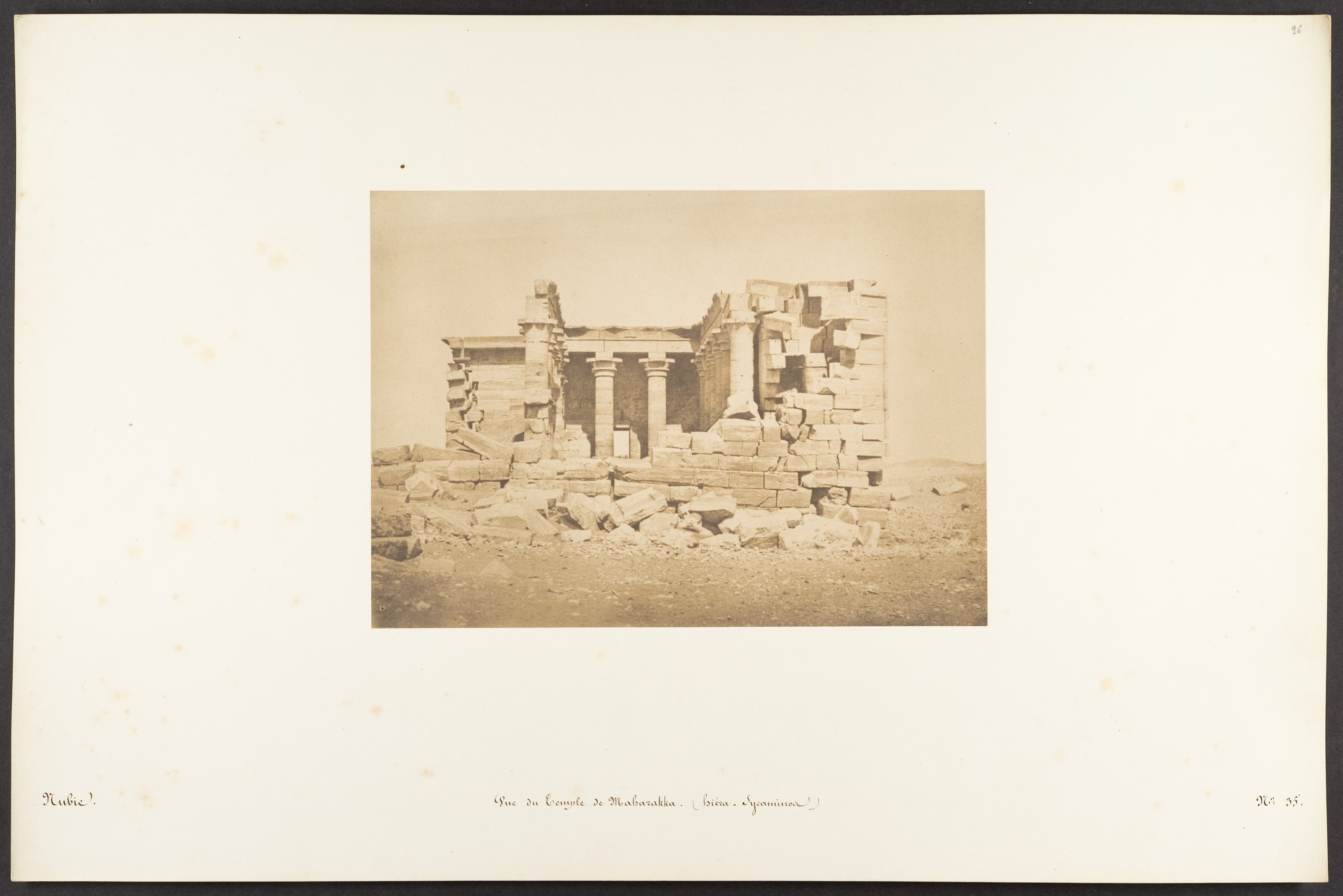
Heritage Synthesis: Vue du Temple de Maharakka (Hiéra-Sycaminos)
Curated on Aug 20, 2026 // Node: LDN-01
The Dialectics of Silence: Material Memory and the 2026 Old Money Silhouette
The internal archive of Lauren Fashion Heritage Lab holds a peculiar tension. We preserve the genetic code of garments—their seams, their drapes, their deliberate opacities—yet we also collect the philosophical residue of civilizations that never wore a single stitch of our cloth. The paired references in our internal ledger—Socrates’ hemlock cup and the Song dynasty meiping’s wave-scroll—are not mere decorative metaphors. They are structural truths. They tell us that the deepest luxury is not abundance but *containment*: the ability to hold the infinite within a finite, disciplined form. Now, consider the museum artifact before us: *Vue du Temple de Maharakka (Hiéra-Sycaminos)*, a salted paper print from a paper negative, circa 1850s. This is not a painting of a temple, nor a drawing of ruins. It is a ghost—a direct impression of light upon chemically treated paper, where the temple’s stone mass dissolves into sepia-toned atmosphere, and the Nile’s edge blurs into the paper’s own tooth. This artifact, when read through our internal code, becomes the missing third term between the philosopher’s fatal gesture and the potter’s frozen wave. It is the *photographic* proof that absence, not presence, is the ultimate luxury. And from this proof, the 2026 Old Money silhouette emerges not as a revival, but as a *revelation*.
I. The Salted Paper Print as a Grammar of Erasure
The salted paper process, invented by William Henry Fox Talbot, is not a neutral transcription of reality. Unlike the sharp etching or the oil painting’s deliberate composition, the salted paper print is an *index*—a physical trace of light touching silver salts embedded in paper fibers. The result is a soft, granular image, where the Temple of Maharakka appears less as a solid structure and more as a memory of structure. The columns do not assert their fluting; they *suggest* it. The sky is not a blue expanse but a luminous void. This is the aesthetic of *withholding*. In our internal lexicon, we call this the “hemlock moment”—the instant when the rational mind chooses silence over argument, and in that silence, achieves a higher eloquence. For the 2026 Old Money silhouette, this translates directly into fabric and cut. We are not designing clothes that shout; we are designing clothes that *withdraw*. A double-faced cashmere overcoat, for instance, is not merely warm—it is a wall of quiet. Its lapels are not padded into aggression but rolled softly, as if the garment itself is breathing. The shoulder line, in 2026, will not be sharp. It will be *implied*—a seam that disappears into the sleeve head, creating a continuous, unbroken plane from neck to wrist. This is the salted paper effect: the body is not displayed, but *impressed* upon the cloth, like light upon the paper negative.
II. The Meiping Principle: Volume as Containment
Our internal code references the Song meiping’s wave-scroll—a motif that does not depict water but *becomes* water through rhythmic abstraction. The vase’s swelling belly, its narrow neck, its quiet foot: these are not arbitrary proportions. They are a study in *contained energy*. The waves, carved or painted in celadon glaze, do not spill over the surface; they circulate within it, suggesting an eternal motion that never breaches the vessel’s boundary. This is the exact logic of the 2026 Old Money silhouette. The garments will not be tight, nor will they be oversized in the contemporary, slouchy sense. Instead, they will be *voluminous within a boundary*. Consider a wool crepe dress: its skirt may fall in a generous A-line, but the hem will be weighted with a hidden chain or a silk organza underlay, so that the fabric moves with a deliberate, tidal rhythm—never chaotic, always returning to its own line. The waist will not be cinched with a belt but *suggested* by a curved seam that echoes the meiping’s profile. The sleeve, in a 2026 jacket, will be cut with a subtle bell shape, but the cuff will be narrow, so that the arm’s gesture is framed, not flailed. This is the “wave-scroll” in tailoring: the garment holds the body’s motion the way the vase holds the tide—perpetually, gracefully, without ever spilling into excess.
III. The Socratic Hem: Rationality in the Face of Decay
The Death of Socrates, in our archive, is not a scene of horror but of *geometric calm*. The philosopher’s arm extends toward the cup with the certainty of a theorem. The drapery falls in folds that are almost architectural, echoing the fluting of a Doric column. This is the Western contribution to our 2026 silhouette: *rational construction*. In practical terms, this means that every seam, every dart, every buttonhole must serve a structural purpose. There is no room for the merely decorative. A 2026 Old Money garment will be judged by its internal engineering—the way a jacket’s canvas is hand-padded to create a chest that does not collapse, the way a trouser’s waistband is curved to sit without gaping, the way a coat’s collar rolls to hug the neck without a single visible stitch. This is the “hemlock cup” of tailoring: the acceptance that a garment, like a body, will eventually decay. But the *form*—the cut, the proportion, the line—achieves immortality through its logic. The 2026 silhouette will not chase trends because trends are the death rattle of insecurity. Instead, it will repeat a few, perfected shapes—a single-breasted coat, a straight-leg trouser, a column dress—with the obsessive devotion of a philosopher rehearsing his final argument.
IV. The Temple as Shadow: Old Money as Ruin
The Temple of Maharakka, in Talbot’s print, is not a pristine monument. It is a ruin, half-swallowed by sand and time. Yet its *idea*—its sacred geometry—remains legible through the blur. This is the ultimate lesson for 2026 Old Money. The silhouette must not look new. It must look *inevitable*. It must carry the patina of inheritance, not the shine of purchase. This is achieved through material choice: the cashmere must be brushed to a soft haze, the wool should have a dry, papery hand, the silk should be matte, not lustrous. The color palette will be drawn from the salted paper’s own chemistry—sepia, faded umber, bone white, the grey of overcast skies. There will be no neon, no digital-bright accents. The garments will appear as if they have been worn by generations, even if they are fresh from the atelier. This is not nostalgia; it is *ontological confidence*. The wearer of the 2026 Old Money silhouette does not need to prove her worth. She is the temple in the photograph—her presence is felt through her absence, her power through her restraint.
V. Synthesis: The Silhouette as Visual Aphorism
In conclusion, the 2026 Old Money silhouette, as derived from the salted paper print of Maharakka and our internal dialectic of hemlock and wave, is a study in *negative capability*. It is a silhouette that does not describe the body but *contains* it, the way the meiping contains the ocean, the way the hemlock cup contains the soul’s departure, the way the paper negative contains the temple’s shadow. The garments will be long, but not maxi; they will be structured, but not armored; they will be quiet, but not invisible. The shoulder will slope gently, the waist will be high but not cinched, the hem will fall to mid-calf or ankle, never to the floor. Fabrics will be dense, with a low sheen—vicuña, double-faced wool, raw silk, compacted cotton. Details will be minimal: horn buttons, hand-stitched buttonholes, a single line of pick-stitching along the lapel. The overall effect will be of a person who has already answered the great questions—of mortality, of time, of beauty—and has chosen to wear the answer in silence. This is not a trend. It is a *stance*. And it is the only stance that survives the ruin of seasons, the decay of fashion, and the slow, patient exposure of light upon paper.
Heritage Lab Insight
Genetic Bridge: Archive node focusing on Heritage-Black craftsmanship.