← BACK TO ARCHIVES
Heritage-Black
Heritage Synthesis: Terracotta fragment of a kylix (drinking cup)
Curated on Aug 20, 2026 // Node: LDN-01
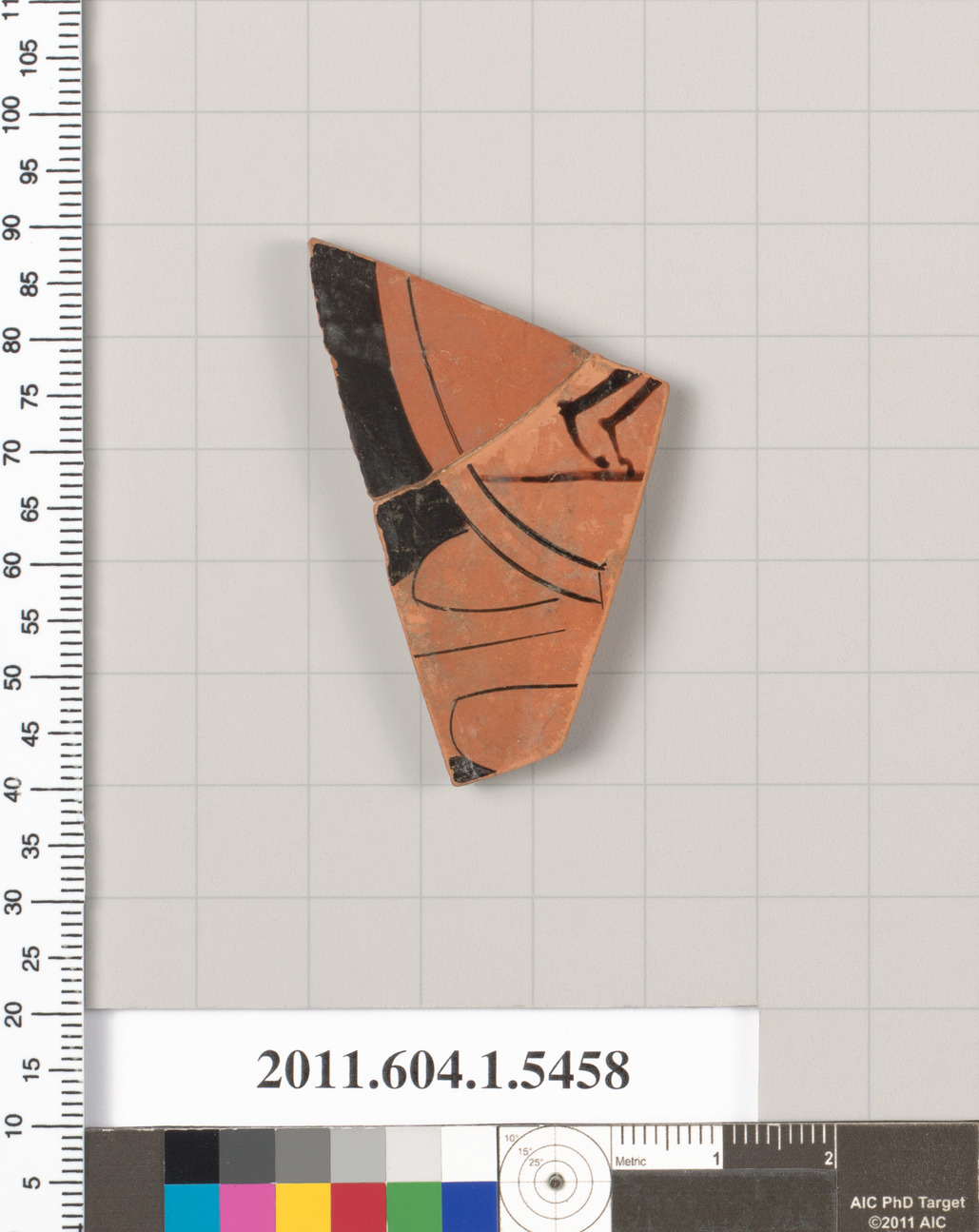
The Absent Blossom: Terracotta Fragmentation and the 2026 Old Money Silhouette
The internal archive of Lauren Fashion Heritage Lab preserves a peculiar object: a moss-green wooden plaque from a Kyoto temple, inscribed with the characters “优昙华” (Udonge), or “Udumbara Flowers.” Gilded in the *maki-e* tradition, the calligraphy appears as ink soaked by night rain, faintly luminous within the gloom. Its profound irony lies not in ornamental splendor but in its silent reference to a form that refers to nothing—the Udumbara, a mythical flower said to bloom once every three millennia, yet which has never verifiably existed. The plaque is a signifier of absence, a vessel for a name without a referent. It is, in the strictest sense, a monument to nothing.
Now, consider the museum artifact before us: a terracotta fragment of an Attic kylix, a Greek drinking cup from the classical era. Broken, chipped, its painted surface eroded to a whisper of its former figuration, this shard is not a complete vessel but a relic of one. It does not hold wine; it holds time. It does not depict a complete myth; it suggests one through lacunae. The kylix fragment and the Kyoto plaque are, on the surface, separated by millennia and geography. Yet both operate on the same aesthetic principle: they derive their power not from what they present, but from what they withhold. The plaque withholds the flower; the fragment withholds the cup. Both compel the viewer to complete the form internally, to project wholeness onto brokenness, and to find beauty in the space of absence.
This dialectic of presence and absence, of materiality and void, is the precise conceptual foundation for the 2026 Old Money silhouette. The prevailing interpretation of “Old Money” style—quiet luxury, understated tailoring, the suppression of logos—is often reduced to a matter of fabric weight or seam allowance. But a deeper reading, informed by these artifacts, reveals that the true luxury of the Old Money aesthetic is not in the garment’s physical completeness but in its deliberate, structural incompleteness. It is a fashion of the fragment, a sartorial architecture of the unseen.
The Kylix Fragment as a Tailoring Principle
The Attic kylix, in its original form, was a vessel of communal ritual—the symposium, where wine was mixed, diluted, and shared. Its broad, shallow bowl and twin handles facilitated a social, almost democratic, act of drinking. The terracotta fragment we possess, however, has lost its handles, its rim, and most of its painted tondo. What remains is a curve, a contour, a suggestion of volume. The 2026 Old Money silhouette must be understood through this lens of the *partial form*. It is not about constructing a garment that is visibly incomplete, but about designing a garment whose *presence* is defined by what it does not reveal.
In practice, this translates to a radical reduction in structural articulation. The 2026 silhouette rejects the aggressive shoulder padding and cinched waists of power dressing. Instead, it embraces the *draped fragment*—a jacket cut with a single, continuous seam that falls from the shoulder without interruption, mimicking the unbroken curve of the kylix’s surviving wall. Trousers are cut with a subtle, almost imperceptible taper, not to conform to the leg but to suggest a column of fabric that has been sheared from a larger whole. The hem of a coat is left raw, not as a signifier of grunge, but as a deliberate acknowledgment of the cut—a visible trace of the moment the fabric was separated from its bolt, akin to the fractured edge of the terracotta. This is not deconstruction in the 1990s sense of exposed seams and fraying; it is *archaeological construction*, where the garment is designed to look as though it has been excavated from a state of wholeness, bearing the dignified scars of time.
The Udonge Principle: Designing for the Invisible
If the kylix fragment informs the *cut* of the 2026 silhouette, the Udonge plaque informs its *materiality*. The plaque’s power lies in its refusal to depict the flower; it merely names it. Similarly, the 2026 Old Money garment must refuse to display its own luxury. The fabric must be chosen not for its obvious luster but for its *internal density*—a wool that feels heavier than it looks, a cashmere whose softness is only perceptible upon touch, a silk that absorbs light rather than reflecting it. This is the “Udonge Principle”: the luxury is present but invisible, awaiting a moment of intimate contact to reveal itself.
For the 2026 silhouette, this manifests in a palette and texture derived directly from the terracotta’s oxidized surface. We are not speaking of a literal clay color, but of a tonal range that echoes the fragment’s weathered patina: the deep umbers of aged iron, the chalky off-whites of dried lime, the muted ochres of sun-baked earth. These are not “neutral” colors in the conventional sense; they are *archaeological* colors, hues that carry the memory of a surface that has been exposed to centuries of light and air. The fabric itself should feel like a fragment—a piece of a larger, unseen textile that has been cut away and preserved. The weave should be irregular, the finish matte, the drape heavy and still. This is the opposite of the tech-fabric, high-performance luxury of the past decade. It is a luxury of *stasis*, of a garment that moves only when its wearer moves, and which otherwise holds its shape like a shard of pottery resting in a vitrine.
The Hunt and the Suspension of Desire
The internal archive also references Piero della Francesca’s *The Hunt*, a Renaissance masterpiece where medieval hunters and hounds are frozen in a crystalline moment of arrested motion. Francesca’s genius was not in narrating the chase but in suspending it, converting kinetic energy into geometric order. The 2026 Old Money silhouette borrows this principle of *suspended intention*. The garments are not designed for action; they are designed for the *pause before action*. A blazer is cut with enough ease to allow movement, but its shoulder line is set slightly back, creating a posture of contemplation rather than aggression. A skirt falls to a length that suggests modesty but is cut with a subtle asymmetry that implies a hidden dynamism—a hint of the leg that will never be fully revealed. The wearer of the 2026 silhouette is not a hunter pursuing a goal; they are a figure in a fresco, existing in a state of perfect, poised stillness.
This is where the terracotta fragment and the Udonge plaque converge with *The Hunt*. All three artifacts reject the literal in favor of the allusive. The kylix fragment does not show us the symposium; it shows us the aftermath, the broken vessel that once held the wine. The plaque does not show us the flower; it shows us the name of the flower, a placeholder for a miracle. *The Hunt* does not show us the kill; it shows us the eternal moment of the chase, forever unresolved. The 2026 Old Money silhouette, therefore, is not a garment of achievement but a garment of *potential*. It is worn by an individual who has nothing to prove, whose status is so secure that it can be expressed through absence. The absence of logos, the absence of bright colors, the absence of tight fits—these are not negations but affirmations of a deeper, more internalized form of wealth.
Conclusion: The Garment as a Reliquary
In the end, the 2026 Old Money silhouette, informed by the terracotta fragment and the Udonge plaque, becomes a kind of reliquary—a vessel designed to hold something that is not there. The garment is the container; the absent content is the wearer’s history, their lineage, their unspoken power. Just as the faithful gaze upon the Udonge plaque and imagine the flower that will bloom in three thousand years, so the observer of the 2026 silhouette must imagine the life of the wearer—a life of inherited grace, of quiet confidence, of resources so vast they need not be displayed. The beauty of this fashion lies not in its visible form but in its capacity to generate an internal, invisible bloom. It is a fashion of the fragment, the pause, and the name without a referent. It is, in the truest sense, a heritage of the void.
Heritage Lab Insight
Genetic Bridge: Archive node focusing on Heritage-Black craftsmanship.