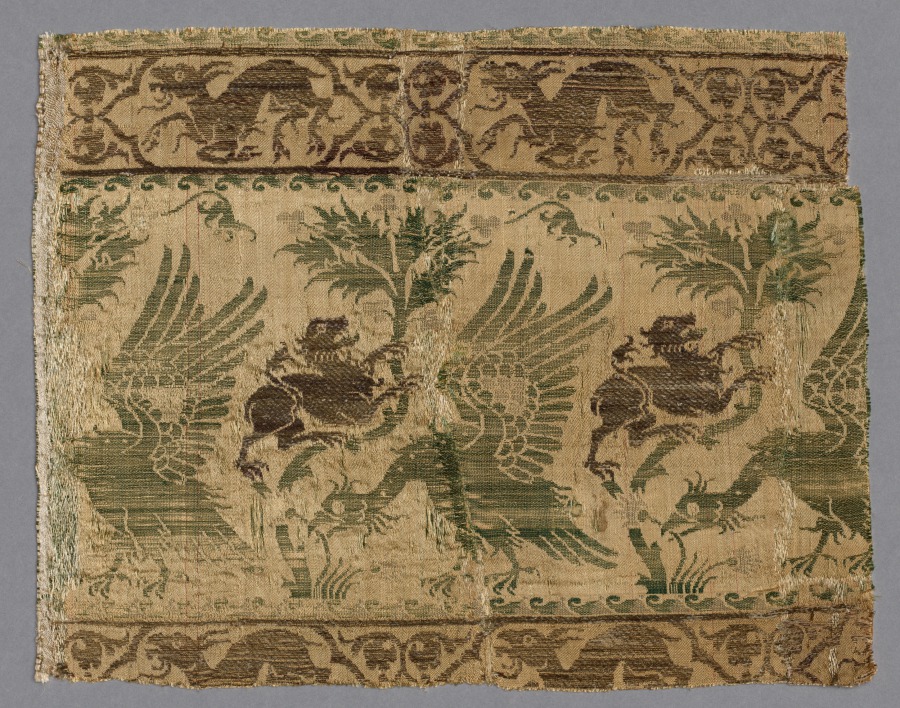
The Golden Thread: Materiality and Imperial Legacy in Silk Weaving
I. The Substance of Sovereignty
In the hushed ateliers of London’s Savile Row, where the cut of a sleeve is debated with the gravity of a treaty, there exists a quiet reverence for the cloth itself. Among the wools and cottons, one material commands a particular, almost sacerdotal, deference: silk. Not merely silk, but the silk-and-gold textile—a composite of lustrous protein filament and drawn precious metal. This is not a fabric; it is a document of power, a physical manifesto of imperial ambition. Its materiality is not incidental but essential, encoding within its warp and weft the entire political economy of the empires that produced it.
To understand this textile is to understand that silk was never merely a commodity. It was, from its earliest dynastic Chinese origins, a form of currency, a diplomatic tool, and a divine insignia. The addition of gold—whether as flat, gilded leather strips (the *orfroi* of medieval Europe) or as a fine, drawn wire wrapped around a silk core—elevated the fabric from luxury to theocratic statement. The gold did not simply decorate the silk; it transformed its physical properties. The resulting cloth was heavier, stiffer, and imbued with a metallic sheen that caught candlelight in a way that mimicked the divine radiance of a monarch’s aura. The weight of the gold made the fabric drape with a solemn, architectural gravity, compelling the wearer to move with deliberate, ceremonial pace. It was a textile engineered for the throne, not the street.
II. The Imperial Loom: Structure as Statecraft
The legacy of imperial silk weaving is fundamentally a legacy of technological monopoly and artisanal secrecy. From the Tang dynasty’s workshops in Chang’an to the Safavid looms of Isfahan and the grand *Manufacture des Gobelins* under Louis XIV, the production of silk-and-gold cloth was a state-sponsored enterprise. The looms themselves were not mere furniture; they were complex mechanisms, often requiring two weavers operating in tandem, one above and one below, to manage the intricate drawloom system that allowed for the creation of repeating, large-scale patterns. These patterns—the pomegranate, the pinecone, the cloud scroll, the imperial dragon—were not arbitrary. They were iconographic ciphers, legible only to the initiated, that proclaimed the sovereign’s cosmic mandate.
Consider the technical feat of the *lampas* weave, a structure that dominated imperial silks from the 12th century onward. Here, the ground weave and the pattern weave are distinct, allowing for a dense, compound structure where the gold thread floats on the surface, creating a raised, almost sculptural relief. The materiality of this structure is crucial: the gold is not woven under tension but laid on top, meaning it is vulnerable to abrasion. This fragility was a deliberate paradox. The cloth was too precious to wear daily; its very impermanence underscored its exclusivity. It was a ceremonial armour, worn for the coronation, the state wedding, the diplomatic audience—moments when the empire was performing itself. The physical difficulty of producing such cloth—the months of labour, the astronomical cost of gold leaf, the risk of a single broken warp thread ruining an entire bolt—meant that its presence was a guarantee of absolute political centrality. If you wore this, you were not merely wealthy; you were the state.
III. The Gold Thread as Global Currency
The silk-and-gold textile was also a vector of globalisation, long before the term existed. The Silk Road was not a single route but a network of arteries, and the gold thread was its most potent lifeblood. When the Mongols sacked Baghdad in 1258, they did not simply destroy a city; they dispersed its weavers, who carried their technical knowledge of gold-thread production to Anatolia and Persia. Later, the Ottoman Empire’s *Bursa* workshops became the epicentre of a new aesthetic, producing velvets with gold-wrapped cores that were so dense they were colloquially called *seraser*—"the king of silks." These textiles were not exported as mere goods; they were imperial gifts, sent to Venice, to the Mughal court, to the Tsar of Russia, as physical embodiments of Ottoman suzerainty.
The European response was one of emulation and economic warfare. In the 17th century, French and Italian weavers, having mastered the technical challenge of producing fine gold thread, began to undercut Ottoman imports. But the materiality of the European product differed subtly. The Italian *seta e oro* used a thinner, more flexible gold strip, allowing for softer, more fluid drapery—a reflection of the Baroque aesthetic of movement and excess. The Ottoman cloth remained stiffer, more hieratic. Thus, the material itself became a marker of cultural identity. You could identify a textile’s imperial origin not just by its pattern but by the very *hand* of the cloth—its weight, its drape, its acoustic rustle. The gold content was not merely decorative; it was a fingerprint.
IV. The Decay and the Dilemma of Conservation
For the modern heritage specialist, the silk-and-gold textile presents a profound conservation paradox. The silk protein is hygroscopic, absorbing moisture and becoming brittle over time. The gold, while chemically inert in its metallic form, is often alloyed with silver or copper, which tarnishes and corrodes, staining the surrounding silk with dark, irreversible oxides. The very weight of the gold that once signified imperial might now threatens the structural integrity of the object. A 16th-century Persian saddle cover, resplendent with gold-wrapped threads, may now be too fragile to be displayed upright; it must be stored flat, in darkness, at a controlled 18°C and 50% relative humidity.
This decay is not merely a technical problem; it is a philosophical challenge. We are asked to preserve an object whose original meaning was predicated on its ephemeral brilliance, its status as a fleeting, costly spectacle. To freeze it in a museum case is to betray its function. Yet to allow it to crumble is to lose a primary source of imperial history. The heritage practice, therefore, becomes an act of translation. We cannot replicate the experience of a Safavid courtier seeing this cloth by torchlight, but we can analyse the twist of the gold thread, the density of the weave, the chemical composition of the dye. We can read the materiality as a text, decoding the labour, the technology, and the political ambition that produced it.
V. The Savile Row Continuum
Why, then, does this imperial legacy resonate on Savile Row? Because the bespoke tailoring tradition is itself a descendant of the court atelier. The master cutter, like the imperial weaver, operates with a monopoly of skill. The cloth is chosen not for its brand but for its provenance and performance. When a contemporary client commissions a dinner jacket in a silk-and-gold brocade, they are not merely buying a garment; they are purchasing a condensed history of sovereignty. The weight of the fabric, the way it holds a crease, the subtle shimmer under artificial light—these are the same physical properties that once declared a monarch’s divine right.
The legacy of imperial silk weaving is thus not a relic. It is a living standard. It teaches us that true luxury is not about abundance but about scarcity of skill, the deliberate difficulty of creation, and the material’s capacity to encode meaning. The gold thread may have lost its political power, but it retains its cultural authority. In a world of fast fashion and synthetic imitations, the silk-and-gold textile stands as a testament to the fact that cloth can be more than a covering. It can be a constitution, written in filament and metal, enduring long after the empires that wove it have turned to dust.
As we handle these fragments in the archive, we are not merely conservators. We are interpreters of a lost language, one where the twist of a thread spoke of conquest, and the gleam of gold was the promise of eternity. The materiality of silk and gold is, in the end, the materiality of power itself—heavy, fragile, and utterly unforgettable.