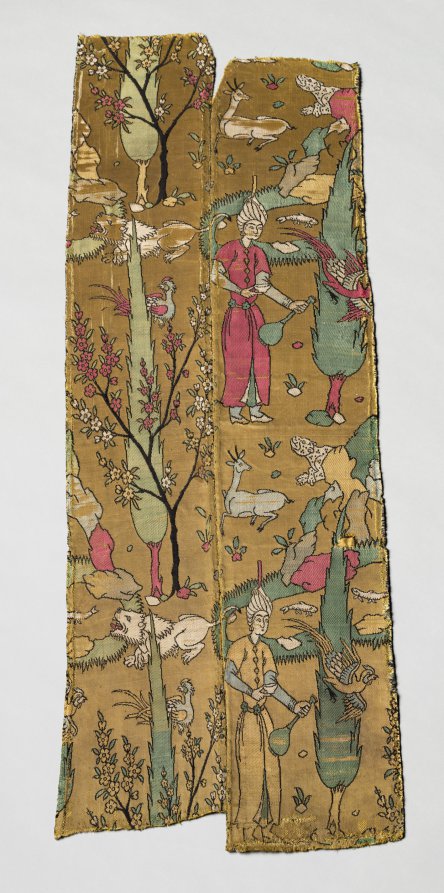
Category: Silk
The Wine Bearers in Landscape: A Study in Imperial Silk and the Architecture of Restraint
In the hushed ateliers of London’s Savile Row, where cloth is treated with the reverence of scripture and the precision of engineering, one learns to read fabric not merely as material, but as memory. The robe fragment before us—a panel of imperial silk bearing the motif of wine bearers traversing a stylised landscape—is not a garment. It is a document. It is a ledger of dynastic power, of agronomic tribute, and of the singular, almost occult mastery of the loom that defined China’s celestial courts. To handle this silk is to handle the residue of an empire’s breath.
Let us first establish the materiality. The ground weave is a tabby, but do not mistake simplicity for modesty. This is a silk of the highest order, likely a *kesi* or, more probably, a fine *satin damask* with supplementary weft floats that create a subtle, three-dimensional relief. The fibre itself is mulberry silk (*Bombyx mori*), reeled from cocoons nurtured in the temperate provinces of Zhejiang or Jiangsu. The thread count is formidable—upwards of 120 ends per centimetre—producing a surface that is at once glassy and tactile, a paradox that only the finest degumming and throwing can achieve. The dyes are mineral and vegetal: indigo for the verdant hills, madder and lac for the cinnabar robes of the bearers, and orpiment for the golden vessels they carry. The colour palette is not decorative; it is cosmological. The blue-green of the landscape speaks to the east, the direction of spring and renewal; the red of the bearers’ attire signifies rank, fire, and the southern quadrant of the celestial mandate.
The Motif as Political Cartography
The iconography—wine bearers in a landscape—is a masterclass in encoded diplomacy. At first glance, the scene is pastoral: two figures, their postures bowed in ceremonial deference, carry amphorae-like vessels across a terrain of cloud-scrolls and pine-studded crags. But this is not a genre scene. In the context of imperial weaving, the wine bearer is a tributary envoy. The vessels they carry are not for personal consumption; they are *li*—ritual wine, fermented from millet or rice, intended for ancestral offerings. The landscape is not a garden; it is the *tianxia*, the "all-under-Heaven," a microcosm of the emperor’s dominion. The figures’ placement within this terrain—neither central nor marginal, but deliberately transitional—signals the flow of tribute from periphery to centre. The wine is the tax; the landscape is the empire; the silk is the contract.
This particular fragment, likely from a *chaofu* (court robe) or a *mangfu* (python robe) of the mid-Qing dynasty, circa 1750–1820, demonstrates a mature phase of imperial weaving. The earlier Ming dynasty silks were bolder, more geometric. Here, we see the influence of the Jesuit-influenced court painters—the subtle shading of the rocks, the atmospheric perspective of the distant peaks. Yet the execution remains rigorously native. The weaver has translated painterly softness into the unforgiving grammar of the loom, using discontinuous wefts to create gradations of tone that mimic ink wash. This is not imitation; it is appropriation. The Qing court absorbed foreign technique and reasserted its own visual sovereignty.
The Loom as Political Instrument
To understand the legacy of imperial silk weaving, one must understand the infrastructure of the *Jiangnan* weaving bureaus, particularly those in Nanjing, Suzhou, and Hangzhou. These were not mere workshops; they were state-run manufactories employing thousands of artisans, overseen by eunuch directors answerable only to the throne. The looms themselves—the *huaji* (drawloom) and the *yaohua* (pattern loom)—required two operatives: a weaver below and a "drawboy" above who pulled the heddles according to a complex pattern cord. The pattern for a single robe could require tens of thousands of cords, each representing a single warp thread. A mistake of one cord would ruin the entire bolt. The margin for error was zero.
This technical severity is the silent partner in the robe’s aesthetic. The wine bearers’ faces, for instance, are rendered with a minimum of detail—two dots for eyes, a single line for the mouth—yet they convey a gravity that is almost unsettling. This is not a failure of artistry; it is a deliberate economy. The weaver knew that the silk’s sheen would catch the candlelight in a court audience, and that the shadows would animate the faces. The robe was designed for motion, for the flicker of torchlight on lacquered floors, for the slow, deliberate turns of a body in ritual. It was not meant to be scrutinised in a vitrine. It was meant to be worn, and worn only by those who had earned the right to carry the empire’s weight on their shoulders.
Material Legacy and the Modern Eye
For the contemporary connoisseur, this fragment offers a lesson in the discipline of restraint. In an age of fast fashion and digital printing, the wine bearers’ robe stands as a rebuke to the superficial. Every thread is a decision. Every colour is a statement of cosmic order. The silk itself, after two centuries, retains a suppleness that modern machine-made fabrics rarely achieve—a testament to the protein structure of the fibre and the gentle, acid-free storage conditions of its imperial custodians.
But there is a deeper resonance for those of us in the heritage trade. This robe is not merely an object of beauty; it is a system of knowledge. The weavers who created it were not artists in the Romantic sense. They were technicians of memory, encoding dynastic legitimacy into a wearable form. When we conserve such a piece, we are not preserving a garment. We are preserving a language—a language of power, of tribute, of the sacred relationship between the land and the loom. The wine bearers walk their landscape forever, carrying their vessels toward an altar we can no longer see. But we can still read their footsteps in the warp and weft. And that, in the end, is the true legacy of imperial silk: not the cloth, but the code.
In the fitting rooms of Mayfair, we speak of drape, of fall, of the way a shoulder seam sits. But the wine bearers’ robe teaches us a more profound lesson: that a garment can hold a civilisation. It is a privilege to study it, and a responsibility to speak of it with the precision it demands.