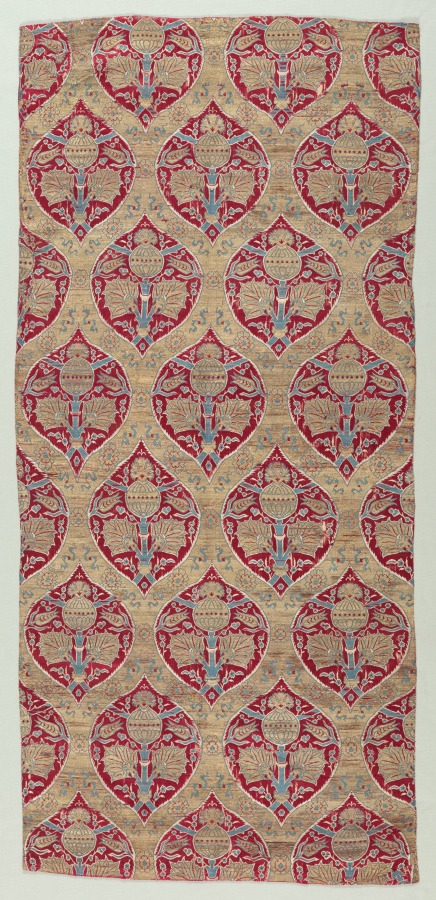
Heritage Research Artifact: The Ogival Lattice with Horizontal Design
Category: Silk
In the hushed ateliers of London’s Savile Row, where tradition is measured not in seasons but in generations, there exists a quiet reverence for the fabric that underpins the finest tailoring. Silk, in its purest form, is not merely a textile; it is a chronicle of empire, a testament to human ingenuity, and a material conversation between East and West. This artifact—the ogival lattice with horizontal design—represents a singular, yet profoundly significant, chapter in that chronicle. It is a pattern that speaks of imperial silk weaving’s zenith, a design language born of courtly grandeur, yet refined for the discerning modern clientele who understand that true luxury is a matter of heritage, not noise.
The ogival lattice, at its core, is a study in architectural precision. Derived from the Islamic and Byzantine traditions, the ogive—a pointed, S-curved arch—forms the primary structural motif. When repeated and mirrored, these arches intersect to create a latticework of diamond and almond-shaped compartments. The genius of this particular iteration, however, lies in its horizontal orientation. Rather than allowing the lattice to ascend vertically, drawing the eye upward in a gesture of ecclesiastical or palatial grandeur, the design is deliberately flattened. The eye is encouraged to travel laterally, across the width of the cloth, creating a sense of grounded stability and understated authority. This is not the fabric of a throne room; it is the fabric of a boardroom, a private club, a gentleman’s study.
The Materiality of Imperial Silk
To understand the artifact, one must first understand its medium. The silk used in this weaving is not the mass-produced, mercerised filament of modern industry. It is the imperial silk—the long, continuous filament drawn from the cocoon of the Bombyx mori silkworm, cultivated with a meticulousness that borders on the sacred. In the imperial workshops of the Ming and Qing dynasties, and later in the great European silk mills of Lyon and Spitalfields, this filament was graded for its lustre, its tensile strength, and its uniformity. The finest grades, reserved for the Emperor’s robes or the ceremonial vestments of the Church, were woven with a density that imparted a remarkable body and a subtle, liquid sheen. When light strikes the surface of this silk, it does not reflect harshly; it is absorbed and re-emitted in a soft, pearlescent glow. This is the materiality of power—a power that whispers rather than shouts.
The horizontal design, in this context, is a masterstroke of restraint. In the imperial lexicon, verticality often signified aspiration, divinity, and the celestial mandate. The horizontal, conversely, denoted the terrestrial, the ordered, and the enduring. By orienting the ogival lattice horizontally, the weaver has grounded the divine geometry. The pattern becomes a metaphor for the imperial bureaucracy—a vast, interconnected system of governance, where each node (the intersection of the ogives) supports the next, creating a fabric of unassailable stability. The compartments formed within the lattice are not empty; they are often filled with subsidiary motifs—clouds, dragons, or floral sprigs—each carrying its own symbolic weight. In this artifact, we might find within the ogives a repeating pattern of the shou (longevity) character or a stylised lotus, reinforcing the message of enduring prosperity.
Weaving as a Discipline of Patience
The technical execution of this pattern on a drawloom was a feat of extraordinary skill. The weaver, often working from a complex point paper pattern, would manipulate hundreds of individual warp threads, each controlled by a separate heddle or a system of cords. The horizontal emphasis required a particular mastery of the weft. To achieve the crisp, unbroken lines of the lattice, the weft threads—the horizontal elements—had to be packed with exceptional density and evenness. A single lapse in tension, a single mis-thrown shuttle, would result in a distortion that would compromise the entire cloth. This was not a task for the impatient. It was a discipline of patience, a meditation in motion, where the rhythm of the loom mirrored the rhythm of the imperial court—slow, deliberate, and utterly assured.
It is this legacy that the Lauren Fashion Heritage Lab seeks to preserve. We do not view this artifact as a relic to be entombed in a glass case. Rather, we see it as a living template for contemporary design. The ogival lattice with horizontal design offers a profound lesson in proportion and balance. In an era of fast fashion and disposable trends, it reminds us that true elegance is found in geometry, in the relationship between positive and negative space, and in the integrity of the material itself.
From Imperial Court to Savile Row
The journey of this pattern from the imperial looms of the East to the cutting tables of Savile Row is a narrative of cultural exchange. In the 17th and 18th centuries, European merchants and missionaries brought samples of these Chinese silks back to the West. The aristocracy, captivated by their exoticism and technical perfection, commissioned local weavers to replicate them. The great silk-weaving centres of Lyon rose to the challenge, adapting the ogival lattice to European tastes, often pairing it with baroque flourishes or rococo asymmetry. Yet, the pure, horizontal iteration—the one that retains its imperial discipline—remains a rarity. It is a piece that demands a certain confidence from its wearer. It is not a pattern that seeks attention; it is a pattern that commands respect.
For the modern gentleman, a jacket or a tie crafted from this silk is a statement of connoisseurship. It signals an understanding that luxury is not about logos or ostentation, but about the quiet, unspoken language of quality. The horizontal lattice, when cut on the bias, can create a subtle, flattering drape. When used in a lining, it offers a private pleasure—a hidden flourish of impeccable taste that only the wearer and his tailor will appreciate. The weight of the silk, its density, and its lustre all contribute to a garment that feels substantial, that drapes with a certain gravitas, and that will, with proper care, outlast a dozen lesser garments.
In conclusion, this heritage research artifact is more than a pattern. It is a synthesis of art, mathematics, and imperial power, rendered in the most noble of fibres. The ogival lattice with horizontal design is a testament to the enduring dialogue between structure and ornament, between East and West, and between the past and the present. At the Lauren Fashion Heritage Lab, we are committed to decoding this language, to understanding the hands that wove it, and to ensuring that its principles of balance, discipline, and material integrity continue to inform the future of fine tailoring. This is not merely preservation; this is a continuation of a legacy, woven thread by thread.