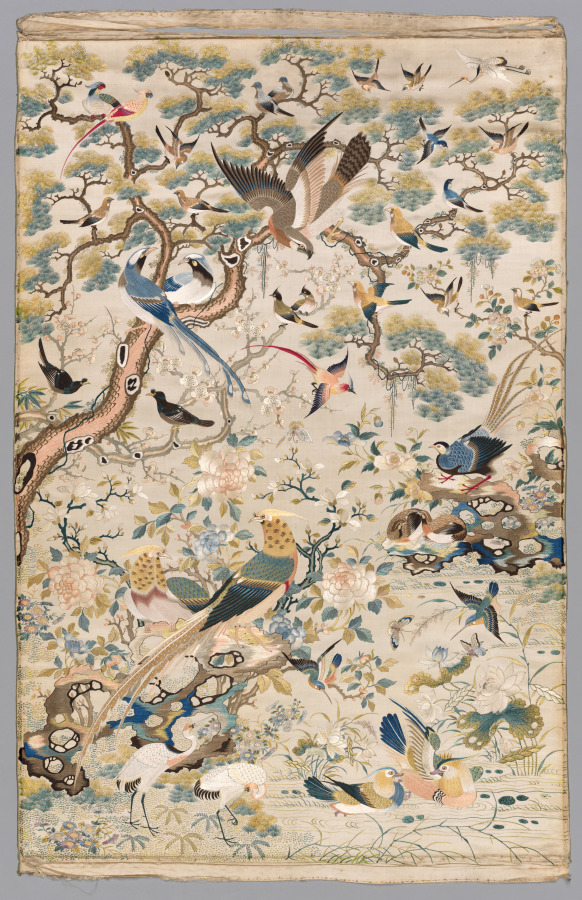
A Myriad of Birds: Materiality and the Imperial Echo in Silk
I. The Weight of a Feather: An Introduction to Imperial Silk
To speak of silk in the context of imperial weaving is not to speak of fabric, but of frozen lightning. The material itself—a continuous filament drawn from the cocoon of the *Bombyx mori*—carries a lineage that predates empire, yet it was empire that perfected its tyranny. When we examine a panel of silk bearing the motif of "A Myriad of Birds," we are not merely observing an ornithological study. We are reading a political document, a meteorological chart of dynastic favour, and a testament to the absolute mastery of the hand over nature. The Savile Row eye, accustomed to discerning the drape of a worsted or the resilience of a tweed, must recalibrate when confronted with this material. Silk does not drape; it *flows*. It does not resist; it *acquiesces*. Yet within that acquiescence lies an immense, silent power—the power to encode meaning in every warp and weft.
The legacy of imperial silk weaving is not a gentle heritage; it is a monumental discipline. From the looms of Suzhou to the ateliers of the Forbidden City, the production of silk was a state secret, guarded with the ferocity of a crown jewel. The mulberry tree, the silkworm, the reeling of the thread—each step was a ritualised act of devotion to the Emperor, who was, in turn, the Son of Heaven. To wear this silk was to wear the heavens themselves, woven into a tangible, tactile form. The "Myriad of Birds" motif, therefore, is not a whimsical flourish. It is a hierarchical cosmology, a feathered bureaucracy where each bird holds a rank, a meaning, and a place within the celestial order.
II. The Ornithology of Power: Decoding the Motif
In the imperial lexicon, birds were not mere fauna; they were emissaries of virtue. The crane, with its snow-white plumage, signified longevity and immortality, often reserved for the highest echelons of the court. The pheasant, resplendent in its iridescent hues, represented literary brilliance and refinement. The mandarin duck, a symbol of conjugal fidelity, was a quieter, more intimate emblem, yet still bound to the Confucian order of harmony. When we speak of "A Myriad of Birds," we are invoking a plenitude of blessings—a wish for the empire to be as numerous and as varied as the avian host, yet always under the unifying canopy of the sovereign.
The materiality of silk amplifies this symbolism. Unlike cotton or wool, which possess a certain democratic grain, silk possesses a chameleonic lustre that shifts with the light and the angle of the viewer. A bird woven in silk is never static; it appears to flutter, to preen, to take flight as the wearer moves. This is not accidental. The imperial weavers understood that power is performative. The Emperor’s presence was meant to be felt as a dazzling, disorienting force, and the silk’s play of light—its ability to reveal a hidden thread of gold or a subtle change in hue—was a deliberate strategy of awe. The bird motif, rendered in this medium, becomes a living thing, a perpetual reminder of the vitality and omnipresence of the throne.
Furthermore, the technical execution of the weave is paramount. The finest imperial silks were not printed but woven with discontinuous wefts, a technique known as *kesi* or "cut silk." This method allows for the creation of intricate, pictorial details with sharp, clean edges, as if the bird has been painted with a needle. The result is a tactile bas-relief—the bird’s eye, its beak, the delicate barbs of its feathers—all raised slightly from the ground fabric. This is not a flat representation; it is a sculptural one. The hand that passes over this silk feels the topography of the design, a silent conversation between the wearer and the artisan who, centuries ago, dedicated months to a single panel. This is the apotheosis of craftsmanship, where patience is not a virtue but a requirement of the medium.
III. The Savile Row Perspective: Tailoring the Celestial
From the vantage of Savile Row, we understand that cloth is the first line of a garment’s argument. A suit is not merely stitched; it is architected. When we consider incorporating an imperial silk of this nature into a contemporary piece, we must approach it with the reverence of a restorer, not the bravado of a designer. The silk is the protagonist; the tailoring must be its humble servant. A structured, padded shoulder would be an affront to the material’s fluidity. Instead, one would opt for a soft, unstructured shoulder, a natural sleeve, and a silhouette that allows the fabric to move as it was intended—with a liquid, unhurried grace.
The challenge lies in the juxtaposition of epochs. How does one bring a relic of imperial grandeur into the modern, pragmatic world of a London gentleman? The answer is in the restraint. A panel of "A Myriad of Birds" silk might be used as a lining for a dinner jacket, a secret flourish revealed only when the jacket is removed. Or it could be crafted into a smoking jacket, a garment of profound leisure, where the opulence of the fabric is appropriate to the intimacy of the setting. The bird motif, in this context, becomes a private indulgence, a whispered reference to a world of absolute authority, rather than a public declaration. This is the essence of quiet luxury—the knowledge that the most powerful statements are often those that are not immediately visible.
Moreover, the legacy of imperial silk demands a certain ethical and historical responsibility. We are not merely handling a commodity; we are handling a fragment of a civilisation’s soul. The artisan’s skill, the emperor’s patronage, the cultural significance of the crane and the pheasant—all of this is embedded in the thread. To cut into this silk is to make a decision of immense consequence. The tailor must act as a custodian of memory, ensuring that the garment honours the source material, that the construction does not compromise the integrity of the weave, and that the final piece serves as a bridge between the imperial past and the discerning present.
IV. Conclusion: The Eternal Flight
In the end, "A Myriad of Birds" in silk is more than a pattern; it is a philosophy of permanence. The birds have flown across centuries, their wings woven in threads that have outlived dynasties, revolutions, and the very empires that commissioned them. The silk remains, a testament to the idea that true luxury is not ephemeral but transcendent. For the modern connoisseur, to wear such a piece is to participate in that transcendence, to carry a fragment of the celestial court into the mundane world. It is a statement not of fashion, but of lineage. And in that lineage, the birds continue their eternal flight, forever myriad, forever in motion, forever caught in the luminous, unbreakable thread of imperial silk.