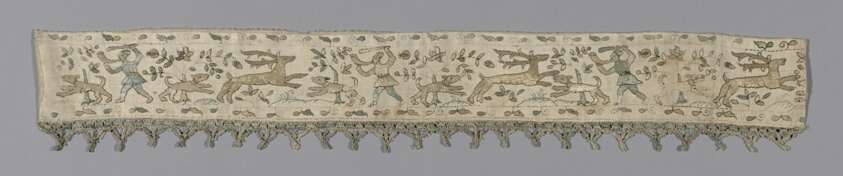
On the Articulation of a Boundary: A Treatise on the Linen & Silk Border Artifact
The consideration of sartorial heritage demands a rigorous examination of those elements which serve not merely as ornament, but as definitive statements of structure and intent. Among these, the border stands preeminent. It is the precise articulation of a boundary, the moment where the field of the garment concludes and a realm of deliberate complexity commences. The artifact under review—a border executed in plain weave linen, elaborately embroidered with silk thread—presents a formidable case study in this principle. It exemplifies not a mere edge, but a cultivated frontier, where the robust integrity of linen engages in a sophisticated dialogue with the fluid elegance of silk craftsmanship. The result is a statement of quiet authority, a perimeter that commands respect through understatement and technical mastery.
Material Foundations: The Linen Ground
Any analysis must begin with the foundation. The selection of a plain weave linen is, in itself, a declaration of principle. Linen, derived from the flax plant, possesses a singular character: it is crisp, durable, and possesses a noble austerity. Its tendency to hold a sharp crease and its subdued, matte lustre provide a ground of impeccable stability. The plain weave—the most fundamental of interlacings—eschews frivolity. It is the textile equivalent of a perfectly prepared canvas or a flawlessly tailored chalk stripe; its virtue lies in its integrity, offering a stable and unforgiving surface upon which further narrative may be inscribed. This is the Savile Row ethos applied to ground cloth: structure, longevity, and a quiet confidence that requires no external validation.
The Silk Inscription: A Grammar of Stitches
Upon this authoritative ground, the narrative of silk is deployed. Silk, in contrast, is the essence of fluid elegance—possessing a inherent luminosity and a pliability that speaks of movement and grace. The craftsmanship here is not one of broad gesture, but of meticulous, grammatical precision. The employment of back stitch, double running, and split stitch constitutes the core syntax. These are the stitches of definition, creating clear, unwavering lines and contours. They are the tailored seams of the embroidery world, ensuring that every motif is sharply delineated, its form communicated with absolute clarity.
Beyond this linear grammar lies a more nuanced vocabulary. The overcast stitch and couching work to modulate texture and secure broader passages, akin to the careful padding of a jacket shoulder to achieve a specific silhouette. The French knots, however, are the definitive flourish—the functional equivalent of a perfectly knotted silk tie or a pocket square arranged with studied nonchalance. They introduce a controlled pointillism, a tactile punctuation that catches the light and the eye without ever descending into mere decoration. Each stitch type is deployed with strategic intent, contributing to a holistic composition where technique remains in service of the overall aesthetic statement.
The Final Perimeter: Bobbin Lace as Concluding Argument
The resolution of the border is achieved through its finishing: an edging of silk and linen bobbin lace. This element is of critical importance. Bobbin lace, with its origins in meticulous handwork, represents a pinnacle of textile engineering. Its creation is a slow, deliberate process of building structure thread by thread. To edge the embroidered linen with such a material is to provide a final, incontrovertible argument for the border’s significance. It is no raw hem, but a fully realized, three-dimensional terminus. The combination of silk and linen in the lace itself echoes the primary material dialogue, ensuring a complete compositional unity. This lace is the bespoke buttonhole, the hand-rolled edge—a detail that, to the untrained eye, may seem subtle, but which to the connoisseur speaks volumes about the artifact’s provenance and the maker’s commitment to a fully resolved conception.
Context and Concluding Remarks: Fluid Elegance Defined
Contextually, this artifact resides at the intersection of classic silk craftsmanship and the overarching ideal of fluid elegance. The elegance achieved here is not that of the fluttering gown, but rather the fluidity of thought and execution. It is the seamless flow from one technical discipline to another—from the weaving of the ground, through the illustrative embroidery, to the architectural lace—that creates a profound sense of cohesion. The border becomes a self-contained world of expertise, a microcosm of textile art.
In conclusion, this linen and silk border artifact transcends its functional role as an edge. It is a scholarly dissertation on the nature of boundaries themselves. It demonstrates that a true border is not a barrier, but a site of concentrated value and meaning. It employs the austere language of linen and the eloquent dialect of silk to articulate a perimeter that is both definitive and enriching. The plain weave provides the sober suit of armour; the silk embroidery, the eloquent speech of its inhabitant; the bobbin lace, the impeccable manners that frame the entire encounter. It stands as a testament to the principle that true elegance, in heritage as in tailoring, is ultimately an exercise in disciplined intelligence and authoritative restraint.