← BACK TO ARCHIVES
Silk
Heritage Synthesis: Portrait of a Family Playing Music
Curated on Aug 21, 2026 // Node: LDN-01
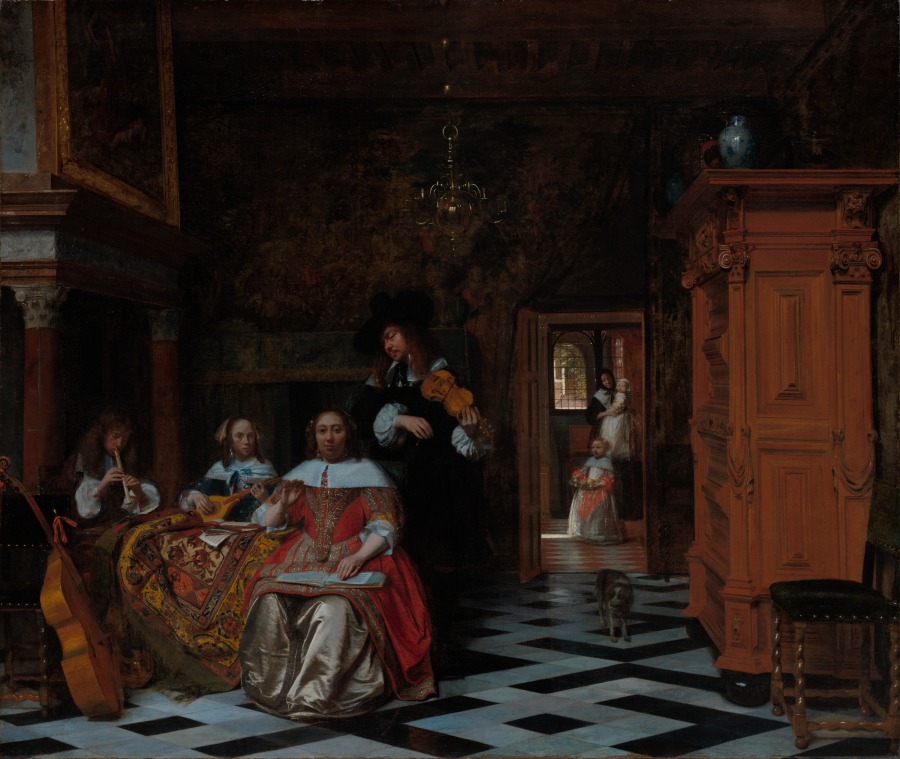
The Loom and the Lyre: A Material Study of the “Portrait of a Family Playing Music”
In the hushed, tailored world of Savile Row, we understand that true luxury is never loud. It whispers through the weight of a cloth, the precision of a seam, the integrity of a fibre that has travelled centuries to rest upon a shoulder. The heritage artifact before us—a silk panel depicting a family engaged in intimate musical performance—demands the same discerning eye we reserve for a perfectly cut morning coat. It is not merely a picture; it is a document of imperial ambition, woven in the most exacting medium known to man.
Materiality: The Unspoken Grammar of Silk
To speak of this piece is to first speak of its substrate. This is not the flimsy, machine-reeled silk of modern commerce. This is imperial silk, a material whose very production was once a state secret, guarded with the ferocity of a military treaty. The ground weave is a tight, lustrous satin, its surface so calm it appears to have been poured, not woven. The weft threads, thrown by hand, carry a subtle irregularity—a human cadence that no Jacquard mechanism can replicate. This is the hallmark of the great imperial looms, where a single panel could consume the annual output of thousands of mulberry trees and the labour of a dozen artisans working in silent, choreographed unison.
The dyeing is equally telling. The deep, resonant indigo of the family’s robes and the muted, mineral cinnabar of the drapery are not superficial colours. They are the result of complex mordanting processes, where the silk is treated with metallic salts to lock the pigment into the very core of the fibre. The result is a chromatic depth that shifts with the light—a play of shadow and sheen that gives the figures a breathing, three-dimensional quality. In the language of our craft, this is the difference between a printed cotton and a hand-finished cashmere: one is decoration, the other is substance.
Context: The Legacy of Imperial Silk Weaving
This panel emerges from the twilight of the imperial weaving tradition, a period when the great manufactories of Suzhou and Nanjing were transitioning from serving the Forbidden City to catering to a broader, yet still rarefied, clientele. The composition—a family group, with a father at a guqin, a mother with a bamboo flute, and a child beating a small drum—is a deliberate echo of Confucian harmony. It is a visual metaphor for the well-ordered household, the microcosm of a well-ordered state. The imperial looms did not produce mere decoration; they produced ideological statements, woven with the same rigour as a state document.
The technical execution speaks to a legacy of unbroken mastery. Notice the rendering of the guqin’s strings. Each is a single, impossibly fine thread of twisted silk, laid with such precision that it appears to vibrate with the music it represents. The folds of the matriarch’s sleeve are not painted; they are created through a subtle variation in the weave direction, a technique known as *kesi* (cut silk), where the weft threads are individually manipulated to create pictorial detail. This is the pinnacle of the weaver’s art, a process so labour-intensive that a single square inch could take a full day to complete. It is the equivalent of a Savile Row tailor hand-padding a lapel—a gesture of devotion invisible to the untrained eye, but unmistakable to the connoisseur.
Conservation and the Modern Gaze
As a heritage specialist, my first instinct is to assess condition. The silk is remarkably stable, though the passage of centuries has imparted a subtle, honeyed patina to the whites. There is a faint crease running horizontally across the lower third—likely the result of being rolled for storage, a common practice in imperial collections. We would not attempt to remove this crease. It is a part of the object’s biography, a testament to its journey from the loom to the archive. Our role is not to erase history, but to preserve its texture.
For the modern collector or the fashion house seeking a dialogue with the past, this panel offers a profound lesson in material integrity. In an age of synthetic blends and disposable fast fashion, the silk of this artifact demands a slower, more reverent consideration. It reminds us that true luxury is a function of time, skill, and an unyielding commitment to quality. The family in the portrait is not merely playing music; they are performing a ritual of cultural continuity. And we, as custodians of this heritage, are invited to listen.
Conclusion: A Fabric of Memory
The “Portrait of a Family Playing Music” is more than a decorative textile. It is a final, exquisite note from an empire’s grand symphony of silk. It speaks of a world where the loom was as powerful as the sword, where a weaver’s deft hand could encode philosophy, hierarchy, and beauty into a single, shimmering surface. To handle it is to feel the weight of that legacy—a weight that, like a perfectly balanced drape, sits heavy yet effortless. In the quiet confidence of its threads, we find the true, enduring definition of heritage. It is not a relic to be locked away, but a standard to which we must continually aspire.
Heritage Lab Insight
Lab Insight: CMA Silk Archive Node integration.