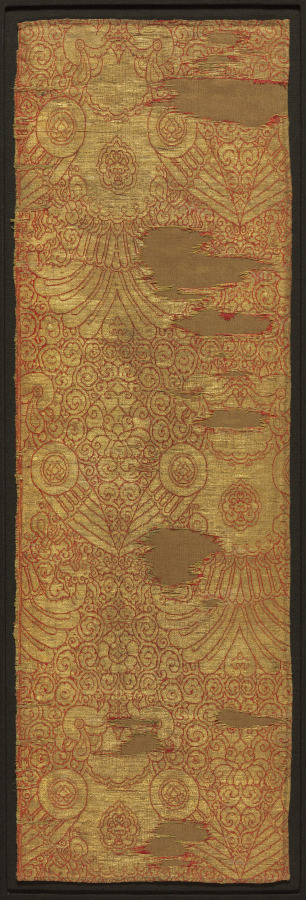
The Gilded Thread: Materiality and Majesty in the Cloth of Gold
Introduction: A Legacy Woven in Light
In the hushed ateliers of London’s Savile Row, where tailoring is a liturgy and cloth is scripture, one encounters a material that transcends mere textile. The Cloth of Gold, specifically its iteration featuring displayed falcons, is not simply a fabric; it is a declarative statement of power, a frozen moment of imperial ambition, and a testament to the unrivalled mastery of silk weaving. To handle such a piece is to touch the very sinews of history, to feel the weight of crowns and the tension of courtly intrigue. This artifact, rendered in lustrous silk and precious metal, represents the apogee of a craft that has, for millennia, been the exclusive language of sovereignty. Our examination begins not with the loom, but with the raw material itself—the filament that binds empire to artistry.
Materiality: The Sovereign Silk
Silk is the foundational element of this masterpiece. Unlike wool or linen, silk possesses a unique optical property—a prismatic lustre that shifts with the light, mimicking the iridescence of a falcon’s plumage. For the imperial weavers of the Byzantine and later Ottoman and Safavid courts, silk was not a commodity; it was a diplomatic weapon. The monopoly on sericulture, guarded fiercely from the 6th century onward, ensured that silk remained scarcer than gold in many European courts. Yet, in this artifact, silk is not the sole protagonist. The term “Cloth of Gold” denotes a weave where the weft is entirely composed of gilded silver or gold thread—often a thin strip of metal wound around a silk core. The result is a fabric that is astonishingly heavy, with a stiff, sculptural drape that does not flow but rather *commands*. On Savile Row, we understand that drape is destiny; a cloth that cannot move with grace is a failure. But this cloth is different. Its rigidity is its virtue. It is designed to hold its form, to project a silhouette of unyielding authority, much like the ceremonial armour of a knight or the vestments of a high priest.
The Motif: Displayed Falcons and the Semiotics of Power
The specific pattern—displayed falcons—is a heraldic device of profound significance. In falconry, the bird of prey is a symbol of the hunt, of control over the natural world, and of the noble’s right to wage war. When depicted *displayed* (with wings spread wide and legs splayed), the falcon becomes an emblem of dominion, its form expanding to fill the available space, asserting its presence. In the context of imperial silk, this motif is not merely decorative. It is a coded message. The falcon is often shown with a crown or a sceptre, or clutching an orb, directly associating the bird with the emperor’s own divine mandate. The repetition of the motif across the fabric’s surface creates a rhythm, a visual chant of sovereignty. Each falcon is a sentinel, guarding the wearer against the chaos of the mundane. The weaver’s skill is evident in the precision of the bird’s anatomy—the sharp curve of the beak, the meticulous rendering of individual feathers, each one a separate pass of the shuttle. This is not mass production; this is a meditation in thread, requiring months, sometimes years, to complete a single bolt.
The Legacy of Imperial Silk Weaving
To understand this artifact, one must trace the lineage of imperial silk weaving. From the Tang Dynasty’s cosmopolitan workshops to the Byzantine *gynaecea* (imperial weaving houses), the craft was a state secret. The weavers were not artisans in the modern sense; they were operatives of the crown, bound by oath and often confined to their workshops. The technical innovations—the drawloom, the complex patterning mechanisms—were guarded as closely as military intelligence. The legacy is one of continuous refinement. The Byzantine weavers perfected the art of the *samite*, a twill weave that allowed for intricate, curvilinear designs. The Islamic courts of Persia and Anatolia later introduced the *lampas* weave, which enabled a greater density of metallic thread, producing a cloth of even more dazzling brilliance. Our artifact, with its bold falcon motif and dense gold weft, sits squarely within this tradition. It is a synthesis of centuries of technical evolution, a culmination of the weaver’s relentless pursuit of the perfect interplay between light, metal, and silk.
Conservation and the Tailor’s Eye
From a conservation perspective, the Cloth of Gold presents a formidable challenge. The metallic threads are prone to tarnishing and embrittlement, while the silk core can suffer from light damage and hydrolysis. The weight of the gold itself can cause stress fractures in the silk over time. A curator must handle such a piece with the same reverence a Savile Row cutter applies to a rare bolt of vicuña—knowing that every fold, every crease, is a historical record. The garment’s construction is equally telling. The seams are often flat-felled, designed to reduce bulk, while the internal structure may include stiff canvas interlinings to support the heavy cloth. The cut is architectural, favouring broad shoulders and a full skirt, creating a triangular silhouette that amplifies the wearer’s physical presence. This is not tailoring for comfort; it is tailoring for theatre, for the grand stage of the imperial court.
Conclusion: A Living Relic
The Cloth of Gold with displayed falcons is more than a museum piece. It is a dialogue between the past and the present, a reminder that the pursuit of excellence in material and craft is a timeless endeavour. For the modern designer or the discerning client, it offers a provocative counterpoint to the casualisation of contemporary dress. It whispers of a time when clothing was a statement of identity, a declaration of one’s place in the cosmic order. As we at Lauren Fashion Heritage Lab preserve and study such artifacts, we are not merely cataloguing the past; we are mining it for the principles that still govern true luxury—rarity, skill, and the unshakeable confidence that comes from wearing something that cannot be replicated. The falcon, wings spread in eternal flight, remains a potent symbol: a reminder that true power is not loud, but woven, thread by gilded thread, into the very fabric of being.