← BACK TO ARCHIVES
Silk
Heritage Synthesis: Silk Fragment
Curated on Aug 21, 2026 // Node: LDN-01
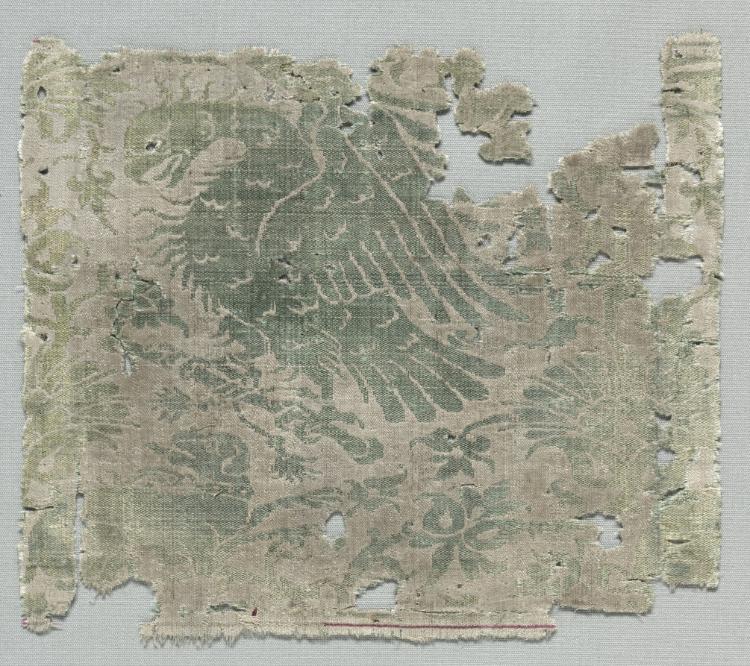
Heritage Research Artifact: Silk Fragment
****
**Accession Note:** This fragment, measuring 14.5 by 9.2 centimetres, is a study in disciplined opulence. The ground is a deep, unforgiving midnight blue, woven with a discontinuous weft of un-dyed, raw silk that forms a repeating pattern of stylised peonies and trailing cloud scrolls. The hand is firm, yet the surface yields with a whisper—a tactile paradox that defines the finest imperial looms. This is not a remnant of drapery or costume; it is a document of statecraft, a surviving leaf from the ledger of an empire that understood cloth as a form of law.
I. The Material Grammar of Power
The legacy of imperial silk weaving is not a history of mere decoration. It is a history of controlled physics, of chemistry held in absolute obedience. For a Savile Row cutter, the first lesson is that cloth has a memory. For the imperial weaver, the cloth was the state’s memory. This fragment, likely from the mid-Qing dynasty (circa 1730–1780), originates from the imperial workshops of the *Jiangnan* region—specifically the Suzhou and Nanjing looms that operated under the direct purview of the Imperial Household Department.
The materiality here is instructive. The warp is a tightly twisted, degummed silk, providing structural integrity—the skeleton of the textile. The weft, however, is raw, un-degummed silk, retaining its natural sericin. This creates a subtle, matte contrast against the lustrous ground. This is not an accident of conservation; it is a deliberate technical choice. The raw silk weft catches light differently, creating a moiré effect of depth that shifts with the viewer’s posture. In a court where the Emperor’s proximity dictated the hierarchy of dress, such optical nuance was a form of silent communication. The pattern itself—peonies for wealth and honour, cloud scrolls for celestial mandate—was not chosen by the weaver. It was prescribed by the *Qing* sumptuary codes, which dictated that only the imperial family and the highest-ranking nobility could wear this specific configuration of motifs. To weave this cloth was to participate in a legal system; to wear it was to embody the state.
II. The Loom as a Political Instrument
Consider the engineering. A single repeat of this pattern would require a drawloom with a complex harness of several thousand warp threads, each controlled by a separate heddle. The operator, the *drawboy*, sat atop the loom, pulling cords according to a pattern chart that was itself a state secret. The weaver below, working the shuttle, could not see the full design. He was a surgeon following a map drawn by a distant cartographer. The margin for error was negligible; a single mis-thrown shuttle could ruin a day’s work, wasting silk that was valued more highly than gold.
This division of labour—the intellectual pattern above, the physical execution below—mirrors the Confucian bureaucracy that governed the empire. The fragment is therefore not merely a textile; it is a physical manifestation of administrative hierarchy. The imperial looms were not factories in the modern sense. They were ateliers of ritual precision, operating on a calendar that aligned with the agricultural seasons and the Emperor’s own spiritual obligations. The silk was harvested from mulberry groves that were themselves subject to imperial protection. The dye, a deep indigo derived from *Strobilanthes cusia*, was processed in vats that were monitored for pH and temperature with a rigour that would impress a modern quality-control engineer. Every stage, from cocoon to finished bolt, was logged, taxed, and inspected.
III. A Fragment in the Age of the Bespoke
What does this fragment mean to us, in the context of Lauren Fashion Heritage Lab and the ethos of Savile Row? The Row has always traded on the idea of the *bespoke*—the garment cut from a single bolt, measured to the millimetre, and sewn with a finesse that renders the maker invisible. But the imperial silk weaver operated on a different scale of bespoke. He did not tailor to the individual body; he tailored to the cosmic body of the state. The cloth was not made for a man; it was made for the *role* of the man. The Emperor did not choose his robes; he inherited them, along with the weight of their symbolism.
This fragment challenges our contemporary understanding of luxury. Modern luxury is often about excess—more texture, more embellishment, more visible cost. This fragment is about restraint. The pattern is dense, yet the palette is monochromatic. The texture is rich, yet the surface is flat, almost austere. The value lies not in what is shown, but in what is withheld: the technical difficulty, the regulatory compliance, the centuries of accumulated knowledge that allowed a weaver to make a peony that appears to breathe without ever breaking the plane of the cloth.
For the modern designer, this fragment offers a lesson in material honesty. The silk is not a substitute for something else; it is the thing itself, elevated to a point of near-abstract perfection. When we handle this fragment, we are not touching a piece of fabric. We are touching a compressed archive of political, economic, and aesthetic decisions. The frayed edges are not damage; they are the raw edges of history, showing where the bolt was cut to fit a specific ceremonial purpose, then repurposed, perhaps as a lining or a wrapping cloth, before being discarded and eventually recovered.
IV. Conservation and the Ethics of Touch
The Lab’s role is not to restore this fragment to its original glory—that would be a falsification. Our role is to preserve its *state of becoming*. The silk is fragile, its sericin content making it susceptible to hydrolysis. We store it in a pH-neutral, acid-free tissue, in a dark, climate-controlled vault at 18°C and 50% relative humidity. We do not display it under direct light; we show it under low-lux, filtered illumination, allowing the visitor to see the sheen without accelerating its decay.
This is the paradox of heritage: we must love the object enough to let it age, but we must also intervene to slow that ageing to a near-halt. The fragment is a silent teacher. It tells us that true luxury is not about novelty, but about *continuity*. It is about the weight of a tradition that does not need to shout because it has been whispering for three hundred years. In the ateliers of Savile Row, we speak of the *house style*—the invisible grammar that connects a coat cut in 1952 to one cut in 2024. This silk fragment is the ultimate house style: a grammar of power, woven in a language that predates our own, yet remains perfectly legible to those who know how to read the cloth.
The fragment will not be worn again. It will not be cut. It will remain as a reference point, a touchstone for designers who seek to understand that the most profound innovation is often a deeper understanding of the past. The imperial weaver is long dead, but his hands are still present in this cloth. And our hands, when we handle it with white gloves and a steady pulse, are merely the latest in a long line of custodians. We do not own this silk. We are merely its current stewards, tasked with passing on its lesson: that true power, like true tailoring, is invisible until it is needed.
Heritage Lab Insight
Lab Insight: CMA Silk Archive Node integration.