← BACK TO ARCHIVES
Silk
Heritage Synthesis: Alhambra Palace Silk Curtain
Curated on Aug 22, 2026 // Node: LDN-01
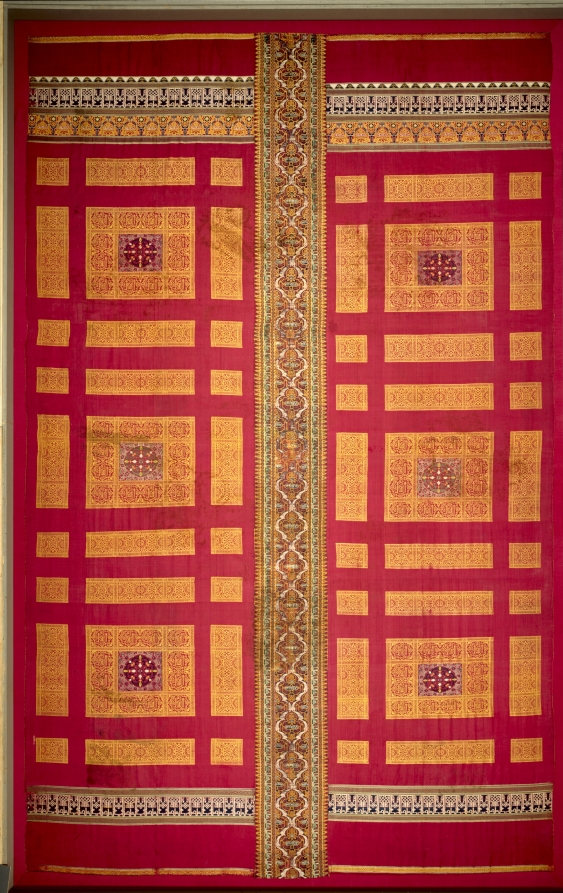
The Alhambra Palace Silk Curtain: A Study in Imperial Threads
In the hushed, tailored world of Savile Row, where cloth is not merely fabric but biography, the Alhambra Palace Silk Curtain occupies a singular position. It is not a garment, yet it speaks the same language of drape, weight, and finish. It is an artifact of imperial ambition, a testament to the fact that the loom, like the needle, is an instrument of power. To examine this curtain is to read a ledger of conquest, trade, and the relentless pursuit of beauty—a pursuit that the Row understands intimately, for we, too, deal in the legacy of threads.
Materiality: The Unyielding Softness of Silk
The curtain’s materiality is its primary argument. Silk, in its raw state, is a filament of extraordinary tensile strength—stronger than steel at equivalent diameter. Yet, when woven, it yields a surface of liquid, mercurial light. This paradox—unyielding strength rendered as supple luxury—is the very essence of imperial aesthetics. The Alhambra curtain, likely a compound weave of warp-faced silk, would have been constructed on a drawloom, a device that required two operatives: one to manipulate the pattern cords, the other to throw the shuttle. This was not a cottage industry; it was a proto-industrial operation, often housed within royal manufactories.
The specific weight and handle of the silk suggest a *taffeta* or *lampas* construction. A lampas weave, with its ground warp and pattern weft, allows for intricate, polychromatic designs without sacrificing structural integrity. The curtain would have possessed a certain *crispness*, a rustle—what the French call *craquant*—that signified newness and prestige. Over centuries, this crispness would have softened into a gentle, almost melancholic fluidity, but the original intent was clear: this was a material designed to command a room, to catch the light from strategically placed candelabra, and to move with the gravity of state ceremony.
Context: The Imperial Silk Road, Woven Westward
The Alhambra, a Nasrid dynasty fortress-palace in Granada, reached its zenith in the 13th and 14th centuries. This was not a period of isolated Spanish splendor; it was the high-water mark of Mediterranean exchange. Silk, originating in China, had traveled westward along the Silk Road for millennia, but by the 14th century, the Islamic world—from Persia to Al-Andalus—had become the undisputed master of its production and design. The Alhambra curtain is not a Chinese artifact; it is a Hispano-Islamic one, a hybrid of technical mastery and localized aesthetic.
The legacy of imperial silk weaving here is twofold. First, there is the legacy of the *tiraz*—royal textile workshops that produced fabrics inscribed with the ruler’s name, titles, and blessings. These were not mere decorations; they were diplomatic gifts, symbols of sovereignty, and forms of currency. A curtain from the Alhambra, bearing the Nasrid motto *“Wa la ghaliba illa Allah”* (“There is no victor but God”), would have been a woven declaration of divine right. Second, there is the legacy of technical transfer. When the Christian Reconquista culminated in 1492, the looms of Granada did not fall silent. Instead, they were repurposed, and the Mudéjar artisans—Muslims under Christian rule—continued to produce silk of extraordinary quality. This continuity is crucial: the imperial legacy is not a clean break but a palimpsest, with each regime overwriting the previous while retaining the underlying threads.
The Curtain as a Political Instrument
From a Savile Row perspective, we understand that a garment—or a curtain—is never neutral. It is a tool of negotiation. The Alhambra curtain would have functioned as a spatial boundary, separating the public *Mexuar* (council chamber) from the private *Harem* or the throne room. Its sheer scale—likely several meters in height and width—would have created a theatrical reveal. When the curtain was drawn, the sovereign appeared; when closed, he vanished into the realm of the unseen. This choreography of concealment and disclosure is the same psychology that underpins a well-cut overcoat: it hides the body’s imperfections while projecting an idealized silhouette.
The color palette is equally telling. Surviving fragments and contemporary accounts suggest a dominance of deep crimson, gold, and lapis blue. Crimson, derived from kermes or cochineal, was the color of power and martyrdom; gold, the metal of the divine; blue, the hue of the heavens. This was not a domestic textile. It was a piece of statecraft, designed to overwhelm ambassadors and courtiers with the sensory weight of the empire.
Legacy: From Alhambra to the Modern Loom
The curtain’s legacy extends far beyond its physical fragments. When the Alhambra fell to the Catholic Monarchs, the silk industry of Granada was reorganized under Christian guilds, but the *technique* remained Islamic. This is the quiet, persistent legacy of imperial weaving: the conqueror adopts the tools of the conquered. By the 16th century, Spanish silks—particularly those from Toledo and Granada—were coveted across Europe, worn by the Habsburgs and the Tudor court. The Alhambra curtain, in its original form, had become obsolete, but its DNA—the drawloom technology, the compound weave, the geometric arabesques—was now woven into the very fabric of European luxury.
For the modern heritage specialist, the Alhambra curtain is a cautionary tale about the fragility of material culture. Silk is proteinaceous; it degrades with light, humidity, and time. What survives today is often in fragments, preserved in museum collections like the Victoria and Albert Museum or the Hispanic Society of America. Yet, in its ruin, it retains its authority. It reminds us that imperial power is not only expressed in stone and steel but in the soft, perishable medium of woven thread.
Conclusion: The Tailor’s Final Word
On Savile Row, we are taught that a suit is a promise—a promise of fit, of longevity, of taste. The Alhambra Palace Silk Curtain makes a similar promise, but on a grander scale. It promises that the empire will endure, that the loom will outlast the sword, and that beauty, however fragile, is the most persistent form of conquest. As we handle a bolt of silk today, we are touching a direct descendant of that Nasrid curtain. The material has changed little; the techniques have evolved, but the *intent*—to clothe power in undeniable elegance—remains unchanged. The curtain is not a relic; it is a blueprint. And for those of us who work in cloth, it remains the gold standard of what a thread can achieve when it is woven with purpose.
Heritage Lab Insight
Lab Insight: CMA Silk Archive Node integration.