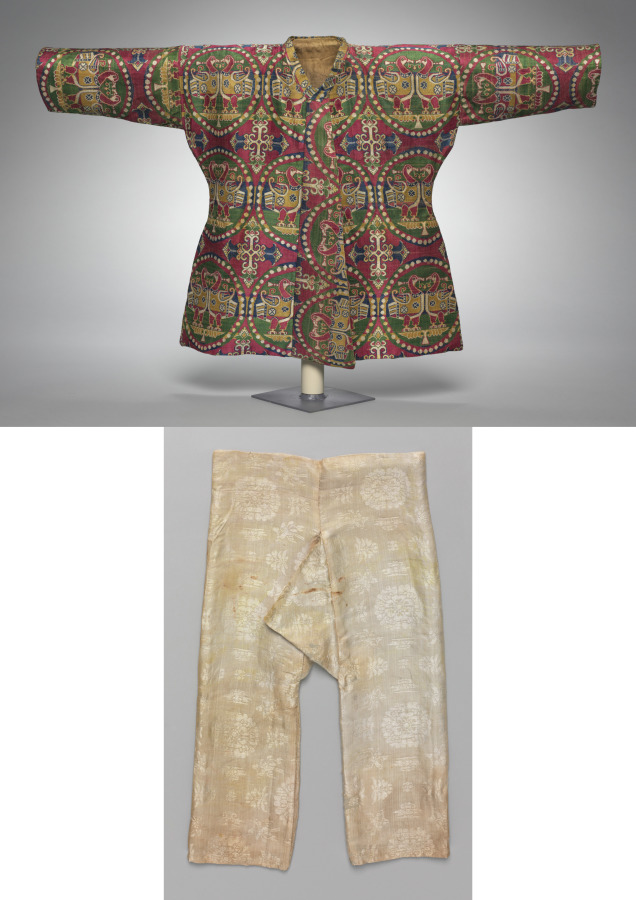
An Examination of Juvenile Silks: Imperial Legacy in Miniature
The study of sartorial heritage, much like the appreciation of a finely balanced cloth, demands a consideration of both the grand narrative and the exquisite, often overlooked, detail. It is within the realm of children's attire that one frequently encounters the most poignant and technically revealing expressions of a textile tradition. The subject pieces—a child’s coat adorned with ducks enclosed within pearl medallions, and a pair of accompanying trousers—are not mere relics of infancy. They are, in fact, profound statements of cultural capital, rendered in the most demanding of mediums: silk. Their existence speaks to a legacy of imperial weaving so advanced that its surplus virtuosity could be deployed for the most transient of purposes, the swift growth of a child. To analyse them is to understand the zenith of pre-industrial textile ambition.
The Foundation: Imperial Silk Weaving as a Technological and Political Enterprise
Prior to any assessment of motif or cut, one must first apprehend the foundational materiality. The silk herein is not simply a fibre; it is the product of a centuries-old, state-sanctioned monopoly on excellence. Imperial silk workshops, particularly those of China under the Ming and Qing dynasties, operated as the apogee of concentrated craft. They represented a perfect, and often ruthless, synthesis of botanical science (the cultivation of the mulberry and the silkworm), chemical mastery (in dyeing), and mechanical ingenuity (in the development of increasingly complex draw looms). The output was a commodity so valued that it formed the backbone of transcontinental trade and diplomacy, a soft power long before the term was coined. The cloth destined for the imperial household itself was characterised by a density of weave, a brilliance of hue, and a complexity of pattern that were explicitly legislated—sumptuary laws ensuring that such magnificence remained the prerogative of the throne. It is from this rarefied ecosystem that the silk of our subject garments ultimately descends, a diaspora of technique and aesthetic that would influence weaving centres from Lyon to Spitalfields.
Decoding the Motif: Avian Imagery within the Pearl Roundel
The coat’s central decorative scheme—ducks ensconced within pearl medallions—is a rich lexicon of symbolism and historical confluence. The pearl roundel itself is a motif of Sasanian Persian origin, transmitted eastwards along the Silk Roads. Its adoption and perpetuation in Chinese textile design signify a sophisticated act of cultural integration, a framing device of foreign pedigree used to present indigenous themes. The duck, within the East Asian context, carries a multitude of auspicious meanings. It is a symbol of marital fidelity and happiness, owing to the bird’s monogamous nature. More broadly, it represents a safe journey and prosperity, perhaps a tacit parental wish for an infant’s smooth passage through life.
The execution is critical. These are not hastily embroidered appliqués. The likelihood is that the ducks and their pearled borders are integral to the weave—a *kesi* (cut silk) tapestry weave or a finely executed satin damask. This technique transforms the garment from a decorated object into a woven painting, where the pattern is inseparable from the ground. The decision to deploy such labour-intensive artistry on a child’s coat is a telling economic and social indicator. It speaks of a household for which the finest materials were a normative expectation, even for its youngest and most ephemeral members. The child becomes a mobile canvas for the display of lineage, taste, and access to paramount craft.
Cut and Conformation: Juvenile Silhouette and Adult Convention
The cut of the coat and trousers, while diminutive, would have faithfully echoed the adult fashions of the prevailing court or elite society. This is a consistent principle across heritage tailoring: children’s attire serves as an induction into the sartorial codes of their station. The coat likely features a straight, boxy silhouette, closing with frogs or toggles, mirroring the *changshan* or robe styles of the adult male. The trousers, simple in their leg construction, would complete the ensemble. This mimicry is not playful but pedagogical. From the earliest age, the individual is encased in the fabric of their social identity, the very drape and fold of the silk instructing them in the physical language of their heritage. The material, with its subtle rustle and particular weight, provides a sensory education in quality—a tactile understanding of hierarchy and refinement that precedes cognitive comprehension.
Conclusion: The Garment as Heirloom and Testimony
In final analysis, this ensemble of coat and trousers transcends its original, practical function. It stands as a heritage research artifact of the first order. It encapsulates the global journey of the silk technique, from imperial edict to domestic luxury. It demonstrates the transmission of symbolic language through trade and adaptation. Most pointedly, it reveals the social imperative of material culture as a tool for encoding status and aspiration from the cradle upwards.
The survival of such pieces is often a matter of sentiment, preserved for the personal memory of a life begun. For the contemporary scholar of heritage, however, they offer a far more rigorous narrative. They are proof of a world where textile was paramount, where the loom was as significant as the legislature, and where the legacy of imperial weaving was so profound that its light, even in the twentieth century, could still be refracted through something as small and perfect as a duck woven in silk upon a child’s coat. The cloth, as always, bears witness. It is our task to interpret its testimony with the requisite gravity and precision.