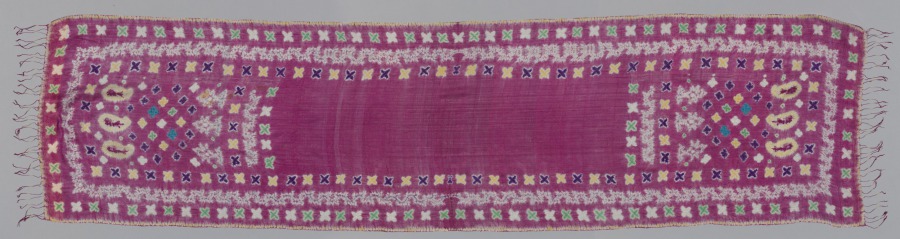
The Silk Veil: An Heirloom of Imperial Craft and Modern Restraint
Provenance and the Weight of Thread
In the hushed ateliers of London’s Savile Row, where the language of cloth is spoken with the precision of a tailor’s chalk, the silk veil occupies a peculiar position. It is not a garment of structure, nor a statement of silhouette. Rather, it is a whisper—a translucent membrane that carries the accumulated gravity of imperial weaving traditions. To handle a silk veil of genuine provenance is to hold a paradox: the material is ethereal, yet its historical density is immense. The legacy of imperial silk weaving, from the looms of Suzhou to the royal manufactories of Lyon, is not merely a story of fibre and dye. It is a chronicle of power, patience, and the relentless pursuit of a lustre that no synthetic mimicry has ever achieved.
The materiality of the veil is its first and most profound argument. Mulberry silk, *Bombyx mori*, extruded in a single, unbroken filament that can span a kilometre, is the only natural fibre that offers such continuous, prismatic clarity. In the imperial context, this was not a commodity; it was a tribute. The finest veils were woven on drawlooms, often requiring two artisans—one to operate the pedals, another perched above to manipulate the pattern harness. The result was a fabric of such diaphanous complexity that it defied the eye. A veil from the Qing dynasty, for instance, was not merely a covering. It was a social hieroglyph, encoding rank, occasion, and the wearer’s proximity to the throne. The weave density, the presence of gold-wrapped threads, the subtle variations in the twill—these were not aesthetic choices but legal distinctions.
The Imperial Loom and the Discipline of Light
To speak of imperial silk is to speak of a discipline that borders on the monastic. The cultivation of the silkworm was guarded with the same ferocity as state secrets. The Empress herself, in ancient ritual, would inaugurate the sericulture season, underscoring that silk was not an industry but a divine mandate. The legacy that survives in the contemporary veil is one of *restraint*. Unlike the flamboyant velvets or the stiff brocades of the same era, the veil demanded a different mastery: the mastery of negative space. The weaver’s skill was measured not by how much pattern was visible, but by how the light passed through the unadorned sections, creating a moiré effect that shifted with the wearer’s breath. This is the technical inheritance that Savile Row respects: the understanding that true luxury is often a function of what is withheld.
Consider the specific construction of a heritage-grade silk veil. The warp is typically thrown in a high-twist, or *crepe*, to impart a subtle granular texture that catches light without reflecting it harshly. The weft, conversely, is often left untwisted to allow for a soft, fluid drape. The intersection of these two tensions—the tight, resilient warp and the languid, yielding weft—creates a fabric that is simultaneously crisp and liquid. In imperial workshops, this balance was achieved through a meticulous process of degumming, where the sericin coating was partially removed to achieve a specific hand-feel. Too much degumming, and the veil would lose its body; too little, and it would feel stiff and unyielding. This chemical precision, executed with organic agents like Marseille soap or rice bran, is a lost art in mass production. The modern veil, even one of high quality, often feels like a mere shadow of this historical standard.
From Courtly Concealment to Modern Tailoring
The transition of the silk veil from imperial court to contemporary wardrobe is a study in semantic evolution. In the East, the veil was a tool of *concealment*—not of shame, but of social stratification. It shielded the face from the public gaze while simultaneously announcing the wearer’s status through its sheer cost. In the West, particularly in the 19th and early 20th centuries, the veil was adopted by the haute couture houses as an accessory of *mystery*. A woman descending from a motorcar, her face obscured by a cascade of black silk chiffon, was not hiding her identity but performing it. The veil became a screen onto which the observer projected desire, wealth, and a certain melancholic elegance.
For the modern heritage specialist, the challenge is to honour this dual legacy without succumbing to costume. The Savile Row approach is to treat the silk veil not as a relic but as a *technical reference*. We study its drape, its optical properties, and its response to humidity. We ask: how does this historical construction inform a modern scarf, a lining, or a discreet inset in a tailored jacket? The answer lies in the handling. A true heritage silk veil, when crushed in the hand, should spring back with a faint, dry rustle—a sound that is almost imperceptible but unmistakably organic. It should not cling to the skin with static, but settle against it like a second, cooler epidermis. This is the material memory of imperial weaving: a memory encoded in the twist of the yarn and the tension of the loom.
Preservation and the Ethics of Wear
Owning or commissioning a silk veil in the heritage tradition is an act of stewardship. Unlike a suit, which is constructed to be worn and eventually replaced, a veil of this calibre is an archive. The imperial looms produced lengths of fabric that were often stored for decades before being cut, allowing the silk to mature and its lustre to deepen. This ageing process is not degradation; it is a slow, chemical evolution where the fibroin molecules align more perfectly over time. The contemporary collector must respect this. The veil should be stored flat, wrapped in acid-free tissue, away from direct light. It should never be folded along the same crease twice. And when worn—for it must be worn, at least once—it should be worn with the knowledge that you are participating in a continuum that stretches back to the first drawloom.
The irony of the silk veil in the 21st century is that its fragility is its greatest strength. In an era of fast fashion and synthetic stretch, the veil demands a pause. It cannot be rushed. It cannot be mass-produced with integrity. It requires the patience of the imperial weaver and the discernment of the Savile Row cutter. To wear it is to reject the tyranny of the permanent and to embrace the elegance of the transient. The veil will not last a century if worn daily, but it will last a lifetime if treated with the reverence it was designed to command. And in that reverence lies the true legacy—not of silk, but of the human hand that spun, wove, and draped it with intention.
In conclusion, the silk veil is not merely an accessory. It is a testament to the fact that the most profound luxury is not opulence, but *precision*. The imperial weavers understood that a single misaligned thread could ruin an entire panel. The modern wearer must understand that a single careless gesture can diminish its history. The veil asks for nothing but attention. In return, it offers a glimpse of a world where time was measured not in minutes, but in the slow, deliberate passage of a shuttle through a warp of silk.