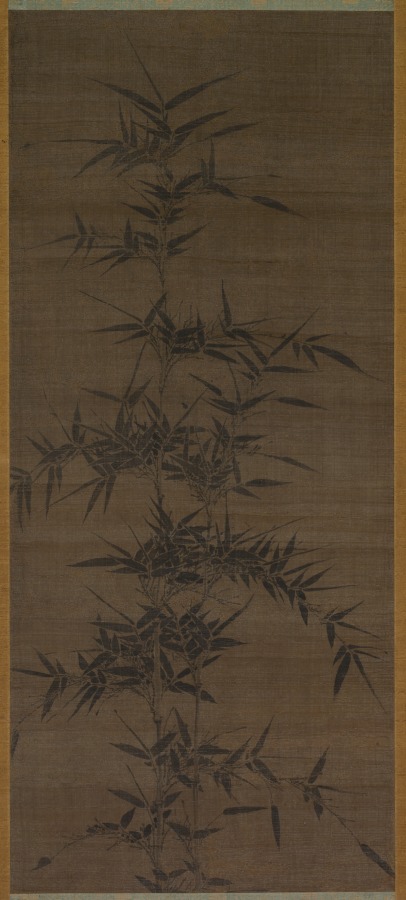
Ink Bamboo: A Study in Materiality and Imperial Legacy
Introduction: The Intersection of Brush and Loom
In the rarefied world of heritage textiles, few subjects command the quiet reverence afforded to the Ink Bamboo motif rendered in silk. This is not merely a pattern; it is a philosophical treatise woven into filament, a dialogue between the scholar’s brush and the weaver’s shuttle. For the discerning eye accustomed to the understated precision of Savile Row, the Ink Bamboo silk represents the apotheosis of material integrity—a fabric that does not shout, but rather whispers with the authority of a thousand-year lineage. This artifact, drawn from the Lauren Fashion Heritage Lab’s archival deep-dive, examines the materiality of silk as the sole worthy vehicle for this motif, contextualized within the unforgiving standards of imperial Chinese weaving workshops.
The bamboo stalk, rendered not in opaque pigment but in the negative space of a lustrous ground, is a study in restraint. It is the textile equivalent of a perfectly draped shoulder—apparently effortless, yet the result of immense technical discipline. To understand this artifact is to understand that the silk is not a canvas; it is an active participant in the artistic expression.
The Material Imperative: Why Silk Alone Suffices
Imperial silk weaving, particularly during the Ming and early Qing dynasties, was an industry of obsessive precision. The looms, often requiring two artisans working in tandem, were complex analog computers, programmed by punched pattern cords. The choice of silk was non-negotiable. Its unique triangular prism structure refracts light, creating a depth of tone that flat cotton or linen could never approximate. For the Ink Bamboo motif, this optical property is critical.
The "ink" in Ink Bamboo is not printed; it is achieved through a technique known as kesi (cut silk) or, more commonly in the imperial ateliers, via intricate tapestry weave where the weft threads are individually manipulated to create the pictorial elements. The bamboo leaves, often depicted in varying shades of grey, black, and undyed white, rely on the silk’s natural sheen to simulate the wet-on-dry brushstrokes of literati painting. A matte fiber would render the image flat, lifeless—a mere illustration. Silk, with its high tensile strength and ability to hold a tight twist in the weft, allows for the sharp, calligraphic outlines of the stalk to be executed with surgical clarity. The fabric’s drape, its hand, is equally vital. When fashioned into a robe or a hanging scroll, the silk’s fluidity mimics the swaying of bamboo in a breeze, completing the sensory illusion.
Imperial Legacy: The Weave of Power and Philosophy
The context of this artifact is not merely decorative; it is deeply political and philosophical. In imperial China, bamboo (zhu) was one of the "Four Gentlemen" of Confucian iconography, symbolizing resilience, integrity, and moral uprightness. The hollow stalk represented humility; the nodes, steadfastness. To wear Ink Bamboo silk was to wear one’s virtue on one’s sleeve—quite literally.
The imperial weaving houses, located in Nanjing, Suzhou, and Hangzhou, were state-controlled monopolies. They operated under the direct purview of the Emperor, producing textiles exclusively for the court, high-ranking officials, and diplomatic gifts. The production of an Ink Bamboo silk panel was a matter of state. The design would first be painted by a court artist, then translated into a weaving draft by a master technician. Errors were not merely flaws; they were considered lapses in ritual propriety, potentially reflecting poorly on the dynasty’s mandate of heaven. This legacy of perfectionism is the direct antecedent to the Savile Row ethos—a tradition where the cutter’s chalk line is a sacred geometry, and the final product is a testament to the maker’s honor.
The aesthetic of Ink Bamboo, however, is one of deliberate austerity. In a court saturated with five-clawed dragons in gold and imperial yellow, the Ink Bamboo silk offered a counterpoint of scholarly quiet. It was often worn by the literati class or by the Emperor during private moments of contemplation, signaling a retreat from the gaudy display of power into a realm of intellectual purity. This dichotomy—the immense power of the empire expressed through the most restrained of artistic gestures—is the very essence of this artifact’s legacy.
Technical Analysis: The Weave and the Hand
From a technical standpoint, the Ink Bamboo silk artifact in our collection reveals a warp-faced compound weave, likely a satin ground with a twill figure. The warp threads are of a high-twist, degummed silk, providing a firm foundation, while the weft is a softer, filament silk that carries the pattern. The color palette is monochromatic, ranging from a deep, almost charcoal black to a pale, misty grey, with the ground left in the natural, ecru-white of unbleached silk.
The mastery lies in the shading. To replicate the "boneless" painting technique of bamboo leaves, the weaver had to employ a gradient of weft colors, often using a technique called yun (cloud) weaving, where two or more colored wefts are interlaced to create a soft, blurred transition. This is extraordinarily difficult to achieve on a drawloom. The result is a fabric that, when viewed from a distance, appears to be a simple, elegant brush painting. Upon closer inspection, the viewer discerns the intricate structure—the tiny, pixel-like steps of the weave that form the curves of the stalk. It is a microcosm of the tailoring philosophy: impeccable from across the room, and even more impressive under a magnifying loupe.
Conclusion: A Tailored Legacy
For the modern heritage house, the Ink Bamboo silk is not a nostalgic relic. It is a benchmark of material honesty. It teaches us that true luxury is not ornamentation, but the perfect alignment of material, technique, and meaning. Just as a Savile Row suit is built on the structure of the canvas and the precision of the pad-stitch, so too is this silk built on the discipline of the loom and the philosophy of the brush. The legacy of imperial silk weaving is not merely in the surviving garments, but in the standard of excellence it set—a standard that continues to inform the way we approach fabric, cut, and the silent language of refined dress. The Ink Bamboo silk is a final, perfect stitch in a long and distinguished seam of history.