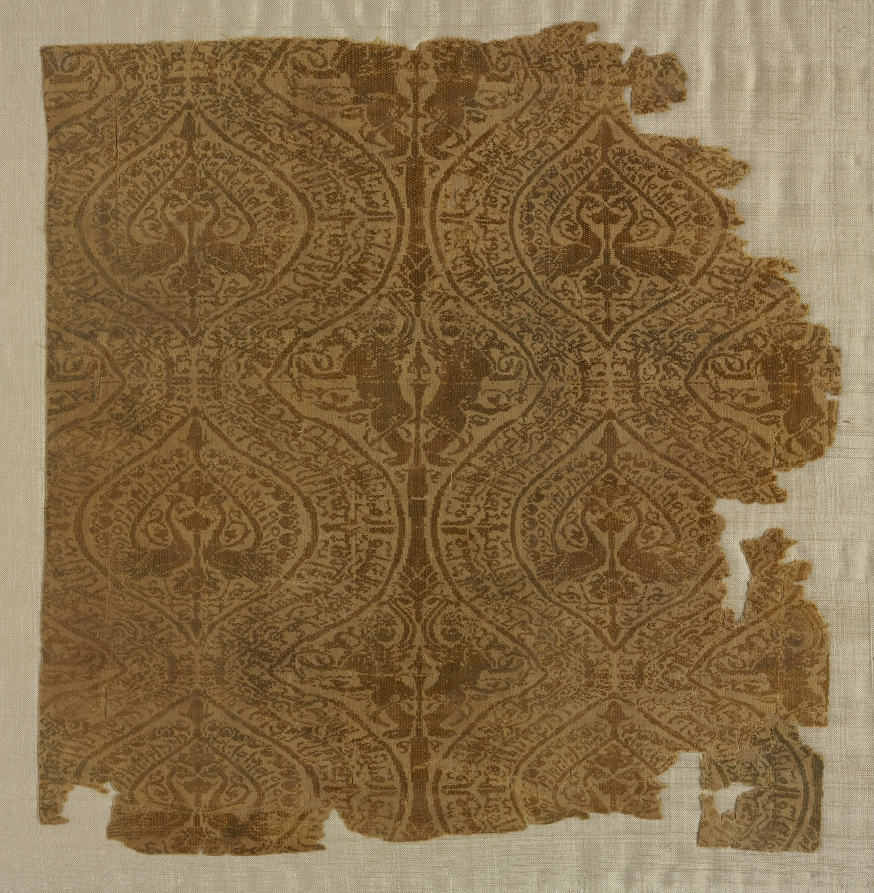
Fragment with Peacocks in Ogival Pattern: A Study in Imperial Lineage and Material Mastery
Provenance and the Language of the Loom
This fragment, a surviving testament to the zenith of imperial silk weaving, speaks in a dialect of power that predates the modern boardroom by centuries. The ogival pattern—a lattice of intersecting curves forming a pointed arch—is not merely decorative. It is a structural grammar, a framework of order imposed upon the chaos of raw silk. Within each compartment, the peacock, a motif of sovereign authority and celestial vigilance, stands in perpetual repose. For the connoisseur of fine cloth, this is not a textile; it is a document. It records a moment when the loom was the most sophisticated instrument of economic and cultural statecraft known to the civilised world.
The materiality of the piece is paramount. Silk, unlike wool or cotton, is a continuous filament—a single, unbroken thread that can extend for nearly a kilometre. This inherent length demands a discipline of production that is almost monastic. The weaver does not piece together; he or she negotiates with a single, unyielding line. The resulting fabric possesses a tensile strength and a lustrous depth that no staple fibre can replicate. When you handle a fragment of this calibre, you are not touching cloth; you are touching the distilled patience of generations. The ground weave, likely a compound twill or satin, provides a subtle, shifting canvas against which the supplementary weft of the peacock pattern rises with a sculptural relief. This is not printing; this is building in miniature.
The Imperial Atelier: Where Politics Became Textile
To understand this fragment, one must appreciate the context of its creation. Imperial silk weaving was not a cottage industry. It was a state monopoly, a strategic asset managed with the same rigour as a modern central bank manages currency. The imperial ateliers were situated within the palace complex, staffed by hereditary artisans whose skills were passed down through bloodlines, not manuals. Every stage—from the mulberry leaf fed to the silkworm, to the dyeing of the thread with madder or indigo, to the final pass of the shuttle—was supervised by eunuch administrators who reported directly to the throne. The peacock, in this context, is a heraldic device. It signals that this cloth was not for the open market. It was a livery of allegiance, a wearable declaration of one’s proximity to the centre of power.
The ogival pattern itself carries a deeper resonance. Its symmetry suggests a cosmic order, a mirror of the celestial bureaucracy that governed the empire. The repetition is not monotonous; it is meditative. Each repeat of the peacock is a reaffirmation of stability. In an era when political fortunes could shift with a single edict, this cloth offered a tangible, unchanging truth. The client who commissioned such a piece—or the courtier who received it as a gift—understood that he was not merely purchasing a garment. He was acquiring a piece of the imperial will. The weight of the silk, the precision of the weave, the vibrancy of the dye: all conspired to create an object that commanded deference before a single word was spoken.
Technical Dissection: The Weaver’s Arithmetic
From a technical standpoint, the fragment reveals a masterclass in drawloom operation. The ogival compartments are not drawn freehand; they are the product of a complex system of heddles and pattern cords, often requiring a second operator—the drawboy—to sit atop the loom and pull specific cords in sequence. This division of labour, between the weaver below and the drawboy above, is a metaphor for the entire imperial hierarchy. The weaver, like the minister, executes the pattern. The drawboy, like the provincial official, transmits the command. The result is a fabric with a repeat that can span several feet, a feat impossible on a simple treadle loom.
Consider the density of the weave. A high-quality imperial silk might contain 120 to 160 warp threads per centimetre. This is not a fabric for the faint of heart or the shallow of pocket. The sheer quantity of raw silk required—and the waste involved in setting up the loom—meant that a single bolt of such cloth could represent the annual income of a minor noble. The peacock motif, with its intricate tail feathers and the fine gradations of colour, would have required multiple shuttles, each carrying a different hue. The weaver had to manage these shuttles with the precision of a surgeon, ensuring that each pass of the weft locked into place without a single misstep. A flaw in the pattern was not a minor defect; it was a breach of protocol, a crack in the facade of imperial perfection.
Conservation and the Modern Eye
Today, this fragment survives in a state of partial decay. The silk, once supple and lustrous, has become brittle in places, the colours faded to a palette of ochre and muted teal. But this decay is not a diminishment; it is a patina of authenticity. For the modern designer or the heritage specialist, the fragment offers a lesson in restraint. The ogival pattern, so rigid in its original context, reads today as a sophisticated geometric abstraction. The peacock, stripped of its courtly pomp, becomes a study in natural form and stylised elegance. This is why such fragments remain relevant. They are not museum curiosities; they are source material for the contemporary atelier.
When we examine the reverse of the fragment, we see the floating weft threads, the loose ends that were never trimmed. This is the architecture of the cloth, the scaffolding that supports the visible surface. It reminds us that every great garment, every tailored suit on Savile Row, is built upon a foundation of unseen labour. The imperial weaver understood this instinctively. He knew that the beauty of the front was contingent upon the integrity of the back. This is a principle that transcends time and geography. Whether you are weaving silk in a Ming dynasty workshop or cutting a two-piece suit in a Mayfair workroom, the discipline is identical: honour the material, respect the process, and the result will speak for itself.
This fragment, therefore, is not merely an object of historical interest. It is a benchmark. It challenges us to consider what we have lost in our age of digital printing and synthetic blends. The peacock in the ogival pattern is a quiet rebuke to the disposable. It demands that we look closer, that we understand the cost of true luxury. And for those who take the time to listen, it offers a masterclass in the art of permanence.