← BACK TO ARCHIVES
Silk
Heritage Synthesis: Dragons Chasing Flaming Pearls
Curated on Aug 22, 2026 // Node: LDN-01
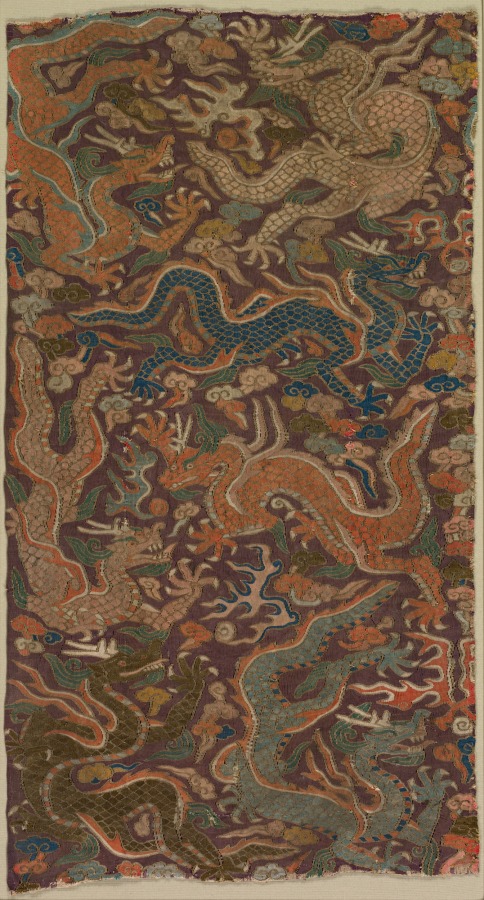
An Heirloom of the Loom: The Dragon and the Flaming Pearl in Imperial Silk
In the hushed, wood-panelled ateliers of Savile Row, where the measure of a man is taken in cloth and the whisper of a needle is a promise of permanence, we speak of legacy. But legacy is not merely cut and sewn; it is woven. And among the most profound legacies ever committed to a warp and weft is the motif of the dragon chasing the flaming pearl—a narrative of celestial pursuit, rendered in the most exacting medium known to the imperial court: silk. This artifact is not a textile; it is a document of power, a testament to the absolute mastery of the Chinese silk weaver, and a relic whose materiality is inseparable from its meaning.
The Material Imperative: Silk as the Only Possible Canvas
To understand this motif, one must first understand its substrate. Silk was not a luxury in the imperial context; it was a political currency, a divine medium. The mulberry silkworm, *Bombyx mori*, was guarded as a state secret for millennia, and the fabric it produced was deemed a conduit for cosmic energy. The sheen of silk—its ability to capture light and shift it from silver to gold to a deep, liquid jade—was not merely aesthetic. It was a physical manifestation of the emperor’s mandate to harmonize heaven and earth. A dragon embroidered on cotton would be a mere illustration. A dragon woven into silk becomes a living entity, its scales shimmering with the illusion of motion, its claws seeming to grip the very air. The materiality of silk, with its tensile strength and its capacity for extraordinarily fine threads (sometimes fewer than ten denier), allowed for a density of weave that was unprecedented. In the finest *kesi* (slit-tapestry) technique, the weaver did not simply pass the weft across the entire width; they manipulated individual colour blocks, creating sharp, painterly transitions that made the dragon’s sinews and the pearl’s iridescence appear almost photographic. No other fibre could hold such detail without fraying or losing its lustre. The silk was the message.
Decoding the Iconography: The Pursuit of the Pearl
The motif itself is a study in dynamic tension. The dragon—*long*—is not a malevolent beast of Western lore but a benevolent, elemental force, a regulator of rain, rivers, and storms. The flaming pearl, or *huozhu*, is often misinterpreted as a simple jewel. In the imperial lexicon, it is the *cintamani*, the wish-fulfilling gem of Buddhist and Taoist cosmology, representing wisdom, spiritual perfection, and the sun’s life-giving energy. The dragon’s pursuit is not one of hunger but of aspiration. It is the sovereign’s eternal quest for enlightenment, for the perfect harmony of yin and yang. The pearl’s flame is not destructive; it is the fire of transformation, the alchemical spark that turns base matter into gold—or, in this context, turns raw silk into a symbol of cosmic legitimacy.
The composition is always one of coiled energy. The dragon’s body, often rendered in a S-curve, twists through clouds or waves, its head thrown back, its jaws open, reaching for the orb that hovers just beyond its grasp. This is a deliberate design choice. The weaver, working on a loom that could be over four metres wide, had to plan the warp tension with surgical precision. The diagonal lines of the dragon’s body required the weaver to manage floats and bindings so that the fabric would not pucker. The space between the dragon’s open jaw and the pearl—the negative space—is as crucial as the positive forms. It is the gap of desire, the eternal distance between the mortal ruler and the divine. In the imperial workshops of the Ming and Qing dynasties, this gap was not an accident. It was a theological statement, woven with mathematical exactitude.
The Imperial Loom: A Legacy of Absolute Control
The legacy of imperial silk weaving is not merely one of technique but of institutional discipline. The Imperial Silkworks in Nanjing, Suzhou, and Hangzhou were not factories; they were bureaucratic extensions of the throne. The weavers were not artisans but civil servants, bound by sumptuary laws that dictated who could wear what. A five-clawed dragon was reserved exclusively for the emperor and his immediate family. Four-clawed dragons were for princes. This hierarchy was enforced with the severity of a death sentence. The silk itself was graded; the finest, known as *gongjin* (tribute silk), was produced only for the palace. The dyeing process was equally controlled. The imperial yellow, derived from the *Sophora japonica* flower or the root of the *Rubia* plant, was a colour so specific that its formula was a state secret.
To weave a dragon chasing a flaming pearl in this context was to participate in a ritual of state. The weaver would begin with a cartoon, a full-scale painting of the design, which was then transferred to the loom. For a *kesi* piece, the weaver would work face-down, using a small mirror to see the right side of the fabric. Each colour change required a separate bobbin, and the weaver would interlock the threads to prevent gaps. A single square inch of the finest *kesi* could take a day to complete. A full robe, with its intricate dragons, clouds, and waves, could take two years. The result was not a product but a relic, imbued with the *qi*—the vital breath—of the weaver, the patron, and the dynasty itself.
Materiality and Meaning: The Fabric as a Political Entity
The choice of silk for this motif was not incidental; it was essential. The dragon’s power is often described as *ling*, a spiritual efficacy that is both visible and intangible. Silk, with its translucent quality when held to light, embodies this paradox. The pearl’s flame, when rendered in gold-wrapped thread, would catch the candlelight in a throne room, appearing to flicker and dance. This was not mere ornamentation; it was a calculated use of material to create a living effect. The emperor, seated in his dragon robe, was not merely wearing a symbol. He was enveloped in a field of power, his every movement causing the silk to ripple, making the dragon appear to writhe and the pearl to pulse. The fabric was an extension of his body, a second skin of authority.
Moreover, the physical weight of the silk—often heavy with gold thread and dense embroidery—was a deliberate assertion of presence. A Ming dynasty dragon robe could weigh over five kilograms. This was not comfortable. But comfort was not the point. The weight was a constant reminder of the burden of rule, the gravity of the mandate of heaven. The Savile Row tailor understands this principle intimately: a well-constructed jacket has a certain heft, a drape that signals quality. The imperial silk weaver understood it on a cosmic scale. The fabric was engineered to command, to intimidate, and to inspire awe.
Conclusion: The Thread That Binds Time
As we consider this artifact today, in the context of a modern heritage lab, we must resist the urge to view it merely as a beautiful antique. The dragon chasing the flaming pearl, rendered in imperial silk, is a masterclass in the unity of form and function. The materiality of silk—its lustre, its strength, its capacity for detail—was not a backdrop for the motif; it was the very engine of its meaning. The legacy of imperial silk weaving is not just a story of technical innovation but of the profound belief that what we wear, and how it is made, can shape the world. In the same way that a Savile Row suit is a silent argument for precision and permanence, this silk artifact is a silent argument for divine order. The dragon still chases the pearl, frozen in a moment of eternal aspiration. And the silk, after centuries, still holds that moment in its shimmering grip, a testament to the weavers who understood that true power is not worn—it is woven.
Heritage Lab Insight
Lab Insight: CMA Silk Archive Node integration.