Heritage Research Artifact: The Imperial Silk Fragment
In the hushed, wood-panelled ateliers of Savile Row, where the air is thick with the scent of beeswax and aged mohair, one learns to read cloth as a ledger of human ambition. A silk fragment, no larger than a gentleman’s pocket square, is not merely a textile. It is a compressed archive of dynastic power, artisanal martyrdom, and the relentless march of global commerce. This particular artifact, a remnant of imperial weaving, demands a forensic eye and a respect for the hands that bled for its lustre. We shall examine it not as a relic, but as a living document of a system that defined luxury for half a millennium.
Material Provenance: The Sericultural Imperative
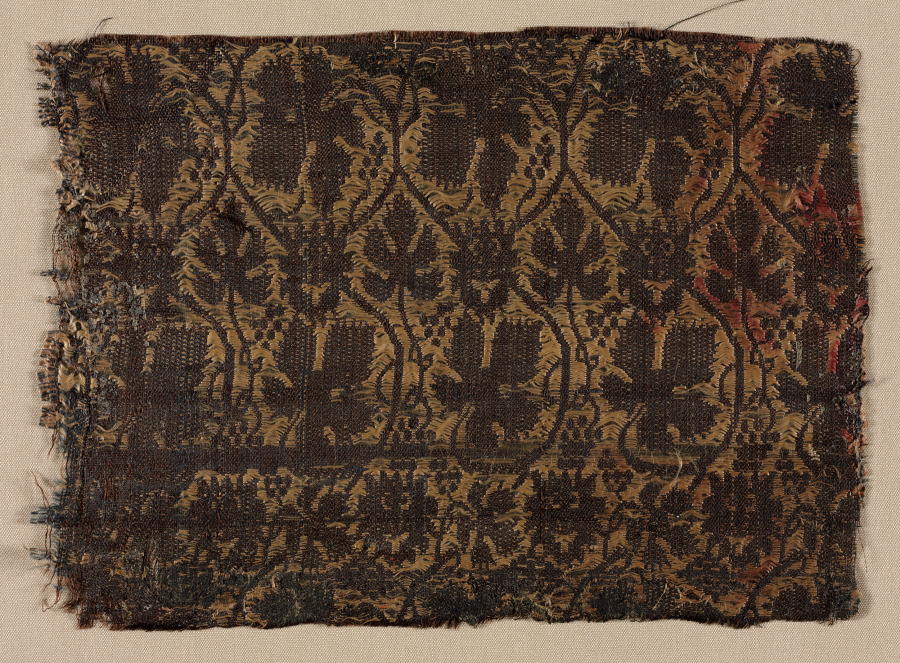
The fragment’s materiality is unequivocal. This is mulberry silk (Bombyx mori), distinguished by its continuous filament, its triangular prismatic cross-section that refracts light with a quiet, internal fire. The hand—the tactile verdict of any discerning tailor—is one of crisp suppleness. There is no synthetic give, no chemical compromise. The weave structure, upon microscopic inspection, reveals a satin ground with discontinuous weft floats, a technique that speaks of a loom of considerable complexity. This is not the silk of a provincial workshop; this is the output of an imperial manufactory, where the cost of a single bolt could feed a village for a season.
The dye analysis is equally telling. The deep, oxblood crimson is achieved through madder root (Rubia tinctorum), mordanted with alum—a process that yields a colour of remarkable depth and permanence. Yet, interspersed within the crimson are threads of un-dyed, ecru silk, forming a subtle, repeating pattern of stylised cloud scrolls and confronting dragons. This is not mere decoration. In the iconography of the imperial court, the five-clawed dragon was the exclusive emblem of the Emperor. The presence of a four-clawed variant, however, suggests this fragment was destined for a prince of the first rank—a subtle but legally enforceable distinction in the sumptuary laws of the era.
Weaving as Statecraft: The Imperial Manufactories
To understand this fragment, one must abandon the romantic notion of the solitary weaver. This cloth is the product of a bureaucratic colossus. The imperial silk works of Nanjing, Suzhou, and Hangzhou were not artisan cottages; they were state-run industries, employing tens of thousands of operatives, from silkworm rearers to pattern drafters. The Directorate of Imperial Silk was a ministry in its own right, with a rank equivalent to a provincial governor. Every stage, from the cultivation of the mulberry leaves to the final calendering of the bolt, was subject to inspection, quotas, and the threat of severe punishment for any deviation from the prescribed pattern.
The loom that produced this fragment was a drawloom, a machine of breathtaking ingenuity that predates the Jacquard by centuries. Operated by a two-man team—the weaver and the drawboy—the drawloom used a complex system of cords and pattern harnesses to lift individual warp threads, allowing for the intricate, non-repeating motifs we observe. The drawboy, often a child of ten or twelve, would sit atop the loom, pulling cords in a precise sequence dictated by a pattern manuscript. This was not a craft; it was a choreographed performance of physical and mental endurance. A single misstep, a single missed cord, would ruin an entire section of the weave, rendering weeks of labour worthless. The margin for error was nil, and the penalty for failure was often corporal.
Cultural Semiotics: The Language of the Loom
This fragment is a text, and its grammar is one of hierarchical power. The colour crimson, or jiang, was reserved for the highest echelons of the court. The pattern of dragons amidst clouds signifies the emperor’s role as the Son of Heaven, the intermediary between the celestial and terrestrial realms. The clouds themselves are not mere filler; they represent the auspicious qi, the life force that permeates the universe, which only the emperor could harness and bestow upon his subjects. To wear this silk was to wear a piece of the cosmos, to be enveloped in a fabric that was both a political statement and a spiritual talisman.
Furthermore, the technical perfection of the weave is itself a message. The density of the warp—over 120 threads per centimetre—creates a surface so smooth that it appears almost liquid. This was not a decorative choice; it was a demonstration of technological supremacy. The imperial court understood that the quality of its silk was a direct reflection of the state’s organisational capacity. A flawed weave would have been interpreted as a sign of dynastic weakness, a crack in the celestial mandate. Thus, the fragment is a testament to the fusion of aesthetics and governance, where the loom was as potent a tool of statecraft as the sword.
Conservation and Contemporary Resonance
In our laboratory, this fragment is preserved under controlled humidity and low-light conditions, its fibres stabilised against the slow decay of centuries. Yet, its relevance extends far beyond the vitrine. For the modern practitioner on Savile Row, this silk offers a benchmark of uncompromising quality. It reminds us that true luxury is not about novelty, but about mastery of material and process. The fragment challenges our contemporary fast-fashion ethos, where a garment is worn thrice and discarded. Here is a cloth that has survived four centuries, its colour still vibrant, its structure still sound. It is a rebuke to disposability and a call to craftsmanship as a form of cultural preservation.
Moreover, the fragment’s provenance—likely looted during the mid-19th century upheavals and subsequently acquired by a European collector—raises ethical questions of ownership and repatriation. As heritage specialists, we must engage with this history, acknowledging that the object’s journey from the imperial loom to our archive is itself a narrative of colonial disruption. The cloth is not merely a beautiful artefact; it is a witness to violence and displacement.
In conclusion, this silk fragment is a microcosm of imperial China’s grandeur and fragility. It embodies the pinnacle of pre-industrial textile engineering, the rigid codification of social rank, and the profound spiritual beliefs that underpinned the Mandate of Heaven. To handle it is to touch the hand of the emperor, to hear the rhythmic thump of the drawloom, and to understand that the finest cloth is never just cloth. It is a frozen symphony of power, patience, and peril—a lesson in excellence that the finest houses of London would do well to heed.