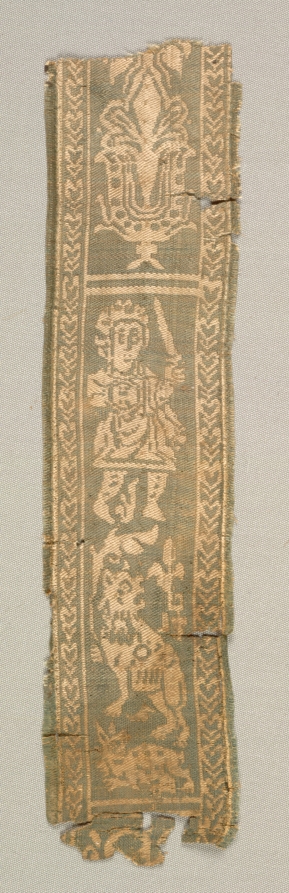
The Materiality of Power: A Silk Decorative Tunic Band with a Hunter
Provenance and the Imperial Loom
Within the hushed, wood-panelled archives of Lauren Fashion Heritage Lab, we encounter an object that speaks not of fleeting trends, but of enduring dynasties. This is a silk decorative tunic band, its field alive with the sinuous form of a hunter in pursuit. To the uninitiated, it is a strip of exquisite cloth. To the discerning eye—the eye trained on Savile Row’s reverence for cloth as architecture—it is a fragment of imperial biography, a document of statecraft woven in filament. The materiality of this piece is its primary text. We are not looking at a printed imitation or a mechanically embroidered afterthought. We are examining the product of a drawloom, an instrument of near-supernatural complexity, operated by a master weaver and a drawboy working in silent, choreographed synchrony. The silk itself, a continuous filament reeled from the cocoon of the Bombyx mori, was the currency of empires, more precious than gold along the Silk Road. Its lustre, even after centuries, retains a cool, internal fire—a testament to the sericin’s careful preservation and the weaver’s refusal to compromise on thread count.
The Weave as a Statement of Sovereignty
Consider the technical virtuosity required to render the hunter’s form. This is not a flat, pictorial representation. The band employs a compound weave structure, likely a twill or satin ground with a complementary weft patterning. The hunter’s musculature, the tension in his bow, the flowing mane of his quarry—all are achieved through the manipulation of warp and weft, creating a subtle, three-dimensional topography. The light catches the raised pattern, casting infinitesimal shadows that animate the scene. This is the legacy of imperial silk weaving, where the loom was not merely a tool but a political instrument. The patterns were codified; the colours, derived from madder, indigo, and the precious murex purple, were sumptuary laws unto themselves. To wear such a band was to declare one’s rank, one’s proximity to the throne, and one’s command over the resources required to produce such a marvel. The hunter motif itself is a potent symbol of aristocratic virtue—the mastery of nature, the discipline of the chase, and the implicit right to dominion. It is a visual assertion of control, woven into the very structure of the garment.
Construction and the Tailor’s Dialectic
From a construction standpoint, this band was never intended to be seen in isolation. It was an integral component of a larger garment, most likely a pao or a court robe. The band would have been applied to the tunic’s hem, collar, or sleeve openings, serving both a functional purpose—reinforcing the edges against wear—and a ceremonial one. The precision of its edges, the evenness of its selvedges, speaks to a standard of manufacture that anticipates the tailor’s craft. On Savile Row, we speak of a garment’s “hand” and its “drape.” This band possesses an impeccable hand; it is supple yet structured, dense enough to hold its shape against the body’s movement, yet fluid enough to follow the line of the sleeve. The way it would have sat against a heavier outer robe—the interplay of weights, the friction between the silk band and the wool or brocade of the main body—would have been a study in contrasting textures, a dialogue between the softness of the interior and the rigidity of the exterior. This is the dialectic of the tailor: the constant negotiation between the cloth’s will and the wearer’s form.
Conservation and the Legacy of Craft
Our responsibility at the Lab is not merely to preserve this artifact but to interrogate it. The silk’s condition—the subtle fading of the dyes, the faint creases where it once folded against a body long since turned to dust—is a narrative of time. We must resist the urge to “restore” it to a hypothetical original state. Instead, we document its current state with forensic precision, using macro-photography and spectral analysis to understand the dye compounds and the weave’s structural integrity. This is not an act of nostalgia but of scholarship. The legacy of imperial silk weaving is not a closed chapter. It is a continuum of expertise that informs contemporary luxury. When a Savile Row cutter selects a silk for a bespoke dressing gown or a couture evening jacket, they are engaging in a dialogue with this history. The principles of balance, of tension, of the interplay between pattern and ground, are as relevant today as they were in the workshops of the Ming or Qing dynasties. This band is a masterclass in restraint and precision—qualities that define the very best of tailoring.
A Living Document
In conclusion, this silk decorative tunic band with a hunter is far more than a decorative fragment. It is a materialised philosophy of power, a testament to human ingenuity, and a benchmark of quality that transcends centuries. Its presence in our collection challenges us to look beyond the surface, to read the cloth as a language. The hunter’s gaze, forever frozen in the weave, is not a relic of the past but a challenge to the present: to uphold the standards of craft, to respect the integrity of materials, and to understand that true luxury is not loud, but quietly, immutably, assured. It is a document that we are privileged to hold, and a standard we are bound to honour.