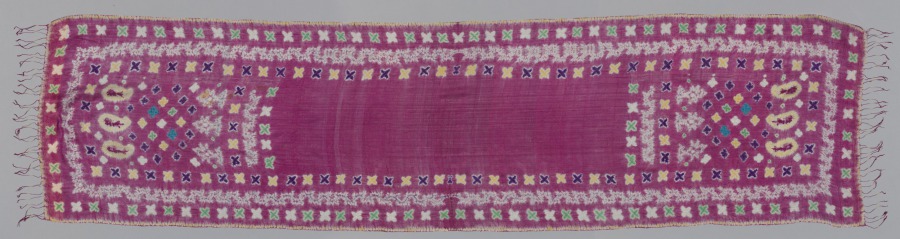
The Silk Veil: An Heirloom of Imperial Craft
Material Provenance and the Imperial Thread
The silk veil, in its most refined iteration, is not merely an accessory; it is a surviving fragment of a vast, disciplined, and utterly singular industrial heritage. When we speak of the legacy of imperial silk weaving, we are not referencing a quaint pastoral craft. We are speaking of a state-sponsored enterprise of such scale and precision that it functioned as the economic and diplomatic engine of empires for over two millennia. The materiality of the veil—the specific weight, the lustre, the tensile strength of the filament—is the primary text. A genuine imperial silk veil, particularly one woven in the great ateliers of the Ming or Qing dynasties, or their European counterparts in Lyon under Louis XIV, carries a specific gravity that machine-made imitations cannot replicate.
The filament itself is the first testament. The Bombyx mori silkworm, fed exclusively on mulberry leaves, produces a continuous, unbroken thread that can extend for nearly a kilometer. This is not a fibre of convenience; it is a fibre of obsession. The imperial weavers understood that the quality of the final cloth was predetermined by the discipline of the rearing process. A single degree of temperature variation, a single leaf of inferior quality, would compromise the filament’s integrity, producing a dull, brittle thread. The resulting fabric would be deemed unworthy of the Imperial Court. Thus, the materiality of the veil is a direct index of the agricultural and logistical command of the state. When you hold a high-grade silk veil, you are holding the distilled result of a supply chain that spanned entire provinces, managed by a bureaucracy dedicated to a single, uncompromising standard.
The Loom and the Grammar of Pattern
The transformation of raw filament into a wearable textile was an act of engineering as much as artistry. The imperial drawloom, a complex apparatus requiring two operators—a master weaver and a drawboy who manipulated the pattern harness—was the apex of pre-industrial technology. This was not a craft for the solitary artisan. It was a collaborative, hierarchical operation, mirroring the structure of the court itself. The patterns woven into these veils were not decorative whims; they were a coded language of rank, power, and cosmic harmony.
Consider the iconography. A veil bearing the five-clawed dragon was reserved exclusively for the Emperor and his immediate family. A four-clawed dragon signified a prince. The presence of specific floral motifs—the peony for wealth, the lotus for purity—was not mere ornamentation but a formal declaration of intention and status. The weave structure itself, often a complex twill or satin derivative, was engineered to create a subtle interplay of light and shadow, a moiré effect that gave the fabric a living, breathing quality. This is the antithesis of the flat, printed silks of the modern era. The imperial veil’s pattern is not applied to the surface; it is integral to the structure. The design is woven in, thread by thread, creating a fabric that is both image and textile, inseparable and permanent.
The Savile Row Perspective: Cut, Drape, and the Weight of History
From the vantage point of a Savile Row cutting room, the silk veil presents a unique set of considerations. We are accustomed to working with cloth that has a memory—a tweed that holds a crease, a worsted that falls with a specific, deliberate weight. Imperial silk, however, possesses a different kind of intelligence. It is a fabric of extreme fluidity and a peculiar, almost liquid drape. It does not hold a shape; it follows a line. This demands a specific approach to design.
The modern client who acquires an antique silk veil, or a contemporary piece woven on a handloom using traditional techniques, is not purchasing a scarf. They are acquiring a piece of architectural history. The correct handling of such a piece is not to force it into a modern silhouette but to allow its inherent properties to dictate the form. A veil of this quality, when draped over the shoulders, should move as a single, continuous entity, catching the light in a way that reveals the depth of the weave. It should feel weightless yet substantial, a paradox that is the hallmark of superior silk. The finishing is equally critical. The hems must be hand-rolled, a technique that requires immense skill to create a delicate, tubular edge that does not add bulk or distort the drape. This is not a process that can be rushed; a single veil can take a skilled finisher a full day to complete.
Preservation and the Ethics of Wear
The legacy of imperial silk weaving is not merely a matter of historical record; it is a living standard. The fragility of the material is its defining characteristic. Silk is a protein fibre, susceptible to light, humidity, and the oils of the skin. To wear an original imperial veil is to accept a responsibility. It is not a garment for daily use. It is an heirloom, to be worn on occasions of significance, and to be stored with the utmost care—wrapped in acid-free tissue, away from direct sunlight, in a climate-controlled environment.
The ethical question for the contemporary house is whether to preserve these artefacts in a static, museum-like state or to integrate them into modern life. The Lauren Fashion Heritage Lab takes the position that a garment’s purpose is to be worn. However, the wear must be informed. We do not cut into an original imperial veil to create a modern jacket; that would be an act of vandalism. Instead, we study its construction, its drape, and its pattern logic, and we apply those principles to new commissions. We commission weavers who still operate on handlooms, using the same techniques, to create new cloth that carries the DNA of the imperial tradition. This is not reproduction; it is continuation. It is the only way to honour the legacy without turning it into a fossil.
Conclusion: A Standard of Excellence
The silk veil, in its imperial context, is a masterclass in the relationship between material, process, and purpose. It stands as a permanent rebuke to the ephemeral, disposable culture of fast fashion. The legacy of imperial silk weaving is not a nostalgic glance backward; it is a benchmark. It reminds us that true luxury is not about price or brand but about the depth of knowledge, the precision of execution, and the integrity of the material. For the discerning client, a silk veil of this heritage is not an accessory. It is a quiet statement of understanding—a recognition that true elegance is a matter of history, engineering, and an unwavering commitment to the craft. It is, in the truest sense, a bespoke piece, tailored not to a body, but to a standard.