← BACK TO ARCHIVES
Silk
Heritage Synthesis: Portrait of a Government Official
Curated on Aug 23, 2026 // Node: LDN-01
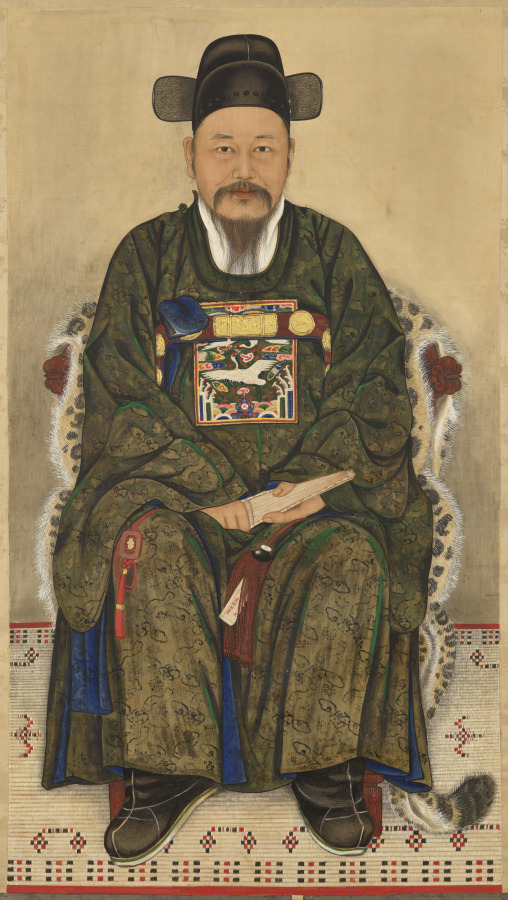
The Weight of Office: A Material Inquiry into the Portrait of a Government Official
In the hushed, wood-panelled corridors of power, where decisions are measured in decades and legacies are stitched with intent, the portrait of a government official is rarely a mere likeness. It is a document of statecraft, a testament to hierarchy, and—most critically for our purposes—a material declaration of authority. The subject before us, rendered in the unforgiving permanence of oil on a silk support, demands more than a cursory glance at its sitter’s countenance. We must attend to the very ground upon which his image rests: the silk. For in this singular choice of material, we uncover the enduring, and often unspoken, legacy of imperial weaving—a craft that did not merely clothe power, but constituted it.
The Substrate as Sovereign Statement
Let us first disabuse ourselves of the notion that silk here serves as a mere canvas, a passive backdrop for pigment. On the contrary, the selection of a silk ground for a formal state portrait is a deliberate act of conspicuous consumption, one that speaks directly to the sitter’s position within a bureaucratic hierarchy that traced its lineage to the imperial looms of the Forbidden City. In the context of Qing-dynasty governance, silk was not a commodity; it was a currency of rank. The imperial silkworks at Nanjing, Suzhou, and Hangzhou operated under direct court supervision, producing textiles whose patterns, colours, and densities were strictly codified by sumptuary law. To be painted upon silk, therefore, was to be inscribed into that very code. The portrait’s materiality performs a dual function: it elevates the official above the common realm of cotton and linen, while simultaneously binding him to the celestial mandate that sanctioned his office. The weave itself—likely a fine, tabby-faced satin with a subtle, lustrous sheen—catches the light in a manner that no linen or canvas could replicate, creating a halo of quiet radiance around the sitter’s shoulders. This is not decoration; it is the visual grammar of governance.
The Imperial Loom as Political Metaphor
To understand the silk, we must understand the loom. The imperial weaving workshops were not factories in the modern sense; they were theatres of precision, where master weavers—often hereditary artisans—operated drawlooms of staggering complexity. A single bolt of ceremonial *kesi* (silk tapestry) could require months, even years, of labour, with the weaver working directly against the warp, building the image thread by thread. This process, painstaking and unforgiving, mirrors the bureaucratic ideal of the official himself: disciplined, patient, and utterly devoted to a pre-ordained pattern. When the portraitist chose to paint on silk, he was not merely selecting a surface; he was invoking the very ethos of the imperial workshop. The sitter, a man who had navigated the intricate examinations and court protocols to attain his rank, is thus visually aligned with the weaver’s craft. Both are engaged in the act of constructing a seamless, ordered reality from disparate threads. The silk’s tight, unyielding weave becomes a metaphor for the administrative fabric of the state—each thread a decree, each intersection a precedent, each flaw an unthinkable breach of protocol.
Materiality and the Patina of Authority
Yet, we must also consider the inherent fragility of this material choice. Silk, for all its splendour, is notoriously susceptible to light, humidity, and time. Unlike the robust oak panels favoured by European portraitists, silk yellows, creases, and can fracture under the weight of its own history. This vulnerability is not a flaw; it is a feature of the object’s semiotic power. The portrait of a government official on silk is, by its very nature, an object that requires preservation—a fact that mirrors the precariousness of political office itself. The official’s authority, like the silk’s tensile strength, must be carefully maintained, protected from the corrosive elements of court intrigue and dynastic decline. The visible craquelure in the pigment, the subtle undulation of the fabric’s surface, and the faint discolouration along the edges are not merely signs of age; they are the patina of legitimacy. They attest to the object’s survival through successive regimes, each generation choosing to preserve the silk rather than discard it. In this sense, the materiality of the portrait performs a political function: it demands stewardship. The official’s legacy, quite literally, hangs by a thread—and that thread is silk.
Beyond the Likeness: The Tactile Politics of Dress
Furthermore, we must consider the sitter’s own attire, rendered upon the silk ground. The official’s *chaofu* (court robe) or *buzi* (mandarin square) would have been embroidered with rank badges—cranes for civil officials, lions for military—each motif stitched in gold-wrapped thread and peacock feather filaments. The portraitist’s task was not merely to reproduce these insignia but to convey their tactile opulence through the medium of paint on silk. The resulting image creates a recursive dialogue: the painted silk depicts embroidered silk, layering material upon material, craft upon craft. This is the apotheosis of the imperial weaving legacy—a self-referential celebration of textile mastery that elevates the official from a mere administrator to a living emblem of the state’s productive capacity. The viewer is invited not to read the official’s face for character, but to read his garments for rank, and his garments’ ground for the very system that produced them. The silk is not the background; it is the argument.
Conclusion: A Loomed Legacy
In closing, the Portrait of a Government Official on silk is far more than a historical curiosity. It is a materialised philosophy of governance, one that found its most eloquent expression not in ink or marble, but in the shimmering, tensile strength of the imperial loom. The legacy of imperial silk weaving persists in this object not as a nostalgic echo, but as a living, structural principle. The official’s authority is woven into the very fibres of his portrait; his rank is inseparable from the material that bears his image. When we stand before this work, we are not merely observing a man. We are observing the state as it wished to be seen—ordered, luminous, and enduring, yet always one careful stitch away from unravelling. It is a testament to the fact that in the highest echelons of power, the medium is never neutral. It is the message, the mandate, and the monument, all rendered in the most precious thread the empire could command.
Heritage Lab Insight
Lab Insight: CMA Silk Archive Node integration.