An Examination of Avian Hierarchy and Seasonal Abundance: A Disquisition on the Silk Scroll
The presented artifact, a hanging scroll executed in ink and colours upon silk, transcends mere decorative appeal. It constitutes a profound statement on natural order, cultivated prosperity, and the aesthetic principles of fluid elegance. To engage with this work is to enter into a dialogue with a legacy of craftsmanship where material, motif, and manner converge with deliberate sophistication. The foundation of this dialogue, the very substrate of its meaning, is the silk itself. This is not a passive ground but an active participant. The fineness of the weave accepts the mineral pigments and ink with a receptive clarity, allowing for gradients of tone that speak of depth and atmosphere. The slight, inherent lustre of the silk provides a subdued luminosity, as if the scene is illuminated from within, a quality utterly unattainable on paper or lesser cloths. This choice of material immediately establishes the artifact’s position within a tradition of consequential creation, where the medium is commensurate with the message.
The Compositions: A Study in Structured Fluidity
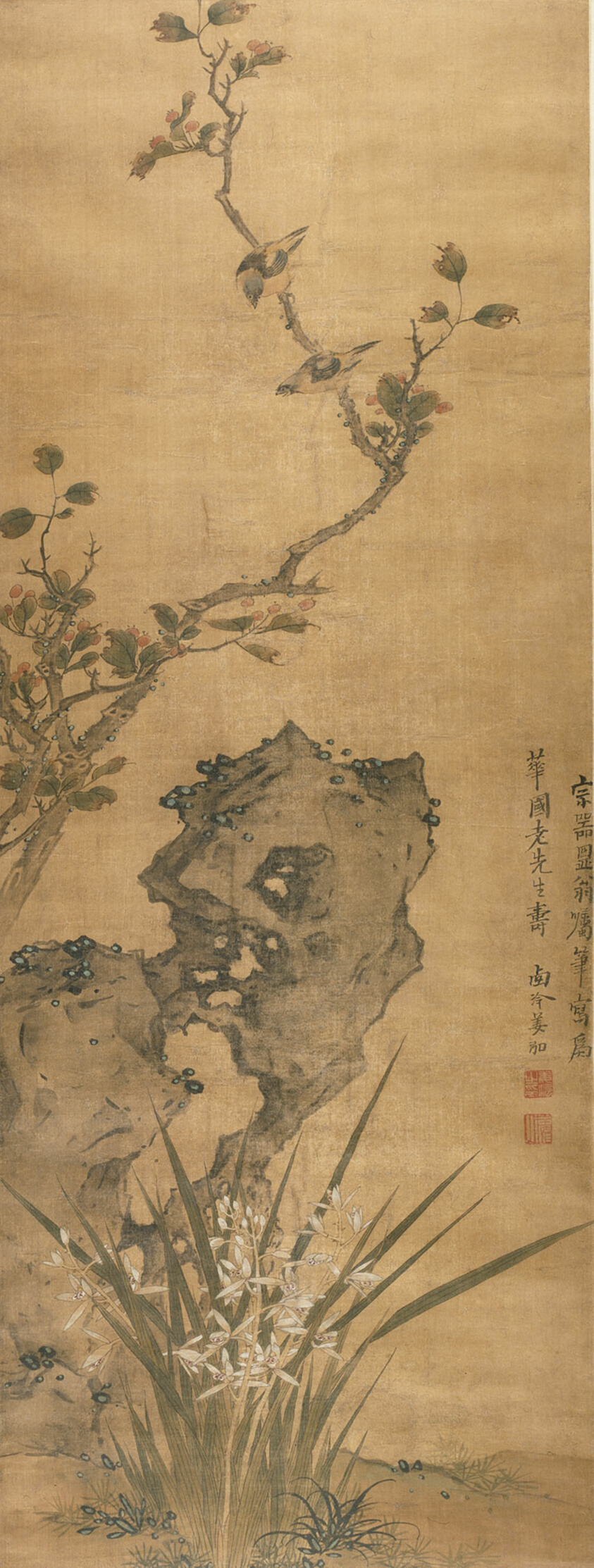
The central motif—birds disposed upon the boughs of a fruit-laden tree amidst autumn foliage—is a lexicon of symbolic richness, rendered with an eye for both botanical accuracy and poetic licence. The composition is neither haphazard nor rigidly formal. It obeys, rather, the higher laws of natural rhythm and visual balance. The tree’s architecture is suggested with confident, calligraphic strokes; its trunk and principal limbs possess a tensile strength, while the finer branches exhibit a graceful, yielding movement. This embodies the principle of fluid elegance: a controlled vitality that suggests growth and resilience without any hint of brittleness.
The foliage, in its autumnal transformation, is not a dirge for summer but a celebration of mature splendour. The palette—ochres, carmine, and burnt sienna—is applied with layered subtlety, suggesting the play of light through a canopy rather than a flat, decorative pattern. This is colour with intelligence and atmospheric intent. The fruit, pendulous and precise, signifies abundance, reward, and the fruitful culmination of the seasonal cycle. It is nature’s bounty, presented with a quiet, assured opulence.
The Avian Assemblage: Portraiture and Protocol
The birds are the protagonists in this sylvan theatre, and their treatment is one of discerning portraiture. Each species is rendered with an ornithologist’s eye for distinguishing detail—the sweep of a wing, the angle of a beak, the particular set of a head—yet elevated through the artist’s brush to a state of idealized character. They are not merely depicted; they are portrayed. Their arrangement on the boughs is a masterclass in spatial dynamics and implied narrative. One observes a hierarchy, a social order within the branches. A dominant figure, perhaps a magpie or a thrush, occupies a central, commanding position, its posture erect and gaze direct. Others engage in quieter communion: one leans to preen a companion’s feathers, another cocks its head in avian curiosity, a third is captured in the delicate act of selecting a berry.
This is not a snapshot of chaos, but a curated assembly. It reflects a worldview where nature, in its perfected state, mirrors a desirable social order—diverse yet harmonious, active yet composed, individualistic yet integrated within the whole. The fluidity of the line describing their forms, from the crisp definition of a claw gripping bark to the soft, blurred suggestion of downy breast feathers, showcases a technical mastery that serves a philosophical end: the depiction of life in its most animated, yet most gracefully contained, form.
Context and Connoisseurship: The Heritage of the Hand
To fully appreciate this artifact, one must consider it within the continuum of classic silk craftsmanship. This is a discipline demanding patience, foresight, and an unwavering respect for the material. Each wash of colour on silk is a commitment; there is little room for correction. The artist must work with a confident deliberation, understanding how pigments will bleed and settle into the silk’s fibres to create effects of soft diffusion and sharp contrast. The resulting image possesses a depth and a tactile sensibility that is the hallmark of the tradition.
The mounting as a hanging scroll further codifies its significance. This format demands respect in display and contemplation. It is an object for a space of reflection, intended to be unfurled and appreciated in a manner both ceremonial and personal. The scroll’s borders, likely of a complementary, muted damask or further silk, act as a proscenium arch, framing the natural world as a performance of enduring beauty. The craftsmanship of the mounting—the precision of the joins, the tension of the silk, the selection of the rollers—is the final, silent attestation to the artifact’s quality. It is the equivalent of a bespoke suit’s inner lining and hand-finished buttonholes: details unseen at first glance, but whose perfection is fundamental to the integrity of the whole.
In conclusion, this artifact, Birds on a Tree with Fruit and Autumn Foliage, stands as a testament to a heritage where artisanal skill and philosophical contemplation are inseparable. Through the esteemed medium of silk, it presents a vision of nature that is ordered, abundant, and elegantly fluid. It speaks of a world where every element, from the grand sweep of a branch to the minute detail of a feather, finds its rightful and beautiful place. It is, in the final analysis, not simply a picture of a tree, but a meticulously crafted argument for harmony, maturity, and the quiet, enduring authority of the natural world, rendered with a Savile Row standard of cut, cloth, and execution.