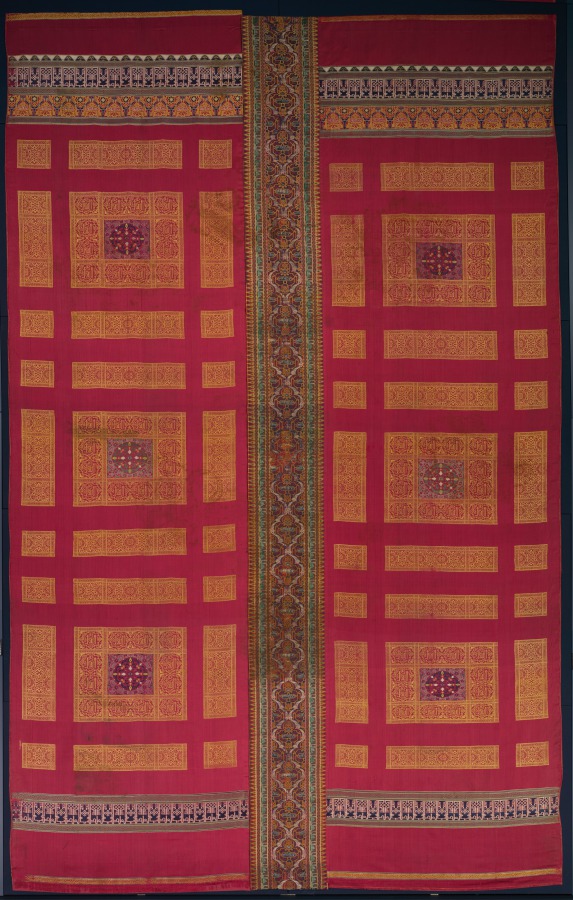
Alhambra Palace Silk Curtain: A Study in Imperial Materiality
Provenance and the Language of Silk
In the rarefied world of heritage textiles, few artefacts command the quiet reverence of the Alhambra Palace Silk Curtain. This is not merely a length of fabric; it is a document, a ledger of imperial ambition, and a masterclass in material storytelling. For the discerning eye—trained on the bespoke tailoring of Savile Row—the curtain speaks in a dialect of lustre, drape, and tensile strength that modern synthetics can only imitate, never inhabit. Its materiality, pure mulberry silk, is the first and most profound statement. The filament, unbroken from cocoon to loom, carries a continuous narrative of craftsmanship that spans continents and centuries.
The Alhambra, a Nasrid dynasty citadel in Granada, reached its zenith in the 14th century, a period when the Islamic world’s textile ateliers were the undisputed arbiters of luxury. Silk, in this context, was not a commodity but a currency of power. The curtain, likely a *cortina* or ceremonial hanging, would have been woven in the royal *tiraz* workshops—state-controlled manufactories that produced fabrics exclusively for the court. To touch this silk is to understand the political economy of the era: the raw material travelled from China along the Silk Road, was spun and dyed in the Maghreb or Al-Andalus, and was then woven into patterns that encoded geometric perfection and calligraphic devotion. The imperial legacy is not incidental; it is structural. Every warp and weft thread was a testament to the ruler’s ability to command resources, labour, and artistic genius.
Materiality and the Craft of the Loom
From a technical standpoint, the curtain’s silk exhibits a character that a Savile Row cutter would recognise immediately: the difference between a fused, machine-made garment and a hand-finished, canvassed jacket. The silk’s *hand*—its tactile feel—is supple yet resilient, with a subtle *scroop* (that faint, crisp rustle) that signals high-quality, degummed filaments. The weave structure, likely a compound twill or lampas, allows for intricate polychrome patterns while maintaining structural integrity. This is not a flimsy decorative piece; it is an architectural textile, designed to hang with weight and authority, to filter light without succumbing to it.
The dye palette, derived from natural sources—madder for the deep crimson, indigo for the lapis blues, and weld for the golden yellows—offers a chromatic depth that is impossible to replicate with aniline dyes. These colours were not merely aesthetic; they were symbolic. Red signified sovereignty and martyrdom; blue, the heavens; gold, the divine. The curtain’s materiality, therefore, operates on two registers: the physical (its weave, weight, and drape) and the metaphysical (its colour, pattern, and provenance). For the heritage specialist, this dual nature demands a methodology that bridges forensic analysis and art-historical interpretation.
Imperial Legacy and the Savile Row Parallel
The legacy of imperial silk weaving is not a static relic; it is a living tradition that echoes in contemporary luxury. Consider the Savile Row house of Anderson & Sheppard, where a single jacket requires upwards of 50 hours of handwork. The Alhambra curtain, similarly, would have consumed hundreds of hours at the loom, with a master weaver coordinating a team of apprentices. The parallel is instructive: both traditions privilege process over speed, and both treat the final object as a repository of skill. The imperial silk workshops were the precursors to the modern atelier, and the curtain is their surviving testament.
Yet, the imperial legacy also carries a cautionary tale. The Nasrid dynasty fell in 1492, and the Alhambra’s workshops were dismantled. The curtain survived, but its production context vanished. This is the fragility of heritage: the object outlives the system that created it. In a contemporary context, the fashion industry’s obsession with speed and disposability stands in stark opposition to the curtain’s ethos. A Savile Row suit is made to last decades; the Alhambra curtain was made to last centuries. The materiality of silk, with its protein-based fibres that can survive for millennia under the right conditions, demands a philosophy of care and longevity. To commission a bespoke garment today is to engage in a quiet rebellion against fast fashion—a rebellion that the Alhambra curtain has already won.
Conservation and the Ethics of Preservation
Preserving the Alhambra Palace Silk Curtain is not a passive act of storage; it is an active negotiation with time. Silk is hygroscopic, absorbing moisture and releasing it, which makes it vulnerable to hydrolysis—a slow, chemical degradation that weakens the fibres. The curtain’s survival is due to the dry, temperate climate of the Alhambra, but modern conservation must go further. Light exposure, even at low lux levels, causes photochemical fading. The reds and blues that once blazed are now muted, and any future display requires a strict regimen of UV-filtered glass and dim, ambient illumination.
For the heritage specialist, the ethical question is one of access versus preservation. Should the curtain be exhibited, risking further damage, or kept in dark storage, unseen? The Savile Row analogy is apt: a fine suit, if worn, will eventually show wear at the elbows and knees. The decision to wear it is a decision to accept its mortality. Similarly, the curtain’s display is a form of use, and its conservation must balance the public’s right to witness imperial craftsmanship with the object’s right to endure. The solution lies in controlled rotation—displaying the curtain for limited periods, followed by extended rest in a stable, dark environment. This is not a compromise; it is a discipline.
Conclusion: The Curtain as a Living Standard
The Alhambra Palace Silk Curtain is more than an artefact; it is a standard against which all subsequent luxury textiles must be measured. Its materiality—the silk, the dyes, the weave—embodies a pinnacle of human achievement, while its imperial context reminds us that beauty is often born of power. For the modern practitioner, whether a Savile Row tailor or a heritage curator, the curtain offers a lesson in integrity: the integrity of material, the integrity of process, and the integrity of preservation. It asks us to slow down, to honour the hand, and to resist the tyranny of the new. In a world of disposable fashion, the curtain stands as a silent, luminous rebuke—a reminder that true luxury is not about novelty, but about permanence.
As we move forward, the curtain’s legacy must inform our own practice. We must weave with intention, dye with meaning, and conserve with reverence. The Alhambra curtain is not a relic of the past; it is a blueprint for the future of heritage luxury. To study it is to learn the grammar of excellence. To preserve it is to speak that grammar fluently for generations yet unborn.