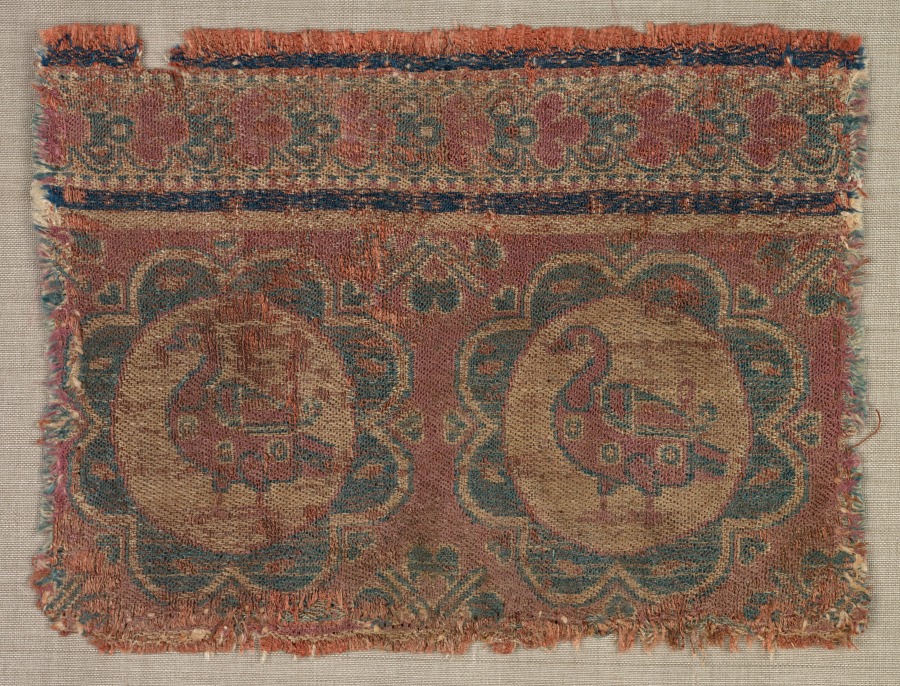
Heritage Research Artifact: Silk Fragment with Duck Roundels
In the hushed, measured world of London’s Savile Row, where cloth is not merely fabric but a form of architectural integrity, a fragment of silk bearing the ghostly imprint of duck roundels commands more than casual admiration. It demands a forensic reverence. This is not a swatch for a summer waistcoat; it is a surviving page from the ledger of imperial ambition, a testament to the fact that the finest tailoring has always been, at its core, a study in the politics of thread. To handle this piece is to understand that the suit, in its purest form, is a descendant of the throne.
Materiality and the Grammar of the Loom
Let us first address the cloth itself. The materiality is uncompromising: a warp-faced compound weave, likely a lampas or a samite, constructed with a disciplined density that speaks of a loom operating under the strictest court supervision. The ground is a deep, oxidized indigo—now a muted midnight—against which the roundels emerge in a contrast of faded ochre and a verdigris that time has rendered almost mineral. The silk’s hand is dry, almost chalky, a result of centuries of desiccation, yet the tensile strength remains formidable. This is not a delicate gauze; this is a structural textile, designed to hold its shape under the weight of ceremonial robes or, later, to be repurposed into the stiff, structured interiors of a gentleman’s coat. The weave is so tight that the individual filaments—each one a continuous, unbroken filament from the cocoon of a domesticated Bombyx mori—are nearly invisible to the naked eye. It is a cloth that whispers of patience, of a process where a single thread could take a week to prepare, and a single bolt, a year to complete.
The Duck Roundel: A Symbolic Lexicon
The roundel itself is the intellectual crux. In the lexicon of imperial Chinese iconography, the duck—particularly the mandarin duck—is not a mere waterfowl. It is a symbol of conjugal fidelity, of domestic harmony, and, crucially, of bureaucratic rank. But the specific iteration here, rendered in a stylized, almost geometric profile, suggests a period of high Tang or early Song dynasty production, when Sasanian and Central Asian motifs were being absorbed and re-articulated through a distinctly Chinese lens. The duck is depicted in flight, its wings spread in a rigid, heraldic symmetry, encircled by a pearl border—a motif that echoes the Buddhist chintamani or the celestial pearl of wisdom. The pairing of the duck with the pearl is not incidental; it is a deliberate fusion of the terrestrial (domestic virtue) with the celestial (imperial mandate). Each roundel is a microcosm of the state: ordered, symmetrical, and infinitely repeatable.
The Legacy of Imperial Silk Weaving
This fragment is a direct descendant of the great imperial workshops—the Ningshou Gong or the later Jiangnan silk bureaus—where the Emperor’s private textile needs were met with a rigour that rivaled the construction of a cathedral. The legacy is one of absolute control. The mulberry trees were cultivated in designated groves. The silkworms were raised on trays of specific bamboo, fed on leaves picked at dawn, and their cocoons were boiled in water drawn from particular springs. The dyers used madder, indigo, and the precious sheh-liao (a crimson derived from insect bodies) under the supervision of eunuch officials who kept ledgers more detailed than any modern supply-chain audit. The loom itself was a vertical drawloom, requiring two operators: one to sit in the pit and pull the heddles, the other to throw the shuttle. The pattern for the duck roundel would have been encoded on a hua ben—a paper pattern—and then transferred to the loom via a complex system of cords and pulleys. The margin for error was zero. A single broken warp thread could ruin a day’s work; a misread pattern card could result in the execution of the weaver.
From Imperial Robe to Savile Row Construction
The journey of this fragment from the Forbidden City to the cutting tables of London is a narrative of appropriation and reinvention. In the late 19th and early 20th centuries, as the Qing dynasty faltered, vast quantities of imperial silk were dispersed through looting, diplomatic gifts, and the auction houses of Paris and London. The Savile Row houses—ever alert to the tactile poetry of exotic cloth—began to acquire these remnants. But they did not treat them as museum pieces. They treated them as material. A tailor on Sackville Street might use a fragment of duck roundel silk as a lining for an evening coat, the imperial motif hidden against the wearer’s body—a private joke, a secret indulgence. Alternatively, a cutter might use the silk to create a smoking jacket for a client who had served in the Far East, the roundels becoming a subtle badge of colonial service. The silk was repurposed, its sacred geometry subordinated to the secular demands of the British gentleman’s wardrobe. The imperial legacy was not erased; it was translated. The discipline of the loom became the discipline of the needle. The symmetry of the roundel informed the balance of a lapel. The density of the weave dictated the drape of a shoulder.
Conservation and the Tailor’s Eye
Today, this fragment is not for sale. It is a study piece, kept in a climate-controlled archive, mounted on acid-free board, and examined under low light. But the lesson it imparts is timeless. For the modern tailor, it is a reminder that cloth is never neutral. It carries the weight of its own making. When a client on Savile Row asks for a suit in a heavy worsted or a crisp mohair, they are unknowingly participating in a tradition that stretches back to the imperial looms—a tradition of patience, of precision, and of the belief that what you wear is a statement of your place in the world. The duck roundel silk is not a relic; it is a benchmark. It asks the tailor a simple question: do you understand the gravity of your material? If you do not, the cloth will know. And it will betray you.
In the end, this fragment is a quiet argument for the enduring power of craft. It is a piece of history that does not shout; it whispers. And in the tailored silence of a fitting room, that whisper is louder than any proclamation.