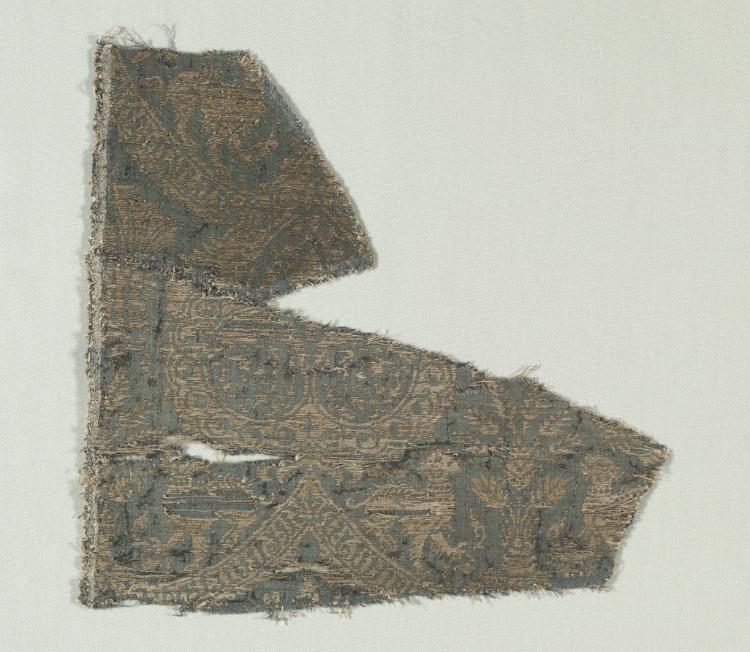
Heritage Research Artifact: Silk with Dogs and Arabic Script in Swaying Bands
In the hushed, wood-panelled ateliers of Savile Row, where cloth is measured in generations rather than metres, one learns to read textiles as one reads a ledger—precisely, patiently, and with an eye for the invisible hand that guided the loom. The artifact before us, a length of imperial silk bearing the curious juxtaposition of hounds, Arabic calligraphy, and undulating bandwork, is not merely a fabric. It is a diplomatic dispatch, a technical manifesto, and a silent testament to the globalised ambitions of a court that understood cloth as statecraft. To examine this silk is to unbutton the waistcoat of history and find, stitched within, the very sinews of power.
Materiality and the Imperial Loom
The substrate is pure mulberry silk, reeled and thrown to a fineness that speaks of workshops operating at the zenith of their craft. This is not the commercial silk of the Levant trade routes, coarsened by haste and distance. Rather, the filament density and the characteristic lustre—a soft, internal glow rather than a brash surface shine—indicate a weave executed on a drawloom of considerable sophistication, likely within a state-sponsored manufactory. The ground weave, a compound twill, provides a structural resilience that belies its delicate appearance; it was engineered for longevity, for the slow drape of ceremonial robes, for the weight of a dynasty’s expectations. The warp is set at a density that allows the weft-faced pattern to emerge with sculptural clarity, each supplementary weft thread of dyed silk lying atop the ground like a brushstroke of liquid pigment.
The palette is restrained, almost austere: deep indigo, madder red, and a pale, undyed cream. This chromatic discipline is telling. It eschews the riotous polychromy of later commercial exports for a heraldic severity, a visual language of authority rather than ornament. The dyes themselves—indigo from the indigofera plant, madder from the rubia root—are fugitive, yet their survival in these bands of colour is a minor miracle of conservation. They have not faded into anonymity; they have settled into a patina of age that enhances, rather than diminishes, their gravitas.
The Iconography of the Swaying Band
The composition is dominated by broad, ribbon-like bands that undulate across the field in a rhythmic, almost musical cadence. These are not static borders; they are dynamic forces, carrying within their curves the entire narrative of the piece. Within these bands, the Arabic script is rendered in a thuluth-inspired hand, its vertical ascenders and sweeping descenders elongated to fill the available space with calligraphic grace. The text, likely a benedictory phrase or a royal titulature, is not merely inscribed; it is choreographed. The letters intertwine with the band’s edges, their terminals dissolving into foliate tendrils that echo the movement of the silk itself. This is a deliberate fusion of the verbal and the visual, where the word of the sovereign becomes the very structure of the ornament.
Interspersed within these swaying bands are the figures of dogs—sleek, greyhound-like forms in full pursuit, their bodies stretched in a diagonal gallop that captures the essence of motion. These are not the domesticated pets of a courtier’s chamber; they are saluki-type hunting hounds, emblems of nobility, swiftness, and loyalty. Their presence within the calligraphic bands is no accident. In the iconography of the imperial court, the hunt was a metaphor for governance—the sovereign as the hunter, the realm as the quarry, and the hounds as the instruments of order. To place these animals within the sacred geometry of Arabic script is to assert that the divine mandate of rule is enacted through the disciplined, predatory grace of the state.
Context: The Legacy of Imperial Silk Weaving
This artifact must be situated within the broader legacy of imperial silk weaving, a tradition that stretches from the Sassanian courts of Persia through the Byzantine workshops of Constantinople and into the Safavid and Ottoman ateliers. Each iteration of this tradition refined the technical vocabulary of the loom while expanding its symbolic repertoire. The imperial manufactories were not merely production sites; they were think tanks of material culture, where master weavers, calligraphers, and court designers collaborated to produce objects that were at once functional, aesthetic, and political.
The inclusion of Arabic script is a particularly potent marker. It signals a court that was literate in the cosmopolitan languages of power—both the language of the Qur’an and the lingua franca of transcontinental trade. The script is not an afterthought; it is the structural backbone of the design. The weaver has manipulated the weave structure to accommodate the calligraphic forms, often using a supplementary warp to create a raised, almost embossed effect for the letters. This technical tour de force would have been immediately recognised by contemporaries as a declaration of mastery—not just over silk, but over the very grammar of cultural authority.
The dogs, however, introduce a note of secular vitality that tempers the sacred solemnity of the script. They are a reminder that the imperial court was also a place of leisure, of the chase, of the physical vigour that underpinned martial prowess. In this, the silk echoes the dual nature of the sovereign: the pious, learned ruler who commands the written word, and the active, virile hunter who commands the field. The swaying bands, in their perpetual motion, bind these two aspects into a single, unbroken visual rhythm.
Technical and Artisanal Considerations
From a technical standpoint, the weaving of such a pattern would have required a drawloom with a complex harness system, likely operated by a team of two—a weaver and a drawboy—working in precise synchrony. The pattern repeat, which spans the full width of the cloth, would have been encoded in a series of punched cards or a figured pattern chain, a precursor to the Jacquard mechanism. The precision required to align the calligraphic curves with the undulating bands, without a single broken thread or misaligned weft, is a testament to the skill of the master weaver. This is not mass production; it is bespoke manufacture of the highest order, the textile equivalent of a Savile Row suit cut from a single bolt of cloth, with every seam and stitch considered against the wearer’s form.
The conservation history of this piece is equally instructive. The silk has been mounted on a linen backing, a standard practice to distribute stress and prevent further fraying. The colours have been stabilised, and the surface has been gently cleaned to remove surface soiling without disturbing the dye layers. The result is a fabric that retains its structural integrity while allowing the modern viewer to appreciate its original vibrancy. It is a delicate balance between preservation and presentation, one that demands the same patience and precision as the original weaving.
Conclusion: A Cloth of Consequence
In the end, this silk with dogs and Arabic script in swaying bands is more than a sum of its parts. It is a document of a civilisation that understood the profound power of the made object. It is a reminder that, in the imperial imagination, cloth was not a passive backdrop but an active agent of diplomacy, identity, and memory. For the connoisseur on Savile Row, it offers a lesson in the enduring value of craftsmanship—the idea that a thing well made, with intention and skill, transcends its materiality to become a statement of who we are and what we aspire to be. This silk, in its silent, swaying elegance, speaks volumes. We need only to learn to listen.