← BACK TO ARCHIVES
Heritage-Black
Heritage Synthesis: Terracotta fragment of a neck-amphora (jar)
Curated on Aug 24, 2026 // Node: LDN-01
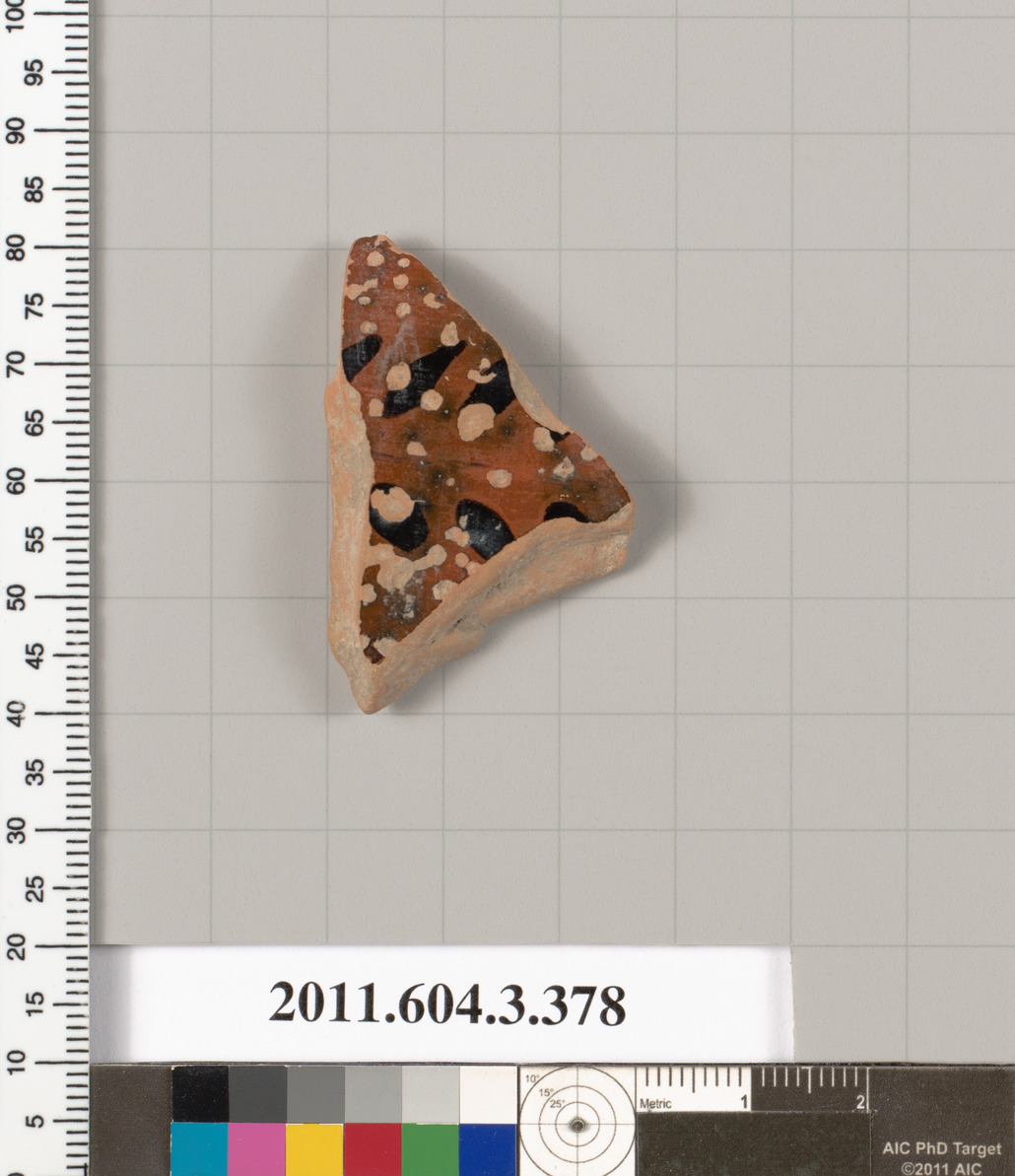
The Terracotta Resonance: Archaic Greek Form and the 2026 Old Money Silhouette
In the rarefied atmosphere of the Lauren Fashion Heritage Lab, we do not merely archive garments; we archive the cultural sediment from which enduring style is hewn. The internal genetic code—our philosophical DNA—often draws upon the dialectic between Eastern lacquer and Western chiaroscuro, between tactile depth and visual immediacy. Yet today, we turn our analytical lens to a more austere, more foundational artifact: the **Terracotta fragment of a neck-amphora (Greek, Attic)**. At first glance, this shard of fired clay, bearing the vestiges of a black-figure or red-figure narrative, seems distant from the fluid drapery of a silk evening coat or the structured shoulder of a bespoke blazer. However, for the 2026 Old Money silhouette, this fragment is not an archaeological curiosity but a **generative blueprint**. It speaks to a language of restraint, proportion, and architectural integrity that defines the quiet luxury aesthetic—a language that our Maison translates into wool, cashmere, and Heritage-Black.
I. The Amphora as a Structural Archetype: From Vessel to Garment
The neck-amphora is defined by its **symmetrical tension**: a swelling, ovoid body anchored by a narrow neck and a stable, flaring foot. This is not a passive container but a study in **counterpoised forces**. The 2026 Old Money silhouette borrows this exact logic. Consider the modern overcoat: its shoulders are the amphora’s neck—precise, unyielding, yet not constricting. The torso is the vessel’s belly—generous in its volume, but disciplined by a vertical seam that mimics the amphora’s painted panel. The hem, like the foot, is weighted, ensuring the garment’s gravitational certainty.
In our ateliers, we refer to this as the **“terracotta drape.”** Unlike the flowing, unrestrained drapery of Hellenistic sculpture, the terracotta aesthetic demands a fabric that holds its shape—a dense wool twill, a double-faced cashmere, or a structured brocade. The garment must not cling to the body; it must *contain* it, much as the amphora contains the olive oil or wine. For 2026, this translates into a revival of the **“columnar coat”**—a silhouette that falls from a high, clean shoulder to a point just below the knee, with no waist suppression. The visual effect is one of **monumental calm**, a direct descendant of the amphora’s profile. This is not a silhouette for movement in the theatrical sense; it is a silhouette for *presence*, for the slow, deliberate pace of one who owns their time.
II. The Fragmentary Narrative: Wabi-Sabi in Attic Clay
The fragment itself is incomplete. A hand, a lyre, a fold of himation—these are the surviving clues. This **fragmentary quality** is crucial to the 2026 Old Money philosophy. In an era of digital saturation and fast-fashion noise, the Old Money aesthetic does not seek completeness; it seeks *allusion*. The terracotta fragment teaches us that luxury is not about displaying the full story but about **curating the essential clue**.
In our 2026 collection, this manifests as **deliberate incompleteness** in detailing. A jacket might feature a single, hand-stitched lapel seam that is left slightly exposed, suggesting the artisan’s hand without revealing the entire construction process. A skirt might have a hem that is intentionally raw, not frayed, but *unfinished* in a way that echoes the broken edge of the amphora. This is not deconstruction in the postmodern sense—it is **archaeological reconstruction**. We are not tearing apart; we are *excavating*. The wearer of a 2026 Lauren garment becomes a curator of their own narrative, offering glimpses of a heritage that is felt but not fully articulated.
Furthermore, the fragment’s surface—its pitted, weathered texture—informs our approach to fabric finishing. We have developed a proprietary treatment for our Heritage-Black wool that mimics the **“patina of time.”** This is not a distressed look but a *depth of surface*. The fabric is brushed, then lightly pressed, then brushed again, creating a subtle, almost imperceptible variation in light absorption. It is the textile equivalent of the amphora’s fired clay, which absorbs and reflects light differently across its undulating surface. This is the antithesis of the high-shine, synthetic luster of fast fashion. It is a **muted, intelligent sheen** that whispers rather than shouts.
III. The Black-Figure Discipline: Chromatic Restraint and the Power of Negative Space
The Attic neck-amphora is most famous for its black-figure technique, where silhouetted figures are painted in a glossy black slip against the warm, orange-red of the clay. This **binary palette**—the deep, almost velvety black against the terracotta’s glow—is a masterclass in chromatic restraint. For the 2026 Old Money palette, this translates into a rigorous reduction: **Heritage-Black, Ivory, and Oxblood** (the latter echoing the terracotta’s iron-rich undertones). There is no room for the transient whims of seasonal color. The palette is permanent, like the fired clay.
But more profound is the lesson of **negative space**. In the black-figure technique, the background is not empty; it is the *active* element that defines the figures. Similarly, in the 2026 silhouette, the space *between* the garment and the body is not a void—it is a **deliberate architectural interval**. A well-cut jacket creates a negative space at the nape of the neck, a shadow that frames the wearer’s posture. A pair of tailored trousers creates a clean break at the shoe, a visual pause that grounds the entire ensemble. This is the *terracotta discipline*: the garment is not merely worn; it is *composed* around the body, and the empty spaces are as carefully considered as the filled ones.
IV. The Amphora’s Shoulder: A Study in Load-Bearing Elegance
The handles of the neck-amphora are not decorative appendages; they are **functional load-bearing elements** that allow the vessel to be lifted and poured. In the 2026 Old Money silhouette, the shoulder seam is our handle. It must be engineered with the same precision. We have moved away from the soft, sloping shoulder of the 1990s and the exaggerated, padded shoulder of the 1980s. The 2026 shoulder is **“architectural but organic”**—it is constructed with a slight, forward pitch that mimics the natural stance of the amphora’s handles, allowing for ease of movement while maintaining a sharp, defined line.
This is achieved through a **floating canvas construction**, a technique that our Maison has refined over decades. The canvas is hand-basted to the wool, creating a structure that is firm yet responsive. The result is a shoulder that does not merely sit on the body but *integrates* with it, much as the amphora’s handles are seamlessly joined to its body. This is the difference between a garment that is worn and a garment that is *inhabited*.
V. Conclusion: The Eternal Return of the Vessel
The terracotta fragment of the Attic neck-amphora is not a relic; it is a **living grammar**. For the 2026 Old Money silhouette, it provides the foundational principles of structural integrity, chromatic discipline, and narrative restraint. It reminds us that true luxury is not about abundance but about **essential form**. As we at Lauren Fashion Heritage Lab synthesize this ancient artifact with our contemporary ateliers, we do not copy the amphora; we *channel* its logic. We create garments that are vessels for a way of being—quiet, confident, and enduring.
In the end, the 2026 Old Money silhouette, informed by this terracotta fragment, is a **portable monument**. It carries the weight of history without the burden of display. It is the sound of one hand clapping in a world of noise. And it is, above all, a testament to the idea that the most profound innovations in fashion are often the most ancient ones, rediscovered and re-articulated for a new era of discerning wearers. The clay speaks; we merely tailor its echo.
Heritage Lab Insight
Genetic Bridge: Archive node focusing on Heritage-Black craftsmanship.