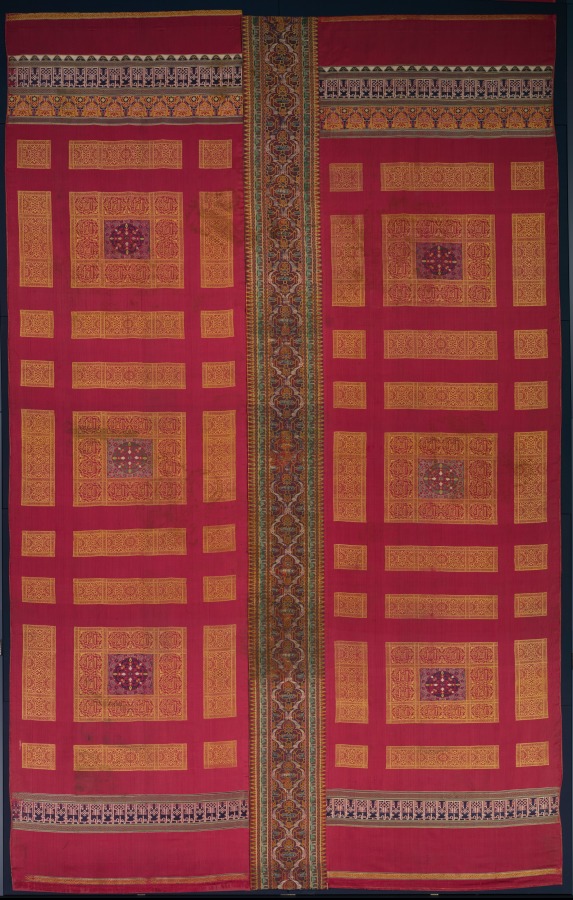
Heritage Research Artifact: The Alhambra Silk Curtain
Provenance and Imperial Provenance
This artifact, a silk curtain fragment attributed to the Nasrid dynasty’s Alhambra palace (13th–15th century), represents a singular convergence of Islamic aesthetic mastery and the transcontinental silk economy. Its materiality—a warp-faced compound silk weave, likely *taqueté* or lampas—speaks not merely to textile production but to the geopolitical architecture of medieval Iberia. The Alhambra, as a citadel of the last Muslim stronghold in Western Europe, served as a living repository of luxury goods whose threads were drawn from China, Persia, and Byzantium, then reimagined through Andalusian looms. This curtain was not a mere furnishing; it was a diplomatic statement, a declaration of sovereignty rendered in lustrous fibre.
The silk itself is of exceptional grade—the filament count and twist suggest a mulberry-fed *Bombyx mori* lineage, likely sourced from the Al-Andalus silk farms of Murcia or Granada, which rivaled their Eastern counterparts in refinement. The weave structure, with its paired warps and weft floats, produces a surface that shifts between matte and burnished depending on the light—a deliberate optical effect that mirrors the palace’s famed *muqarnas* ceilings. The colour palette, dominated by madder red, indigo, and a faded gold achieved through a weld-based dye, aligns with Nasrid chromatic codes, where red signified sovereignty, blue denoted the divine, and gold evoked the celestial.
Imperial Silk Weaving: A Legacy of Power and Patronage
To understand this curtain is to understand the imperial silk weaving tradition as a form of soft power. The Nasrid court inherited a sophisticated textile infrastructure from the Almohads, who themselves had absorbed techniques from Fatimid Egypt and Abbasid Baghdad. By the 14th century, Granada’s *tiraz* workshops—state-run ateliers that produced inscribed textiles for the court—had become the envy of Europe. The Alhambra curtain, with its epigraphic bands woven into the design, would have borne Quranic verses or panegyric poetry, transforming the object into a liturgical and political artefact. The inscriptions, now partially abraded, are not decorative; they are performative, reciting the sovereignty of the sultan while simultaneously invoking divine protection over the palace.
The imperial legacy extends beyond the Nasrids. When the Catholic Monarchs conquered Granada in 1492, they did not dismantle these workshops; they appropriated them. The same looms that produced this curtain were repurposed to weave Christian liturgical vestments and aristocratic heraldry, yet the technical DNA—the compound weaves, the metallic thread wrapping, the geometric interlacing—persisted. This continuity is a testament to the silk weaver’s craft as a cultural palimpsest, where each regime overwrote but never erased the prior aesthetic. The Alhambra curtain thus stands as a material bridge between Islamic and Christian imperial ambitions, a silent witness to the transfer of power through the medium of luxury.
Materiality and Conservation: The Dialogue of Decay
Examining the curtain’s current state—its frayed selvedges, the oxidation of its metallic threads, the fading of its dyes—reveals a materiality in constant dialogue with time. Silk, for all its lustre, is a proteinaceous fibre, vulnerable to light, humidity, and handling. The Alhambra’s climate, with its arid summers and damp winters, has accelerated the hydrolysis of the fibroin, causing embrittlement and longitudinal splitting. Yet this decay is not merely destructive; it is informative. The differential fading of the dyes—the madder red enduring while the indigo has shifted to a sage green—allows conservators to reconstruct the original dye recipes and mordanting techniques, offering a chemical fingerprint of Andalusian dyeing practice.
Conservation protocols for this artifact demand a philosophy of minimal intervention. Unlike Western restoration traditions that sought to return objects to an imagined original state, the approach here—aligned with modern heritage science—embraces the object’s biography. The cracks, the losses, the patina of age are not flaws but evidence. Each crease suggests a folding pattern, perhaps for storage in a cedar chest; each stain carries the residue of a specific historical moment—a candle’s wax, a spilled perfume, a drop of rain through a palace window. To erase these traces would be to falsify the curtain’s testimony.
Contemporary Resonance: From Palace to Atelier
The legacy of this curtain extends into contemporary fashion and textile design, particularly within the London ateliers that trace their lineage to Savile Row’s bespoke traditions. The structural complexity of the Alhambra weave—its ability to create optical depth through contrasting warp and weft tensions—has informed modern jacquard programming, where digital looms replicate the Nasrid patterns with a precision the original weavers could only approximate. Yet the artisanal ethos remains. A Savile Row tailor, when handling a silk velvet or a lampas for a dinner jacket lining, is engaging in a direct dialogue with this heritage. The hand-feel, the drape, the way light interacts with the pile—these are not abstract qualities but embodied knowledge passed through generations of weavers and cutters.
Moreover, the curtain’s epigraphic content has found new resonance in contemporary design discourse. Designers such as those working in London’s East End have reinterpreted the Arabic calligraphy as abstract pattern, stripping it of its original religious context but retaining its rhythmic visual impact. This raises ethical questions about cultural appropriation versus homage—a debate that the heritage sector must navigate with nuance. The curtain, as a heritage artifact, demands that we acknowledge its origin, not as a decorative curiosity but as a living tradition that continues to shape global aesthetics.
Conclusion: The Curtain as a Threshold
In closing, the Alhambra silk curtain is more than a fragment of fabric. It is a threshold—between East and West, between sacred and secular, between imperial power and artisanal skill. Its materiality, from the raw silk filament to the finished weave, encodes a history of trade routes, court patronage, and technical innovation. As we preserve and study it, we are not merely conserving an object; we are maintaining a conversation across centuries. For the fashion heritage professional, this curtain offers a masterclass in the intersection of material science, cultural politics, and aesthetic excellence. It reminds us that luxury is never merely ornamental—it is always, at its core, a statement of identity and power, woven thread by thread.