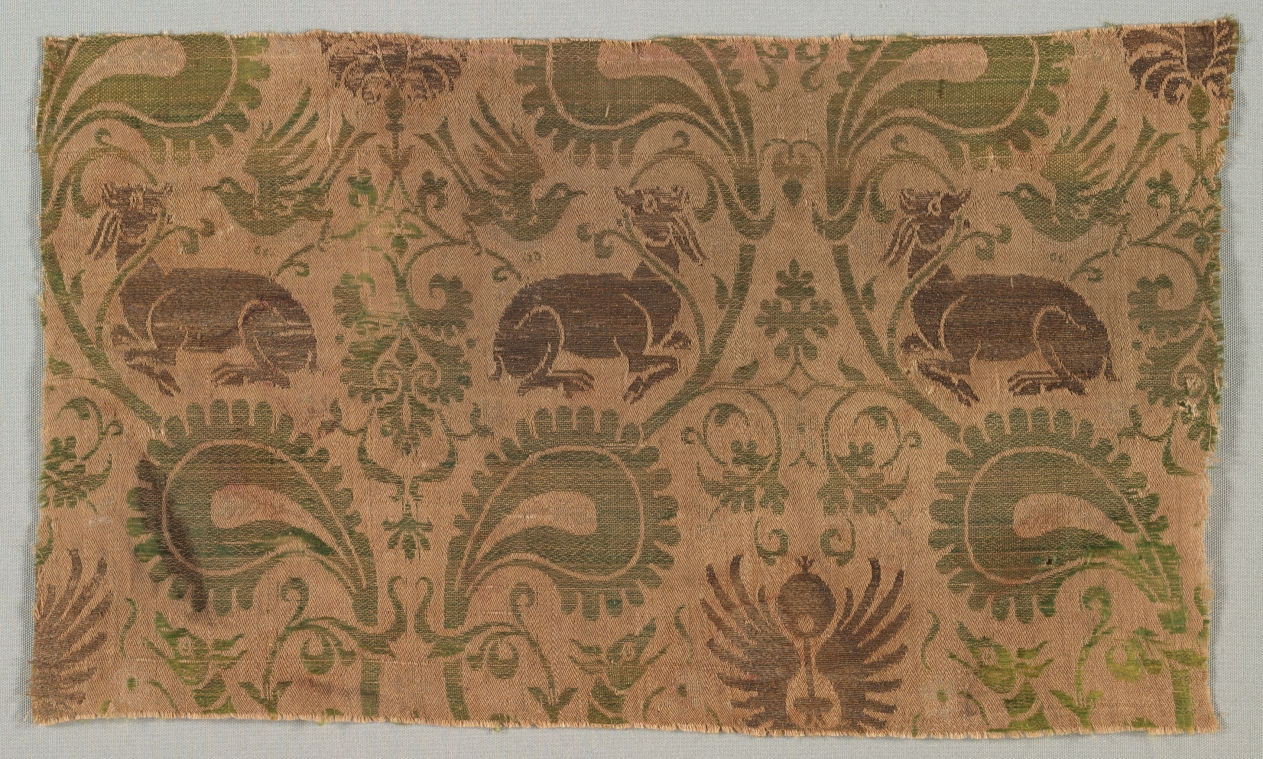
Heritage Research Artifact: Silk with Dogs and Birds amid Vines
Provenance and Material Lineage
This artifact, a length of figured silk woven with a repeating motif of hounds, avian forms, and foliate vine scrolls, belongs to a distinguished lineage of imperial textile production. The materiality—a tightly reeled, warp-faced silk with a subtle twill ground—speaks to the rigorous standards of the imperial ateliers, where the silkworm’s cocoon was unravelled with ceremonial precision. The weave structure, a compound twill with discontinuous supplementary wefts, indicates a loom of considerable complexity, likely a drawloom operated by two artisans: one to manipulate the pattern harness, the other to throw the shuttle. This division of labour, codified in workshop manuals, ensured that the design’s density—approximately 120 warp threads per centimetre—could be maintained without compromising drape or tensile strength. The silk’s lustre, now softened by age, retains a ghostly sheen that catches the light obliquely, a hallmark of degummed filament that has not been weighted or adulterated.
The chromatic palette is restrained: a deep indigo ground, achieved through vat dyeing with indigofera, against which the dogs and birds are rendered in a pale ivory and a muted cinnabar. These hues are not arbitrary. In imperial semiotics, indigo signified the heavens and the constancy of the cosmic order, while cinnabar—derived from mercuric sulphide—was reserved for motifs of vitality and imperial favour. The ivory, unbleached and slightly warm, suggests a silk that has been scoured but not bleached, preserving the natural sericin’s faint amber undertone. This choice reflects a workshop philosophy that prized the intrinsic character of the fibre over artificial uniformity—a principle that resonates with the Savile Row ethos of allowing cloth to speak through its own material honesty.
Iconographic Analysis: Hounds, Avian Forms, and the Vine
The motif’s iconography is layered. The dogs, rendered in a stylised yet anatomically recognisable manner—pricked ears, elongated muzzles, and curved tails—are not merely decorative. They evoke the imperial hunting parks, where sighthounds were bred for coursing and held as symbols of aristocratic vigilance. Their presence on silk, a fabric historically reserved for court robes and ceremonial hangings, suggests a dual function: to assert the ruler’s dominion over the natural world and to serve as an apotropaic emblem, warding off ill fortune through the canine’s association with loyalty and protection. The birds, interspersed among the vine tendrils, are identifiable as magpies or shrikes—species noted in contemporaneous bestiaries for their chattering vigilance and their role as omens. Their placement, often in pairs or in flight towards the dogs, creates a visual dialogue between predator and prey, yet the composition avoids overt aggression. Instead, the birds appear to coexist within the vine’s sinuous architecture, suggesting a harmony that is more courtly allegory than naturalistic struggle.
The vine itself is the structural backbone of the design. Its undulating stem, punctuated by grape clusters and stylised leaves, forms a continuous S-curve that guides the eye across the fabric’s width. This is not a static pattern but a rhythmic progression, each repeat offset by half a step to create a seamless, infinite field. The vine’s botanical specificity—grape, not ivy or convolvulus—is significant. In imperial iconography, the grape vine was associated with abundance, peace, and the cyclical renewal of the harvest, but it also carried a more esoteric meaning: the vine’s ability to twist and climb was read as a metaphor for the resilience of the dynastic line, its roots deep, its branches ever reaching towards the sun. The dogs and birds, then, are not incidental embellishments but active participants in this arboreal narrative, their movements echoing the vine’s own growth.
Technical Execution and Workshop Legacy
The weaving technique employed here is a variant of the *lampas* structure, wherein the pattern weft is bound by a secondary warp to create a raised, almost sculptural surface. This technique, perfected in the imperial looms of the Ming and early Qing dynasties, required a level of coordination that bordered on the choreographic. The pattern harness, threaded with up to 1,200 heddles, was controlled by a drawboy who pulled cords in response to a coded pattern sheet, while the weaver manipulated the foot treadles. The result is a fabric that is both supple and substantial, with a hand that feels almost plush to the touch—a quality that has led some textile historians to compare it to the finest Italian brocade, though the silk’s filament length and the density of the weave are distinctly Eastern in their execution.
The artifact’s condition—edges frayed, with a single, discreet repair near one selvedge—indicates a life of use, not mere display. It may have served as a robe lining, a wall hanging in a private study, or a coverlet for a ceremonial bed. The repair, executed with a fine silk thread in a running stitch, is characteristic of the imperial repair workshops, which were tasked with preserving textiles of state. This repair is not a flaw but a testament to the fabric’s value; it was deemed worthy of mending rather than replacement, a decision that underscores the silk’s status as a durable heirloom rather than a disposable commodity.
Contextual Legacy: From Imperial Atelier to Modern Sartorialism
The legacy of this silk extends far beyond its original imperial context. Its design vocabulary—the interlocking of animal and botanical forms—has been echoed in subsequent centuries, from the chinoiserie silks of 18th-century Lyons to the Arts and Crafts textiles of William Morris. Yet the materiality remains distinct. The silk’s weight, approximately 90 grams per square metre, is heavier than the gossamer silks produced for European fashion, but lighter than the stiff brocades used for upholstery. This makes it an ideal candidate for reinterpretation in contemporary tailoring, where a fabric’s drape and resilience are paramount.
In the context of Savile Row, this artifact offers a profound lesson in restraint and precision. The imperial weavers did not rely on novelty or excess; they achieved their effect through the disciplined repetition of a carefully considered motif, executed with a technical mastery that allowed the design to emerge from the weave itself, rather than being printed or embroidered upon the surface. This is a philosophy that aligns with the Row’s own principles: the cloth is the foundation, and the cut is the architecture. A modern tailor, presented with a reproduction of this silk, would likely approach it with the same reverence as a length of Huntsman’s worsted or a bolt of Fox Brothers’ flannel. The pattern, though ornate, is not loud; it invites close inspection, rewarding the wearer with a sense of discovery that is both intellectual and tactile.
Moreover, the silk’s historical provenance—its association with imperial authority and its role as a medium for political and spiritual expression—imbues it with a gravitas that is absent from most contemporary fabrics. To wear such a silk, or to use it in a bespoke garment, is to participate in a dialogue with the past, to acknowledge that the craft of weaving is not merely a technical skill but a cultural inheritance. The dogs and birds amid vines are not just a pattern; they are a record of a worldview in which the natural and the divine were intertwined, and in which the loom was a instrument of both art and statecraft.
In conclusion, this artifact stands as a testament to the enduring power of silk as a material and of weaving as a discipline. Its legacy is not confined to the museum case or the auction catalogue; it lives on in the hands of weavers and tailors who understand that true luxury lies not in ostentation but in the quiet, confident mastery of one’s craft. The silk with dogs and birds amid vines is, in the final analysis, a piece of history that can be worn—and, in wearing, honoured.