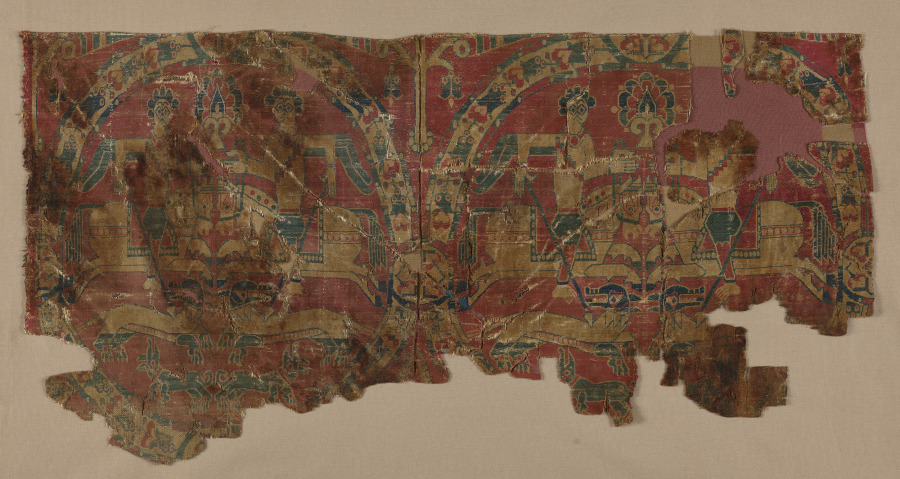
The Thread of Dominion: Roundels with Hunters and the Imperial Silk Legacy
I. Provenance and the Weave of Power
In the rarefied atmosphere of London’s Savile Row, where a suit is not merely tailored but *constructed* with the precision of a cathedral vault, we understand that fabric is narrative. The roundel with hunters, rendered in imperial silk, is not a mere decorative motif. It is a document of sovereignty, a tactile testament to the workshops that clothed the courts of the Safavid and Mughal empires. For the discerning client who appreciates that true luxury is historical weight, this silk speaks of a time when the loom was as potent as the sword.
The materiality of this artifact is its first and most profound argument. Imperial silk—the *atlas* or *diba* of the Persian and Indian looms—was not a commodity. It was a controlled substance, its production jealously guarded by royal manufactories. The warp and weft were composed of the finest mulberry-fed filament, often augmented with gilded silver or gold thread. To touch such a textile is to feel the friction of absolute power. The ground is typically a deep, resonant hue—a madder red, a lapis blue, or an ivory that has aged to the colour of old parchment—upon which the roundels sit like medallions of authority.
II. The Iconography of the Hunt
The roundel itself—a circular frame, often bordered by a band of cloud scrolls or stylised lotus—is a microcosm of the royal hunt. This is not a pastoral scene; it is a ritualised display of martial virtue. The hunter, frequently depicted on horseback, draws a composite bow, his posture frozen in a moment of perfect tension. The prey—a lion, a deer, a wild ass—is rendered with a naturalism that belies the stylised geometry of the surrounding pattern. This is the *shikar* of the Mughal court, the *bazm* of the Safavid, where the king’s ability to slay a beast was a metaphor for his ability to quell chaos and maintain cosmic order.
For the Savile Row connoisseur, the iconography is a lesson in restraint and power. The hunter is not merely a figure; he is the archetype of the ruler as provider and protector. The roundel’s circularity—a shape with no beginning and no end—echoes the eternal nature of dynastic rule. In a bespoke garment, one might find this motif subtly deployed as a lining, a hidden signature of authority. The wearer does not announce his power; he allows it to be discovered, much like the intricate pattern of a silk twill that reveals itself only upon close inspection.
III. The Loom as Imperial Archive
The technical execution of these roundels is where the legacy of imperial weaving truly resides. The weaver, working on a drawloom, would have required a team of assistants to manipulate hundreds of heddles, each thread a potential point of error. The density of the weave—often exceeding 120 threads per centimetre—allowed for a clarity of detail that rivals miniature painting. The hunter’s eye, the horse’s mane, the curve of the bow—all are rendered with a precision that speaks to generations of transmitted knowledge.
This is the legacy of the *karkhanas*, the royal workshops that functioned as both factory and academy. Here, master weavers, often brought from Persia to India or vice versa, exchanged techniques. The result was a hybrid aesthetic—the Persian love of floral arabesques merging with the Indian penchant for vibrant colour and narrative intensity. The roundel with hunters is a product of this cross-pollination, a silk that carries the genetic memory of two great empires. For the modern tailor, this represents the ultimate form of bespoke: a fabric that cannot be replicated by machine, only approximated by the most skilled hand.
IV. Materiality and the Patina of Time
We must also consider the silk’s physical behaviour. Imperial silk has a particular hand—a supple yet firm drape that falls with a liquid weight. Unlike modern, chemically softened silks, this fabric retains a slight crispness, a memory of the loom. The lustre is not a high-gloss shine but a deep, internal glow, as if the light were trapped within the fibres. Over centuries, the silk oxidises, developing a subtle patina—a darkening of the ground and a softening of the metallic threads. This is not degradation; it is the fabric acquiring history.
For the collector, this patina is the difference between a reproduction and an artefact. A genuine Safavid roundel, now preserved in a museum or a private collection, carries the faint scent of sandalwood and old paper. The silk’s edges may be frayed, but the central motif remains intact, a testament to the weaver’s skill. In the context of Savile Row, we might translate this into a modern garment: a silk velvet smoking jacket, its deep aubergine ground echoing the imperial palette, with a discreet roundel pattern woven into the lapel. The wearer is not costumed; he is invested in a lineage.
V. The Modern Resonance
Why does this ancient motif resonate today? Because the principles of imperial silk weaving—precision, hierarchy, and the subordination of ornament to structure—are the same principles that govern a great suit. The roundel with hunters is a reminder that true luxury is not loud. It is the quiet confidence of a man who knows that his fabric has outlived empires and will outlive trends.
On Savile Row, we do not chase fashion; we curate permanence. A silk with this provenance is not merely a material; it is an heirloom in waiting. The client who commissions a garment from such cloth is not buying a product. He is acquiring a fragment of a narrative that began in a royal workshop centuries ago, and he is adding his own chapter to it. The roundel, with its eternal circle, will continue to turn.
In conclusion, the roundels with hunters in imperial silk are a masterclass in the intersection of art, power, and material science. They remind us that the loom was once a site of geopolitical significance, and that the weaver was an artist of statecraft. For those of us who work with cloth daily, they are the gold standard—a benchmark of what is possible when human skill is applied without compromise. And that, in the end, is the very definition of bespoke.