An Examination of Imperial Legacy in Woven Form
To consider silk is to engage with the very fabric of history, a material whose narrative is interwoven with empire, diplomacy, and the pinnacle of artisanal ambition. Within the Lauren Fashion Heritage Lab, we examine not merely textiles, but tangible testaments to civilisational dialogue. The presented artifacts—a Brocaded Silk Cushion Cover and its companion Iranian Striped Silk Surround—serve as a profound case study. They are discrete yet eloquent expressions of a shared legacy in imperial silk weaving, speaking to the transmission of technique, aesthetic language, and symbolic power across continents and epochs. Their materiality, being pure silk, is the essential, non-negotiable foundation upon which this legacy was built.
The Sovereign Thread: Silk as a Currency of Power
One must first apprehend the context: silk was never a mere commodity. From its mythic origins in China, guarded with imperial severity, to its status as a prized diplomatic gift along the Silk Roads, silk functioned as a soft-power asset of the highest order. Its possession and mastery denoted sovereignty. The establishment of sericulture and complex loom technology in Byzantine workshops, and later in Italian city-states and Safavid Persia, was a deliberate act of economic and cultural sovereignty—a refusal to be dependent on another empire’s whims. The very fibre, with its unparalleled luminosity, strength, and capacity to hold colour, was deemed fit for royalty, liturgy, and the most significant state occasions. Thus, when we handle these pieces, we are handling material that was, by its nature, regal.
Decoding the Brocade: A Language of Opulence
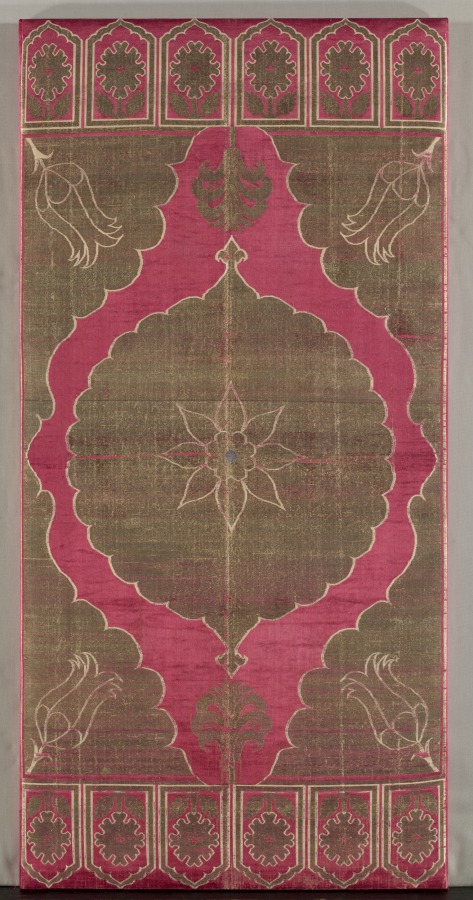
The Brocaded Silk Cushion Cover demands a particular focus. Brocade, from the Italian ‘broccato’ meaning ‘embossed cloth’, is a technique where supplementary weft threads are added to create raised, often metallic, patterns. This is not mere decoration; it is architectural in its approach to the fabric’s surface. The likely motifs—intricate florals, pomegranates, or scrolling vines—are not arbitrary. They are a direct inheritance from the Sino-Persian dialogue, motifs that travelled west from Chinese imperial workshops, were absorbed and reinterpreted by Safavid and Mughal master weavers, and later filtered into European courtly taste via trade and diplomacy.
The cushion’s function is equally telling. In the courts of Isfahan, Istanbul, or Versailles, such an item was never purely utilitarian. It was an element of a curated environment designed to overwhelm and signify. Placed upon a divan or throne, a brocaded cushion elevated the occupant, literally and figuratively. The labour-intensive process—requiring a draw-loom and immense skill—meant that its value was self-evident. The wear on certain threads, the patina of the metal yarn, these are not flaws but an honest provenance, a record of presence in a rarefied atmosphere.
The Striped Silk: Structural Elegance and Nomadic Echoes
In contrast, the Iranian Striped Silk Surround presents a different, though equally potent, strand of the imperial narrative. Striped silks, particularly those emanating from historical Persia, carry within their rhythmic bands a memory of both structure and mobility. The precision of the stripes demonstrates a masterful command of the loom’s tension and dyeing consistency, a technical prowess cherished in imperial workshops. Yet, the stripe itself has a nomadic heritage, found in the woven arts of tribal cultures integral to the Persian empires.
This piece, therefore, represents a synthesis: the refinement of the court absorbing and formalising a vernacular motif. The colours are of paramount importance. Deep indigos, saffron yellows, and madder reds were derived from precious dyes, their cost and stability legislated in imperial decrees. The surround’s purpose—perhaps as a trim, a sash, or a framing element—highlights its role as an accent of controlled brilliance. It provides a counterpoint to the brocade’s density, a lesson in strategic restraint that amplifies the overall splendour.
A Confluence of Legacies: The Dialogue Across the Pieces
Considered together, these artifacts enact a silent dialogue on the principles of imperial aesthetics. The brocade speaks of concentrated, pictorial opulence; the stripe speaks of rhythmic, chromatic authority. One is declarative, the other is insistent. Both rely on the supreme quality of the silk substrate to achieve their effect—the sheen that gives depth to the brocade’s patterns and vitality to the stripe’s colours. This is the legacy of imperial patronage: the resources to secure the finest raw silk, the most skilled artisans, and the time required for perfection.
Their journey to a modern context, perhaps via colonial trade routes, diplomatic gifts, or the collections of nineteenth-century Grand Tourists, adds another layer. They become fragments of a dispersed language, now studied in a Heritage Lab rather than displayed in a divan chamber. Yet, their power persists. They inform contemporary design not through literal replication, but through the lessons they embody: the weight of material integrity, the narrative depth of motif, and the understanding that true luxury resides in authentic provenance and technical mastery.
Conclusion: The Enduring Weft
The legacy of imperial silk weaving, as encapsulated by these two pieces, is ultimately one of synthesis and assertion. It is the story of how empires co-opted a miraculous fibre and its associated techniques, fused them with local visual languages, and deployed them as instruments of identity and prestige. The Brocaded Cushion Cover and the Iranian Striped Silk are more than relics; they are benchmarks. They remind us that in the hierarchy of materials, silk remains preeminent, and in the language of weaving, the imperial dialects—with their complex grammar of symbol, colour, and structure—continue to set the standard for what is considered, unequivocally, the finest.