Category: Silk
The Roundel as a Testament to Imperial Craft
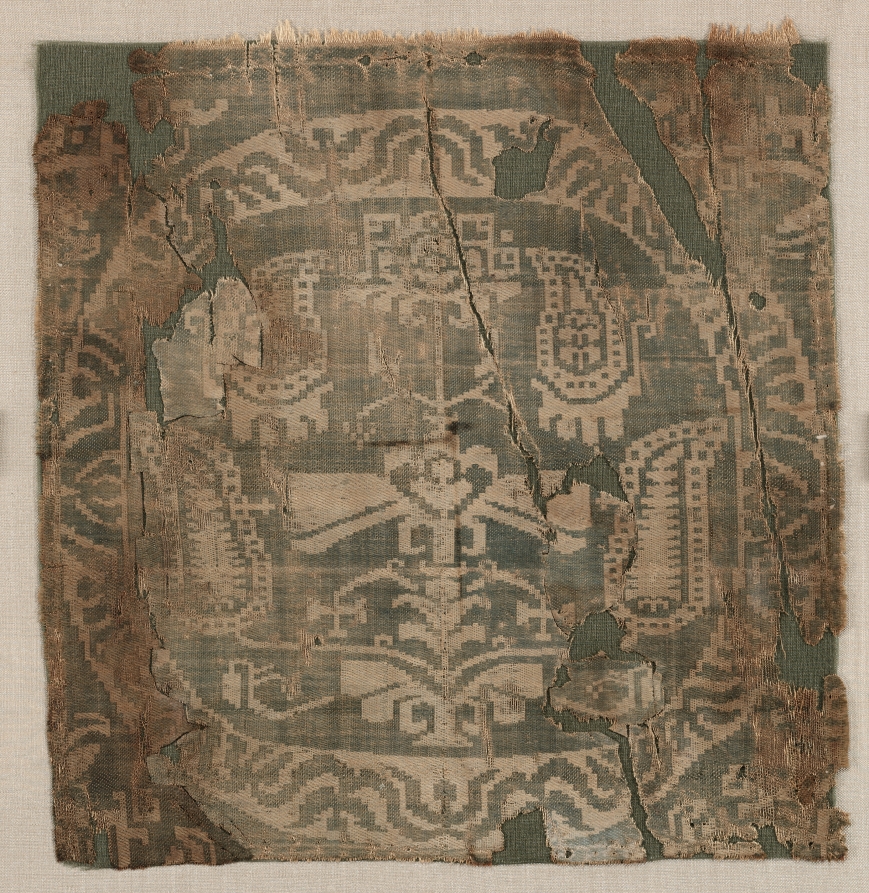
In the hushed ateliers of London’s Savile Row, where a bolt of cloth is treated with the reverence of a rare manuscript, one learns to read the language of thread. The Roundel from a Tunic with Palmette Tree is not merely a fragment of ancient textile; it is a diplomatic dispatch, a ledger of dynastic power, and a masterclass in material ambition. Woven in silk, this roundel speaks of an era when the loom was a throne and the weaver held the keys to an empire’s aesthetic authority.
To handle this piece—even in its current, fragmented state—is to appreciate the sheer physical intelligence of its construction. The silk is not a passive ground; it is a taut, lustrous membrane that captures light and bends it to the weaver’s will. The roundel’s composition, a central palmette tree flanked by symmetrical fronds, is not a casual floral motif. It is a codified emblem of arboreal sovereignty, a stylised representation of the Tree of Life that recurs across Sasanian, Byzantine, and early Islamic courts. The palmette, with its radiating, fan-like leaves, is a symbol of renewal and eternal order—a fitting insignia for a ruler who saw himself as the axis of the cosmos.
Materiality and the Imperial Loom
The legacy of imperial silk weaving is inseparable from the sericulture monopolies of Late Antiquity and the early medieval period. By the sixth century, the Sasanian Empire had perfected the art of figured silks, using complex drawlooms that required a team of artisans—one to operate the pedals, another to pull the pattern cords. This was not craft; it was precision engineering executed in protein fibre. The roundel’s repeating structure, likely woven in a twill or compound weave, demonstrates a level of technical control that modern mills still struggle to replicate without digital assistance. Each warp thread is held under exacting tension; each weft pick is packed with a hammer-like force. The result is a fabric that is both supple and unyielding, a paradox that defines luxury.
Consider the dye. The deep crimson or indigo hues, now faded to a mellow patina, would have been achieved through madder root or woad, mordanted with alum to fix the colour. The silk itself, imported along the Silk Road from China or cultivated in the Byzantine workshops of Constantinople, was a commodity worth more than its weight in gold. To wear such a roundel on a tunic was to declare not just wealth, but access to global trade networks. The palmette tree, with its symmetrical branches, is a visual shorthand for that connectivity—a botanical map of the routes that brought the fibre, the dye, and the design together in a single, wearable object.
Cutting and Construction: The Tailor’s Dilemma
From a Savile Row perspective, the most intriguing aspect of this roundel is how it was cut and applied. The tunic from which it originates would have been a substantial garment—likely a dalmatica or a courtly caftan—constructed from a plain-weave wool or linen ground. The silk roundel was not woven into the garment as a single piece. Instead, it was cut from a larger bolt and applied as an appliqué or inserted as a panel. This is a critical point for the modern tailor. The roundel’s circular form presents a geometric challenge: how to align the pattern so that the palmette tree stands upright when the wearer is standing, yet does not distort when the arm is raised or the torso twists.
The ancient weaver solved this by designing the roundel as a self-contained medallion, with the tree’s trunk running vertically along the warp. When the tailor cut the roundel, he would have left a generous seam allowance, turning the raw edge under and securing it with a fine, silk-wrapped thread. The stitching would have been invisible from the front—a technique known as sous-ponce in French tailoring, where the fabric is held in place by a secondary, hidden layer. This is not decoration; it is structural integrity. The roundel is not meant to be seen as a patch; it is meant to be seen as an intrinsic part of the garment’s architecture, a jewel set into the cloth.
The Legacy of Imperial Weaving in Modern Dress
Why does this roundel matter to a contemporary house on Savile Row? Because the principles it embodies—material integrity, pattern discipline, and the marriage of form to function—are the very foundations of bespoke tailoring. When a cutter places a chalk line on a length of British worsted, he is performing the same act of respect that the ancient weaver performed when he aligned the palmette tree with the warp. The roundel is a reminder that luxury is not about excess; it is about restraint and precision.
Moreover, the roundel’s imperial provenance offers a lesson in cultural transmission. The palmette tree did not originate in the Sasanian court; it travelled from Mesopotamia, through Hellenistic Egypt, and into the Byzantine repertoire. Each culture adapted it, re-cutting the leaves, altering the proportions, and re-colouring the ground. This is the same process that occurs when a Savile Row tailor interprets a client’s request for a “soft shoulder” or a “drape cut.” The language of cloth is always evolving, but the grammar—the tension between warp and weft, the logic of the seam, the weight of the fibre—remains constant.
In the end, this roundel is a fragment of a larger narrative. It tells of a tunic that once graced a courtier’s shoulders, of a loom that hummed in a palace workshop, of a silk worm that spun its cocoon in a mulberry grove thousands of miles away. To hold it is to hold a chain of human ingenuity. And for those of us who make clothes, it is a quiet, persistent standard: weave with intention, cut with respect, and let the material speak. The palmette tree may be ancient, but its branches still cast a shadow over every bolt of cloth that enters a bespoke workroom.