← BACK TO ARCHIVES
Silk
Heritage Synthesis: Tapestry with golden lions and palmettes
Curated on Aug 25, 2026 // Node: LDN-01
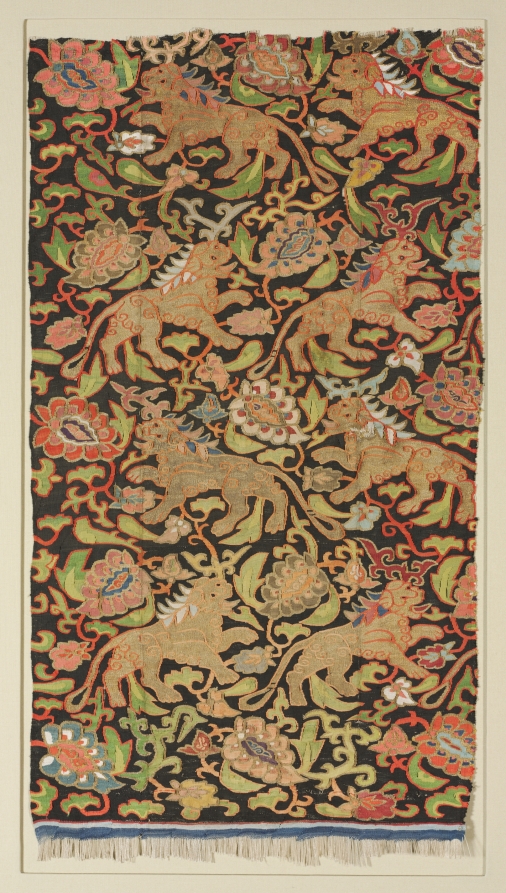
The Gilded Thread: Deconstructing the Imperial Tapestry
In the rarefied atmosphere of heritage preservation, one encounters artefacts that transcend mere textile construction to become chronicles of power, patronage, and technical virtuosity. The tapestry before us—a composition of golden lions and stylised palmettes rendered in lustrous silk—is precisely such an object. It is not a decorative afterthought; it is a declarative statement, woven with the precision of a master tailor’s needle and the gravitas of a royal warrant. To examine this piece is to read a diplomatic treaty, a ledger of trade routes, and a manual of dynastic iconography, all encoded in warp and weft.
Materiality as a Language of Authority
The choice of silk is never incidental. In the imperial context, silk was not merely a fabric; it was a currency of legitimacy, a medium of statecraft. The materiality here speaks with a quiet, commanding voice. The silk’s natural lustre, its ability to catch and reflect light in a manner that mimics liquid gold, is not a happy accident. It is the result of a deliberate, meticulous process—from the cultivation of the mulberry worm to the reeling of the filament—that had been perfected over centuries within the imperial workshops. The thread count is extraordinary; the density of the weave suggests a loom of considerable width, operated by artisans whose skill bordered on the supernatural. This is not the silk of a merchant’s bolt; it is the silk of the *Neidan*, the inner alchemy of the loom, reserved for the highest echelons of the court.
The golden lions, rendered not in metallic thread but in a tightly twisted, yellow-dyed silk that simulates the gleam of bullion, are the focal point. Their posture is heraldic, yet their musculature is rendered with an anatomical awareness that suggests the weaver had studied the beasts in motion. The lions are not merely decorative; they are guardians. They flank a central axis of palmettes, a motif of Persian and Hellenistic origin that had been thoroughly Sinicised by the time of the imperial looms. This fusion is telling. It speaks to the Silk Road not as a passive conduit but as an active, generative dialogue. The palmette, with its radiating, flame-like leaves, represents vitality and renewal, while the lion embodies martial prowess and sovereign protection. Together, they form a visual syllogism: the empire is strong, the empire is fertile, the empire is eternal.
The Imperial Loom and the Art of Control
To understand this tapestry, one must appreciate the infrastructure that produced it. The imperial silk workshops were not artisanal ateliers in the Savile Row sense; they were industrial complexes of staggering scale and bureaucratic oversight. The *Zhiranju*, or Dyeing and Weaving Bureau, operated under the direct purview of the court, with a hierarchy of officials, master weavers, and apprentices. Every stage—from the sorting of cocoons to the final clipping of loose threads—was subject to regulation. The pattern itself would have been drawn by a court painter, then translated into a point paper design, a grid that dictated every single interlacing of the threads. This was a proto-programming language, a binary code of silk.
The technical challenge of weaving a tapestry of this complexity is immense. Unlike a patterned brocade, a tapestry requires the weft threads to be discontinuous; each colour area is built up independently, creating slits where the colours meet. The weaver must manage dozens, sometimes hundreds, of small shuttles, interlocking the wefts to prevent the fabric from falling apart. The precision required to render the lion’s mane, with its subtle gradations of gold and ochre, or the delicate curve of the palmette leaf, is a feat of manual dexterity that borders on the obsessive. The reverse of the tapestry would reveal a chaotic landscape of dangling threads and knots—a testament to the front-facing discipline. This is the hallmark of a master weaver: the ability to impose order on chaos, to create a seamless facade from a tangled interior.
Iconography and the Politics of Pattern
The iconographic program is not arbitrary. The lion, while not native to the Chinese landscape, was a potent import, arriving via Central Asian tributes and diplomatic gifts. Its adoption into imperial iconography was a deliberate act of appropriation, a way of claiming the exotic and the powerful as part of the imperial domain. The golden colour is equally significant. Gold was the colour of the emperor, reserved for his person and his immediate family. To wear or display gold silk was to claim a proximity to the throne, a share of its reflected glory. The tapestry, therefore, functioned as a form of soft power. It was likely not a wall hanging in the Western sense, but a furnishing fabric, perhaps for a throne dais or a ceremonial canopy. It would have been seen by foreign envoys, who would have understood immediately the message of wealth, stability, and cultural superiority it conveyed.
The palmette, in this context, is more than a floral ornament. It is a symbol of the *Tao*, the natural order, and the emperor’s role as its earthly steward. The symmetrical arrangement of the palmettes around the central axis mirrors the cosmic order, with the emperor at the centre, mediating between heaven and earth. The tapestry, then, is a microcosm of the state itself. The lions are the military, the palmettes are the civil bureaucracy, and the silk is the unifying fabric of the empire. To unravel this textile is to unravel the entire edifice of imperial rule.
A Legacy in Threads
The legacy of this tapestry extends far beyond its physical form. It is a direct ancestor of the great European tapestry workshops, which were themselves inspired by the silks that arrived via the Silk Road. The technical innovations—the use of discontinuous wefts, the point paper system, the division of labour—were transmitted westward, influencing the production of the *Gobelins* and the *Beauvais* manufactories. The aesthetic vocabulary of the golden lion and the palmette would be endlessly recycled, appearing in Renaissance velvets, Baroque damasks, and even the jacquard patterns of the 19th century.
For the contemporary observer, this tapestry offers a lesson in the enduring power of materiality. In an age of digital reproduction and fleeting trends, this object stands as a monument to the slow, deliberate, and irreplaceable value of handcraft. It reminds us that true luxury is not about novelty but about mastery, not about speed but about patience. It is a piece that demands to be read slowly, to be examined under different lights, to be appreciated for the sheer, staggering amount of human intention that is woven into every square inch. It is, in the truest sense, a bespoke object—tailored not for a single body, but for the body politic itself, and cut to a standard that has yet to be surpassed.
Heritage Lab Insight
Lab Insight: CMA Silk Archive Node integration.