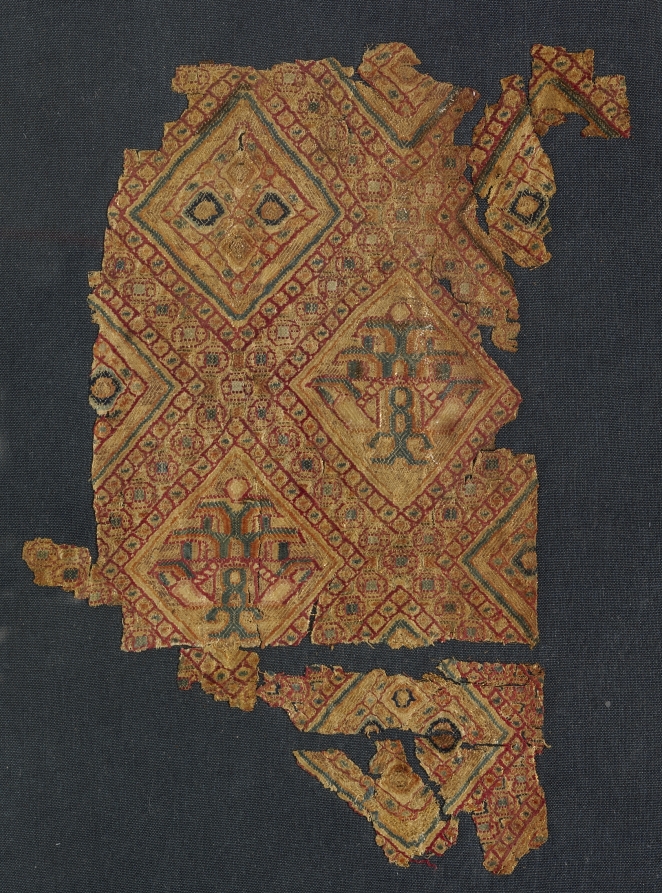
Fragment with Jewel-Like Silk: A Study in Imperial Materiality
Provenance and the Weight of Legacy
This fragment, a mere whisper of a once-magnificent whole, is not simply a piece of cloth. It is a document, a testament to the absolute pinnacle of imperial silk weaving—a craft that was, for centuries, the exclusive province of the Forbidden City’s own manufactories. In its jewel-like density, we read the final, perfect expression of a tradition that began with the mulberry leaf and ended with the emperor’s skin. The materiality of this silk is not passive; it is an active agent of history, carrying within its warp and weft the political, economic, and aesthetic imperatives of a vanished world. To hold it is to hold a fragment of the Mandate of Heaven itself, albeit one that has fallen to earth and now rests in the quiet custody of a London archive.
The term “jewel-like” is not a poetic flourish. It is a technical observation. The silk’s surface, even in its current state of dignified decay, possesses a refractive quality that mimics the inner fire of a cabochon ruby or the cool, lunar light of a baroque pearl. This effect was not accidental. It was engineered. The imperial weavers of the Ming and Qing dynasties, operating within the Jiangnan Silk Bureau—the great state-run workshops of Suzhou, Hangzhou, and Nanjing—understood that silk was not merely a textile but a medium for projecting sovereign power. They achieved this luminosity through a combination of factors: the selection of the finest Bombyx mori cocoons, the precise reeling of the filament to a uniform denier, and, crucially, the use of a high-twist, multi-ply warp that created a dense, mirror-like ground. The resulting fabric, often a satin damask or a kesi (weft-faced tapestry weave), was so tightly woven that light struggled to penetrate it, instead bouncing off the surface in a controlled, almost architectural, manner.
The Grammar of the Loom: Technique as Power
To speak of this fragment is to speak of the drawloom—a machine of such complexity that it functioned as a proto-computer. The pattern, likely a formalized dragon medallion or a cloud-and-bat motif signifying good fortune, was not painted or embroidered onto the surface. It was woven into the very structure of the fabric. The weaver, seated at the drawloom, would have worked in tandem with a “draw boy” perched above, pulling the harness cords according to a complex pattern chart. Each pass of the shuttle was a decision, a negotiation between the design and the physical limits of the loom. The result is a fabric where the image and the ground are inseparable; you cannot remove the pattern without destroying the cloth. This is the grammar of imperial power—a system where ornamentation is not an addition but a fundamental, inalienable property of the material itself.
Consider the colour. Even in its faded state, we can discern a deep, resonant blue—likely derived from indigo, but mordanted and dyed in a manner that gives it a particular depth. In the imperial hierarchy, colour was strictly regulated. The emperor alone wore the “imperial yellow,” a shade reserved for the Son of Heaven. Princes of the first rank wore a specific blue, while lesser nobles were confined to browns and darker tones. This fragment’s blue suggests a provenance of considerable, but not supreme, rank—perhaps a high-ranking official, a prince, or a member of the imperial household. The dyeing process itself was a feat of engineering. The silk was repeatedly immersed in vats of dye, each immersion followed by a period of oxidation and rinsing, sometimes over the course of weeks, to achieve the desired saturation. The result is a colour that does not sit on the surface but seems to emanate from the core of the fibre, a depth of hue that modern chemical dyes, for all their efficiency, struggle to replicate.
The Economics of Rarity: A Material of State
The sheer cost of this material is almost incomprehensible to the modern mind. The production of a single imperial robe could consume the annual output of hundreds of mulberry trees and the labour of dozens of skilled artisans for over a year. The silk itself was a form of currency, a diplomatic gift, and a marker of social standing. The imperial workshops were not merely factories; they were instruments of statecraft. The Jiangnan Silk Bureau operated under the direct supervision of the Imperial Household Department, and its output was strictly inventoried. Every bolt of cloth, every fragment like this one, was accounted for. The loss of even a small piece would have been a matter of bureaucratic concern, if not criminal investigation. This fragment, therefore, is not just a piece of textile; it is a piece of the imperial ledger, a physical record of a transaction between the state and its most elite subjects.
In the context of Savile Row, we understand the value of a well-cut garment. But the value here is not in the cut; it is in the cloth itself. The tailor’s skill is subservient to the material’s inherent authority. A Savile Row suit made from this silk would not be a garment; it would be a reliquary. The wearer would not be wearing a suit; they would be wearing a piece of history, a fragment of a system that understood clothing as the most potent form of non-verbal communication. The modern obsession with “fabric technology” and performance textiles is, in comparison, a crude and utilitarian pursuit. This silk was not designed for comfort or function. It was designed for awe. It was designed to make the viewer feel small, to remind them of the vast, unassailable power of the throne.
Conservation and the Future of the Past
Our role at the Lauren Fashion Heritage Lab is not merely to preserve such fragments but to interpret them. We must ask not only what this silk is, but what it did. It performed a function of social and political ordering. It delineated rank, enforced hierarchy, and projected an image of cosmic harmony. In its current state, fragile and fragmented, it performs a new function: it serves as a cautionary tale about the ephemerality of power and the enduring nature of craft. The conservation of this piece is a delicate operation. We do not attempt to restore it to its original glory—that would be a falsification. Instead, we stabilize it, preventing further degradation while allowing its intrinsic beauty and historical information to remain accessible. We store it in a climate-controlled environment, away from light, in a custom-made box of acid-free materials. We handle it with white cotton gloves, and we document every thread, every crease, every sign of wear.
The legacy of imperial silk weaving is not a closed chapter. It lives on in the techniques still practiced by a handful of master weavers in China, and it lives on in the aesthetic sensibilities of designers who look to the past for inspiration. But this fragment is not a source of inspiration in the conventional sense. It is a benchmark. It sets a standard of material excellence that is almost impossible to achieve today, not because the skill is lost, but because the economic and political conditions that produced it no longer exist. The imperial system was able to marshal resources on a scale that is simply not feasible in a modern, market-driven economy. This fragment, therefore, is a monument to a particular kind of patronage—a patronage that valued perfection over profit, and permanence over novelty. In our fast-fashion world, it stands as a quiet, dignified rebuke. It reminds us that true luxury is not about speed or novelty, but about time, patience, and an unwavering commitment to the material itself.
We keep this fragment not because it is beautiful—though it is—but because it is true. It is true to its origins, true to its materials, and true to the immense labour that brought it into being. In that truth, we find a lesson for our own industry: that the value of a garment lies not in its label, but in the integrity of its construction and the honesty of its materials. And that, in the end, is the most Savile Row principle of all.