Category: Silk
The Art of Atmospheric Weave: Interpreting “Mountain Market, Clear with Rising Mist”
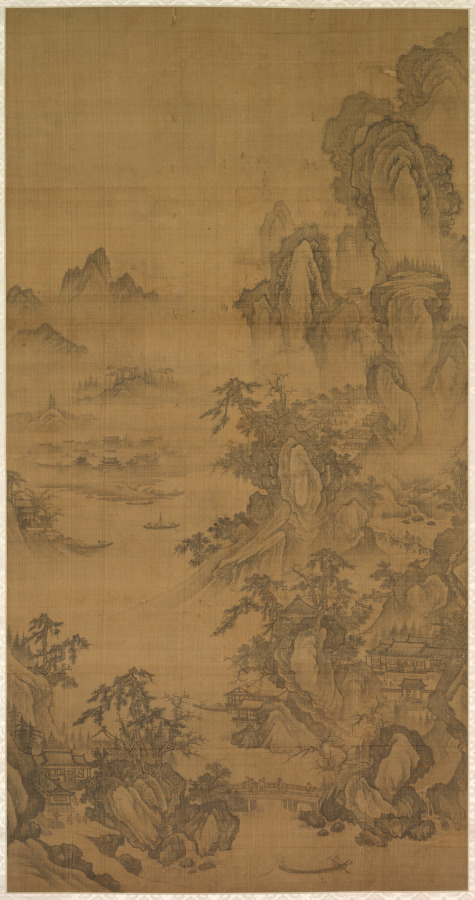
In the hallowed ateliers of Savile Row, where cloth is not merely cut but composed, we understand that true luxury resides in the narrative of the fibre. The subject before us—*Mountain Market, Clear with Rising Mist*—is not a landscape to be painted, but a condition to be woven. It is a study in atmospheric tension, a dialogue between the solidity of the mountain and the ephemerality of the mist. For the Lauren Fashion Heritage Lab, this subject presents a profound opportunity to revisit the legacy of imperial silk weaving, translating a painterly moment into a tactile, wearable architecture.
The legacy we inherit is not one of mere production, but of alchemical mastery. The imperial silk workshops of Suzhou and Hangzhou were not factories; they were sanctums of patience. There, the *jacquard* loom was a precursor to the modern computer, its punch cards encoding not just pattern, but a philosophy of light. The weaver’s craft was to capture the *qi*—the life force—of a scene. To render “Mountain Market” in silk is to engage in this same discipline. We are not printing a picture; we are constructing a surface that *behaves* like the scene itself. The clarity of the market—the sharp, defined stalls, the precise geometry of goods—must be rendered with a crisp, tight weave, a high-thread-count taffeta or a compact duchesse satin that holds its shape like a well-cut shoulder. Conversely, the rising mist demands a dissolution of structure, a blurring of the grid. This is achieved through the deliberate introduction of slack tension, creating a *gaufre* or a semi-sheer organza that allows light to pass through as if through fog.
Materiality as Meteorology: The Structural Grammar of Mist
Consider the physical properties of silk itself. Unlike cotton or wool, silk possesses a triangular prism-like structure that refracts light, creating a natural lustre. In imperial weaving, this was exploited to create *changeant* effects—colours that shift with the angle of viewing. For our “Mountain Market,” we employ this property to simulate the meteorological shift of the subject. The warp threads, running vertically, will be dyed in a deep, verdant green—the colour of the mountain’s pine-clad slopes. The weft threads, running horizontally, will be a pale, almost translucent pearl-grey. When the cloth lies flat, the eye perceives a solid, mossy green—the market in full, clear operation. But as the garment moves, as the wearer turns, the weft threads catch the light, and the grey rises to the surface. The mountain recedes; the mist advances. This is not a static image; it is a kinetic weather system, engineered into the cloth.
The “clear” aspect of the market requires a different technical intervention. In imperial silk, clarity was achieved through the use of *kesi*—a technique of slit tapestry weaving where each colour is woven independently, creating a sharp, almost painted edge. For the market stalls, we would employ a modernised *kesi* technique, using a fine, 120-denier silk filament to create crisp, unyielding outlines for the architectural elements—the wooden beams, the stone steps, the woven baskets. This precision is the antithesis of the mist. The contrast between the two weaves—the razor-sharp *kesi* and the diffuse, cloud-like *jacquard*—is the very essence of the subject. It is the tension between the permanent and the transient, the built and the atmospheric.
Imperial Legacy: The Weight of Provenance
To wear this silk is to wear a piece of dynastic history. The imperial looms were guarded secrets, their patterns reserved for the Emperor and his court. The dragon robes, the *chaofu*, were not merely garments; they were cosmological maps, encoding the wearer’s place in the celestial hierarchy. Our “Mountain Market” draws from this same symbolic vocabulary. The mountain is not just a geological feature; it is a symbol of stability, of the emperor’s mandate. The mist is the veil of the unknown, the mystery of the heavens. The market is the bustling commerce of the earthly realm, the prosperity of the people.
In our contemporary interpretation, we honour this legacy not through replication, but through translation. The weight of the silk—a substantial 22-momme crepe de chine for the base, with a 30-momme satin for the structural panels—gives the garment a gravitas that speaks to its provenance. It drapes with a liquid heaviness, a reminder that this is a cloth of consequence. The finishing is equally critical. We do not use modern chemical softeners. Instead, we employ the traditional *shibori* method of hand-twisting and steaming the silk after weaving, which relaxes the fibres and imparts a subtle, organic texture—the feeling of mist on skin. The edges are hand-rolled and stitched with a silk thread so fine it is nearly invisible, a nod to the meticulous hand-finishing of the imperial workshops.
Ultimately, “Mountain Market, Clear with Rising Mist” is a masterclass in controlled contradiction. It demands that the tailor and the weaver work in concert, understanding that the garment is not a shell for the body, but a lens through which to view the world. The jacket cut from this cloth—a structured, double-breasted silhouette with a soft, unpadded shoulder—will hold its form at the chest, echoing the mountain’s solidity. But the skirt or the trouser, cut on the bias, will ripple and flow, allowing the mist to perpetually rise and fall with each step. This is the true legacy of imperial silk: not a static object, but a living, breathing atmosphere, tailored for the modern connoisseur who understands that the finest cloth is not seen, but experienced.