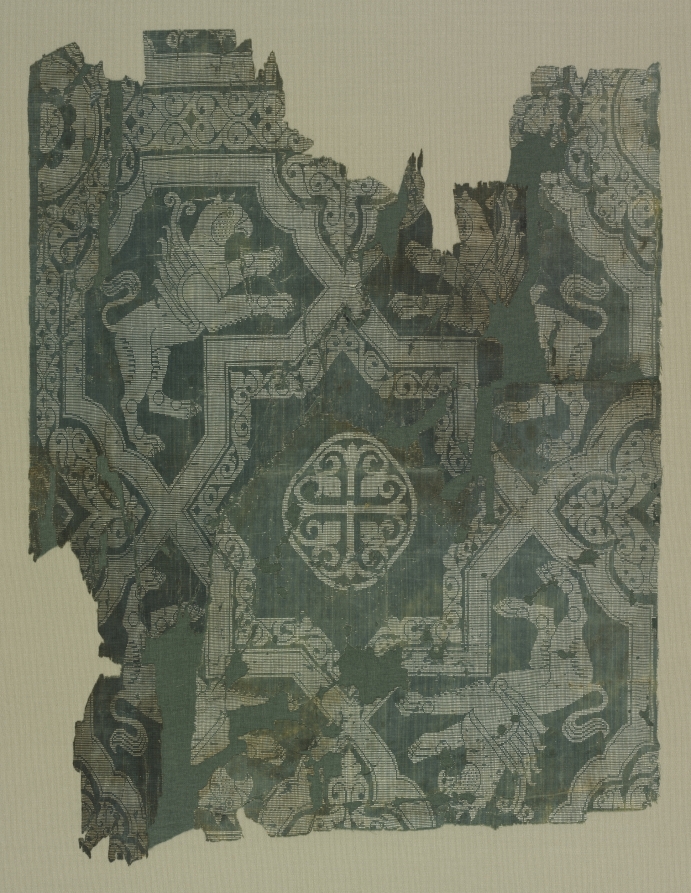
Fragment with Star Pattern and Griffins: A Study in Imperial Silk and Tailoring Lineage
Provenance and Materiality
This fragment, a whisper of a once-magnificent whole, presents a study in disciplined opulence. The ground is a deep, undyed ivory silk, its natural lustre now softened by centuries into a matte, parchment-like finish. Upon this field, the pattern is woven with a precision that speaks of the imperial loom’s absolute command. The star pattern—an eight-pointed, geometric constellation—is rendered in a tightly packed, repeating grid. Each star is formed by interlacing bands of deep indigo and a faded, yet still discernible, madder red. The griffins, guardians of the celestial and the terrestrial, are woven into the interstitial spaces, their winged forms and leonine haunches stylized with a formal, almost heraldic rigidity. The silk’s hand is surprisingly supple, a testament to the high-twist yarns and the density of the weave, which together create a fabric that is both substantial and fluid—a quality that would have draped with a particular, weighty grace.
The Imperial Loom: A Legacy of Control and Craft
To understand this fragment is to understand the very architecture of imperial silk weaving. This is not the product of a cottage industry; it is the output of a state-controlled manufactory, likely from the late Safavid or early Ottoman courts, where the production of silk was a monopoly of power. The pattern’s complexity is not merely decorative; it is a technical manifesto. The star pattern, a motif of cosmic order and divine kingship, required a drawloom operated by a skilled team—a master weaver and his assistants—who would manipulate hundreds of heddles to create the intricate, repeating design. The griffin, a creature of myth and protection, was a symbol reserved for the highest echelons of the court, adorning robes of honour, ceremonial hangings, and the linings of royal tents. The very existence of such a fragment implies a system of patronage, where master artisans were commissioned to produce works of extraordinary technical and artistic merit, their names lost to history but their skill immortalised in every thread.
This legacy of control is crucial. Unlike the more fluid, organic patterns of later European silks, this design is rigidly geometric. The stars are not scattered; they are regimented. The griffins are not whimsical; they are symmetrical. This is a visual language of order, of a cosmos that is predictable and governed by a single, supreme authority. The silk itself, likely a blend of domestic and imported raw material, was a commodity of immense value, often used as currency or diplomatic gift. To wear or display such a fabric was to declare one’s place within a rigid hierarchy, a statement of proximity to the throne.
From Court to Cloth: The Savile Row Translation
Now, consider this fragment not in a museum case, but on the cutting table of a Savile Row workroom. The connection is not one of direct lineage, but of shared principles: discipline, structure, and the pursuit of perfection. The Savile Row tailor, like the imperial weaver, operates within a framework of rigorous tradition. The craft is passed down through apprenticeship, not textbooks. The tools—the shears, the thimble, the chalk—are extensions of the hand, used with a precision that borders on the obsessive.
The star pattern’s geometry finds a natural echo in the tailor’s approach to construction. The sharp, angular lines of a well-cut shoulder, the precise break of a trouser, the immaculate lapel roll—these are all exercises in controlled geometry. The griffin, a creature of power and protection, resonates with the garment’s purpose: to armour the wearer for the battles of commerce and society. A Savile Row suit is not merely clothing; it is a defensive structure, a statement of intent, a piece of personal heraldry.
However, the translation is not without its tensions. The imperial silk is a fabric of spectacle, designed to be seen and admired from a distance. The Savile Row cloth, by contrast, is often chosen for its subtlety, its quiet authority. The modern tailor would not use this exact pattern for a business suit; it would be too loud, too overtly decorative. Instead, the principles are abstracted. The discipline of the weave informs the choice of a tightly woven worsted. The geometric precision of the star pattern influences the construction of a structured, architectural silhouette. The griffin’s protective nature is translated into the reassuring weight of a heavy tweed or the impenetrable finish of a high-twist fresco.
The true inheritance of the imperial silk is not in its literal pattern, but in its materiality as a statement of power. The imperial weaver understood that fabric could be a weapon of statecraft. The Savile Row tailor understands that cloth can be a tool of personal advancement. Both are engaged in the same fundamental act: using textile to construct an identity, to project an image of authority, and to command respect. The fragment’s star pattern, with its cosmic order, and its griffins, with their mythic guardianship, are not so much copied as they are re-interpreted into a new language of tailored confidence.
In the end, this fragment is a reminder that the finest tailoring is not a mere trade, but a continuation of a grand tradition. It is a dialogue with history, a respectful nod to the masters of the loom who understood that a piece of cloth, woven with intent and skill, could be far more than a covering. It could be a declaration of self, a piece of armour for the soul, and a legacy stitched in silk and time.