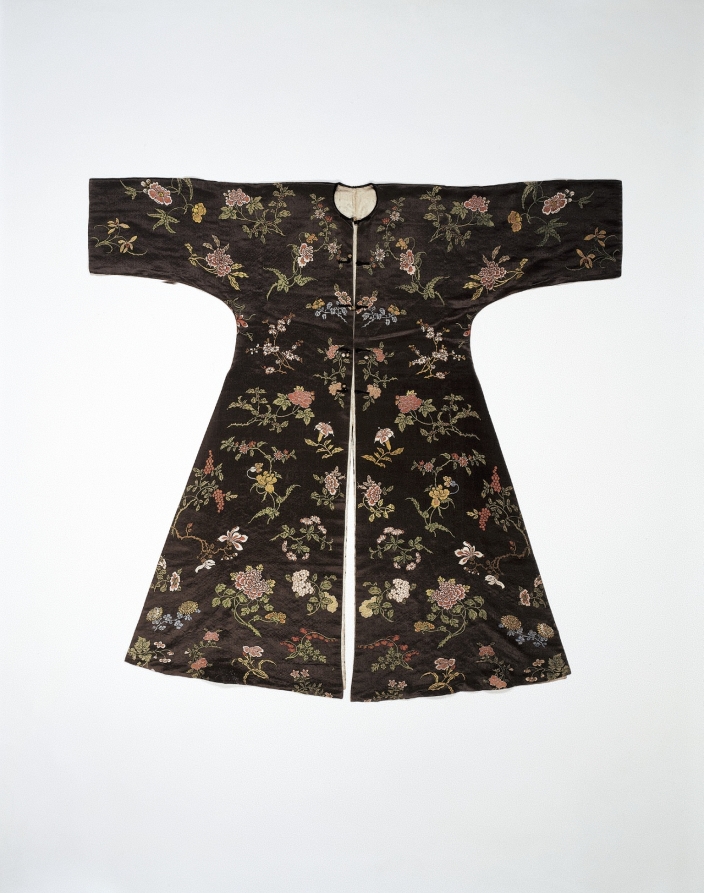
The Material Poetics of Power: A Woman's Silk Robe and the Imperial Legacy of the Loom
In the hushed, amber-lit archives of Lauren Fashion Heritage Lab, one encounters garments not merely as cloth, but as codified documents of civilisation. Among the most eloquent of these is the woman’s silk robe—an object that, at first glance, whispers of private luxury, yet upon closer examination, speaks in the declarative tones of empire. To hold such a robe is to hold a fragment of a vast, intricate system of labour, tribute, and aesthetic absolutism. Its materiality is not passive; it is an active agent of history. This artifact, rendered in lustrous silk, is a testament to the enduring legacy of imperial silk weaving—a legacy that transformed a caterpillar’s secretion into the very currency of power, diplomacy, and desire.
The Genesis of the Thread: From Sericulture to Sovereignty
The story begins not in the ateliers of Paris or the fitting rooms of Mayfair, but in the mulberry groves of ancient China, where sericulture was guarded as a state secret for millennia. The silk filament, unspooled from the cocoon of Bombyx mori, was never merely a textile. It was a metaphysical substance, believed to embody the order of the cosmos. By the time of the Han Dynasty, silk had become the primary instrument of imperial diplomacy—a soft power weapon more persuasive than any sword. The Silk Road was not a route for the exchange of goods alone; it was a conduit for the transmission of legitimacy. To possess silk was to possess a piece of the Emperor’s mandate. This robe, therefore, inherits a lineage of sovereignty. Its very fibres are encoded with the protocols of the Forbidden City, where the imperial weaving workshops, or Nèi Zhīzào, operated under the direct supervision of the throne, producing fabrics that were strictly regulated by sumptuary laws. The colour, the weave density, and the motif were not aesthetic choices but legal declarations of rank. A robe of this calibre would have been a privilege granted to the highest echelons of the court—a wearable patent of nobility.
Materiality as a Lexicon: The Grammar of the Loom
Let us now turn to the physical object itself, with the discerning eye of a Savile Row cutter who understands that drape is destiny. The silk of this robe is not a single, homogenous entity. It is a composite of technical virtuosity. The ground weave is likely a satin—a structure that floats the warp threads across the surface, creating a mirror-like sheen that catches light with the fluidity of water. This is not accidental. The satin weave was perfected in the imperial workshops to maximise the reflective quality of the silk, creating an aura of luminosity around the wearer. The robe would have shimmered in the candlelit halls of the palace, a moving source of light that distinguished the imperial presence from the mere mortal gloom.
Yet, the materiality extends beyond the base weave. The embroidery, executed in silk floss and often augmented with gold-wrapped threads, is not merely decorative. It is a structural dialogue between the ground and the raised surface. The motifs—perhaps a profusion of peonies for wealth, bats for fortune, or the five-clawed dragon reserved exclusively for the imperial family—are rendered in a technique known as couching, where the metallic thread is laid upon the surface and secured with a finer silk stitch. This creates a relief that is tactile as well as visual. The robe, therefore, demands to be touched. It is an invitation to a sensory experience that is both intimate and intimidating. The weight of the garment—substantial yet fluid—speaks to the density of the weave, a hallmark of the finest imperial silks, which were woven with such precision that they were virtually airtight, protecting the wearer from the elements while simultaneously proclaiming their insulation from the vulgarities of the world.
The Cut and the Silhouette: A Study in Restrained Grandeur
From a tailoring perspective, the robe’s construction is a masterclass in the philosophy of negative space. Unlike the structured, shoulder-padded jackets of the Western tradition, this robe is cut on the straight grain, with wide, flowing sleeves that fall from the shoulder without a defined armhole. The garment is not fitted to the body; rather, it is designed to accommodate the body within a moving architecture of fabric. This is a deliberate departure from the Western ethos of the tailored silhouette, which seeks to discipline the form. The Chinese imperial robe, in contrast, celebrates the form by obscuring it. The body becomes a mere armature for the silk to drape upon, allowing the fabric to take on a life of its own with every gesture. The closure is asymmetrical, fastened at the right side with a series of small, intricate frogs or knotted buttons—a detail that requires the wearer to engage in a ritual of dressing, a slow, deliberate act that reinforces the garment’s ceremonial nature. The hem, often weighted with a subtle border of contrasting silk or fur, ensures that the robe falls with a satisfying, grounded finality. This is not a garment for haste; it is a garment for procession.
The Legacy of the Loom: From Imperial Court to Global Atelier
The legacy of this imperial weaving tradition is not confined to the museum vitrine. It is a living lineage that has profoundly influenced the language of modern luxury. When we consider the great houses of fashion—from the opulent embroideries of a couture house to the disciplined minimalism of a Savile Row shirt—we see the ghost of the imperial loom. The technical innovations of the Chinese weavers—the development of the drawloom, the mastery of complex figure weaving, and the invention of jacquard (which is, in essence, a mechanised memory of those ancient patterns)—are the foundational technologies of the global textile industry. The woman who wears a silk robe today, whether in a private residence or on a red carpet, is participating in a ritual that is millennia old. She is not merely wearing a fabric; she is wearing a history of conquest, trade, and artistic genius.
Furthermore, the robe’s materiality offers a poignant counter-narrative to the fast-fashion ethos of disposability. In its construction, we see a commitment to permanence. The silk is not treated as a transient surface but as a durable membrane, designed to be repaired, re-embroidered, and passed down through generations. The robe is an heirloom, a physical manifestation of familial and cultural memory. Its very existence challenges the modern notion of the garment as a disposable commodity, urging us instead to consider the garment as an investment in heritage.
Conclusion: A Garment of Consequence
In the final analysis, this woman’s silk robe is far more than a beautiful object. It is a materialised philosophy of power, a technical triumph of the loom, and a silent witness to the ebb and flow of empires. Its silk threads are the arteries of history, carrying the lifeblood of a civilisation from the imperial courts of the East to the discerning wardrobes of the contemporary world. To wear such a robe is to accept a weight—not of physical fabric, but of consequence. It demands a posture of grace, a measured pace, and an awareness of one’s place within a continuum of elegance. For the Heritage Lab, this artifact serves as a cornerstone, reminding us that true luxury is never merely new; it is always, at its core, a dialogue with the past. And in that dialogue, the imperial loom still speaks with an unrivalled authority.